

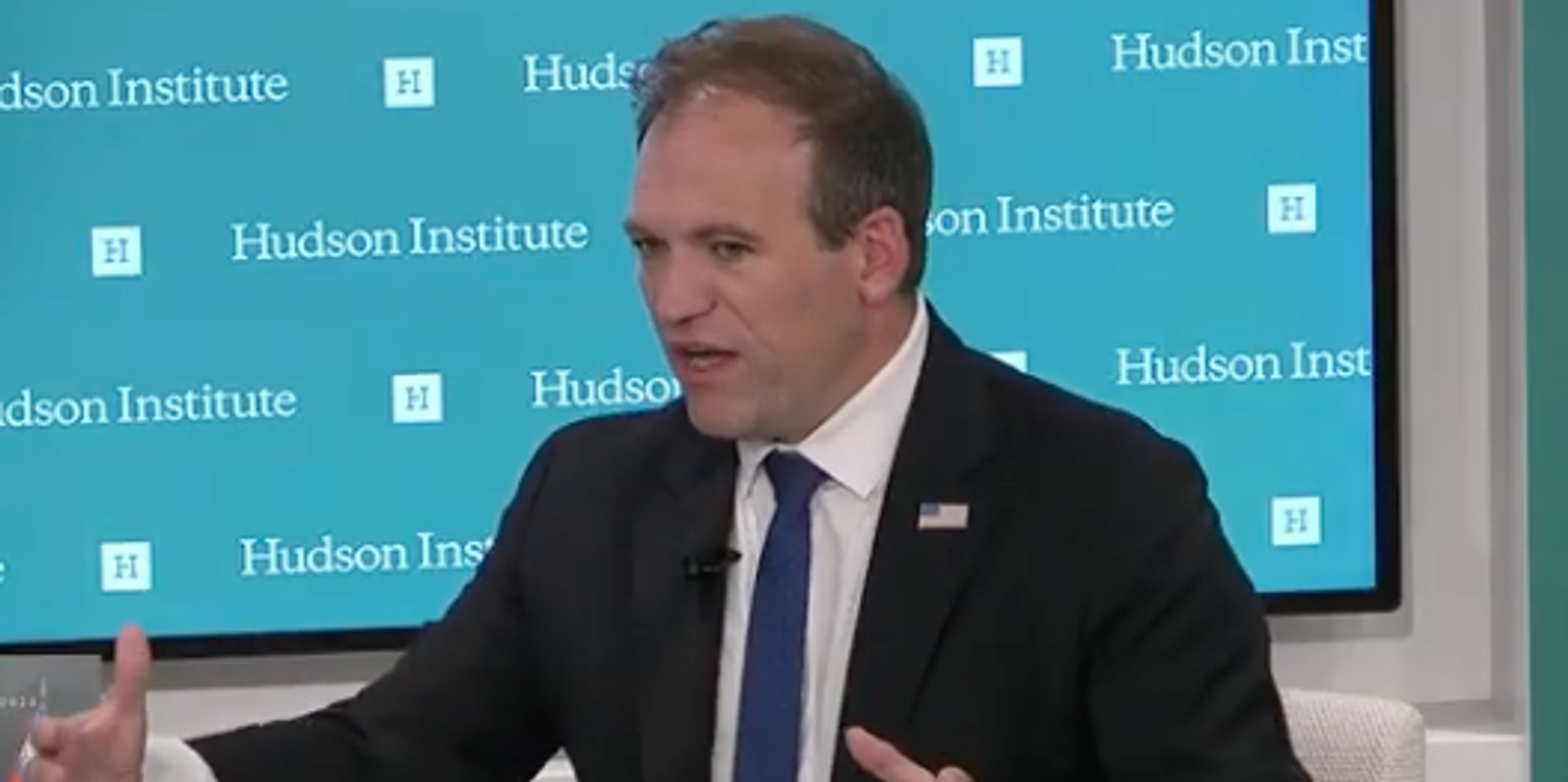
On Wednesday evening, the Hudson Institute’s Michael Doran sat down for an hour-long interview with the Chair of the Gaza Humanitarian Foundation, Johnnie Moore.
You might think that Doran, or any interviewer, would ask Moore a question or two about the credible eyewitness accounts of aid-seekers being slaughtered at GHF sites. After all, more charges have been raised, seemingly every day, about atrocities committed by IDF soldiers and American contractors on the ground working with GHF. An IDF soldier called an aid site "a killing field.” One video shows armed US contractors firing into a crowd of Palestinians while cheering “Hell yeah, boy!”
Despite the golden opportunity — even if only to set the record straight — Doran ignored it completely. As though none of this had been dominating the news for the last several weeks. He in essence, let Moore off the hook.
Instead, Doran asked the GHF head what the Hudson Institute could do to help the organization push back on “disinformation.” “The disinformation problem in general but particularly with regards to Israel, do you have any ideas about what we can do?” he said. “This kind of event, it can’t really have that much impact. What would you like to see happen?”
Moore himself raised the only reference to the killing of aid-seekers throughout the interview. “Like all disinformation, there's an element of truth down deep inside of it, and the element of truth is, we do not deny that there have been civilian casualties of people waiting for aid in the Gaza Strip. The irony is that far more of those casualties have taken place at the hands of Hamas in UN distribution sites than in any proximity to our sites.”
Unfortunately, there is more publicly available evidence to the contrary. IDF soldiers themselves have told Israeli media they were given orders to shoot at unarmed Palestinians, even if they did not pose a threat.
After the event, I approached Moore about these eyewitness accounts directly. Here’s a transcript of that conversation, edited for clarity:
RS: There are a lot of documented cases of violence from the IDF towards aid seekers…Anthony Aguilar, a contractor for the GHF said that he witnessed contractors instructed by the IDF to shoot children at an aid hub. He said he witnessed the IDF forces ‘firing into the crowds of Palestinians, firing over their head, firing at their feet, firing into the crowd, not just with rifles or machine guns, but tanks, tank rounds, artillery, mortars, missiles.’
JM: On that particular issue, you should go to GHF’s update page and watch the 20-minute briefing that our spokesperson did yesterday with legal counsel from the organization. It’s very very clear when you watch that these are not credible allegations and they are not from a credible source. [GHF released a 14-minute briefing video responding to Aguilar’s allegations, who a spokesperson refers to as a “terminated and disgruntled contractor.” GHF also circulated sworn statements from contractors that worked with Aguilar that contradict his claims.]
RS: I've seen the briefing. And there are other instances, you had IDF soldiers saying it’s a ‘killing field.’ That’s a direct quote. ‘When I was stationed, between one and five people were killed every day, they're treated like a hostile force, no crowd control measures, no tear gas.’
JM: This is not true. This information is not true. What is true is there's an enormous amount of disinformation that's originating with a globally designated terrorist organization that's being laundered through organizations and also through news outlets. And if the world had half the interest in the amount of civilians that have been killed by Hamas, we might actually see this, this terrible, terrible war, which must end much more quickly.
RS: You said the 1,000 figure that's been shared is a sham number. [the UN human rights office has said that over 1,000 aid seekers have been killed by Israeli forces since May, which Moore referred to in a separate July 25 event at the Hudson Institute as a “sham number.”] But these are first-hand accounts. These aren't from Hamas. These are first-hand accounts, IDF soldiers, people that have witnessed or even participated in some cases, in these killings. So if you say that that 1000 figure is a sham number, I'm curious where you would put the real number of IDF killings at GHF sites.
JM: It's very, very important that you get credible information. Everything you've said to me is not, it's not credible. It’s just not credible information. If you care about the truth, go find the truth. I can say much of this reporting, I would say almost all the reporting that we see. It's not something that we've seen at all in our experience on the ground. So you either care about the truth or you don't care about the truth. We care about truth, and so we say the truth, and I'd encourage you to go find the truth.
Case closed, folks. The videos are doctored. The numerous eyewitness accounts are all fake. It would be helpful if Israel let reporters into the Strip to verify GHF’s claims that none of the witness accounts “are credible,” but as of this writing, international journalists are still curiously banned from the sites. Instead, Moore wants us to just take his word for it.- Will contractor disgust bring down Israel's 'hunger games' in Gaza? ›
- Not Blackwater or Wagner, Americans in Gaza are 100% mercenaries ›
- Former Green Beret: The IDF is the GHF’s ‘client’ ›