

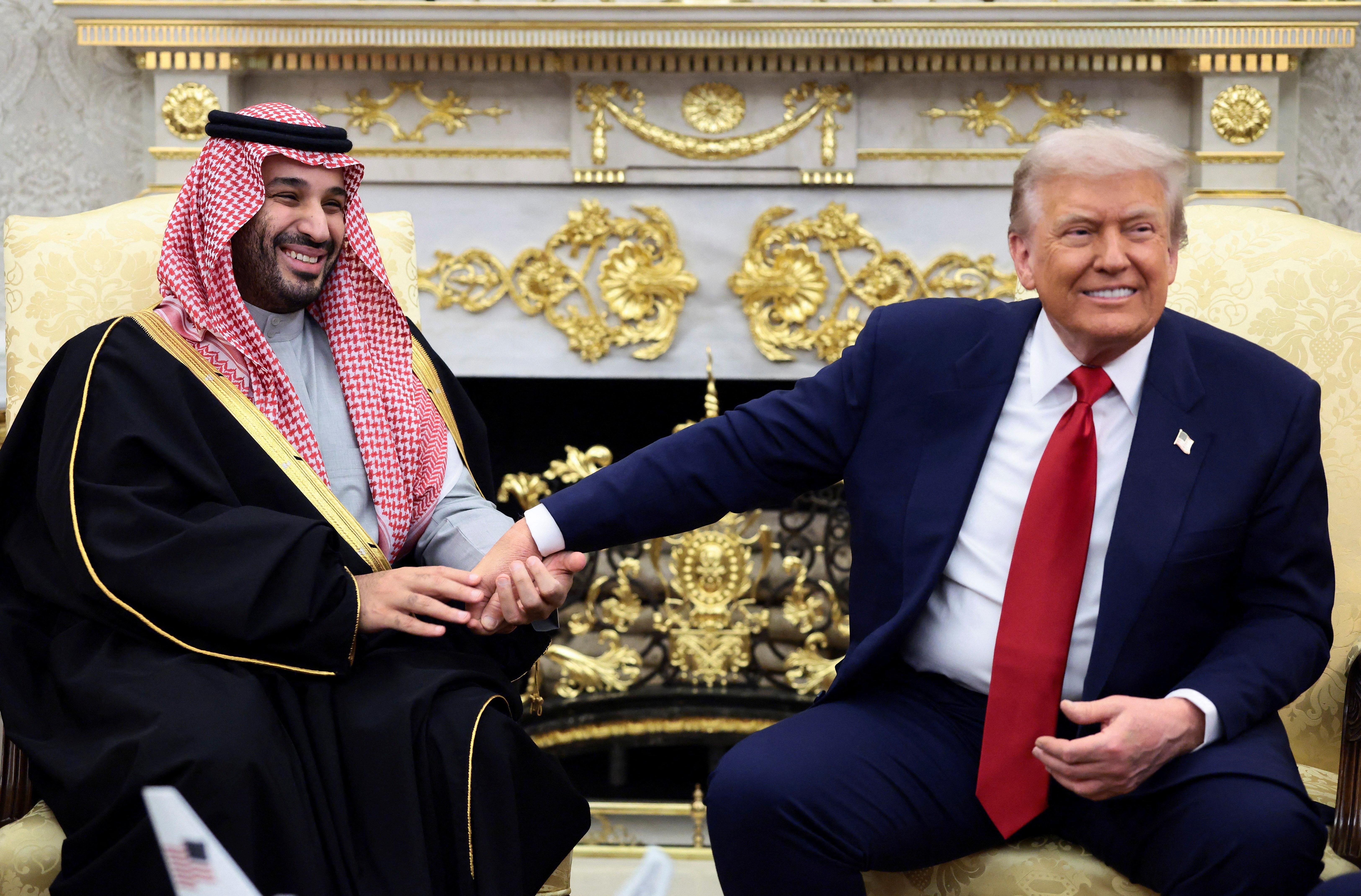
Saudi Crown Prince Muhammad bin Salman arrived at the White House Tuesday in style. Emerging from a Black Mercedes on the South Lawn, the crown prince received a warm greeting from President Donald Trump, who led the Saudi leader through a gallery of American notables including Vice President JD Vance and Secretary of State Marco Rubio.
Trump and MbS, as the crown prince is known, shared jokes as they stood for their obligatory photo-op. The U.S. Army Band sounded triumphal tunes, drowned out only briefly by the roar of military jets flying overhead. As the leaders headed inside to begin their meeting, Trump placed his hand on the crown prince’s shoulder and guided him through the door.
The scenes capped off a remarkable turnaround for MbS. Less than a decade after he ordered the gruesome murder of Saudi dissident and Washington Post columnist Jamal Khashoggi, there can now be no doubt that the crown prince has returned to Washington’s good graces. The process began under President Joe Biden, who drew criticism for even sharing a fist bump with MbS back in 2022. But Trump has markedly accelerated this effort, as today’s ceremonies showed.
The pomp and circumstance may well be more consequential than the substance of the meeting. The crown prince appears determined to “demonstrate that since his last visit in 2018, he has come in from the cold and is fully rehabilitated,” wrote Aaron David Miller of the Carnegie Endowment. On this score, he seems to have succeeded. During a joint press conference, Trump even lauded the crown prince for his “incredible” work on human rights while disparaging Khashoggi as “extremely controversial.”
Some notable deals emerged from the meeting. Trump confirmed that the U.S. will sell F-35 fighter jets to Saudi Arabia, a move that has already drawn criticism from Israel, which usually has a veto over high-tech U.S. weapons sales to the Middle East. (Trump downplayed these concerns, saying Israel “is going to be very happy” about the deal.)
The president also said the U.S. and Saudi Arabia “have reached agreement” on a new defense pact, without clarifying whether this included formal security guarantees like the ones Trump gave Qatar earlier this year. MbS, for his part, promised to invest as much as a trillion dollars in the U.S. economy.
But no visible progress was made on Trump’s top priority: persuading Saudi Arabia to normalize relations with Israel and join the Abraham Accords. While Trump appeared eager to push the issue, MbS told reporters that his country will only join the accords if there is a “clear path to a two-state solution.”
Still, Trump went to great lengths to laud the U.S.-Saudi relationship, calling MbS a “very dear friend.” The president appears to view Riyadh as a key American ally — one that can provide significant investment opportunities while helping to counter Iranian influence in the Middle East.
But, as Washington Post columnist Jason Rezaian wrote, the president may want to be careful about aligning American policy with the controversial crown prince. “MbS has repeatedly shown himself to be a liability for his country, for the Middle East and for the U.S.,” Rezaian argued, citing Saudi Arabia’s “protracted war with Yemen” and its conflict with Iran.
“If this is a preview of his reign once he is officially king, buckle up,” he continued. “With the world likely stuck with him for decades to come, the U.S. will likely have endless messes to clean up.”
- Trump courts Saudi at the risk of US, Middle East security ›
- Trump doesn't need to buy Saudi loyalty with a security pact ›