

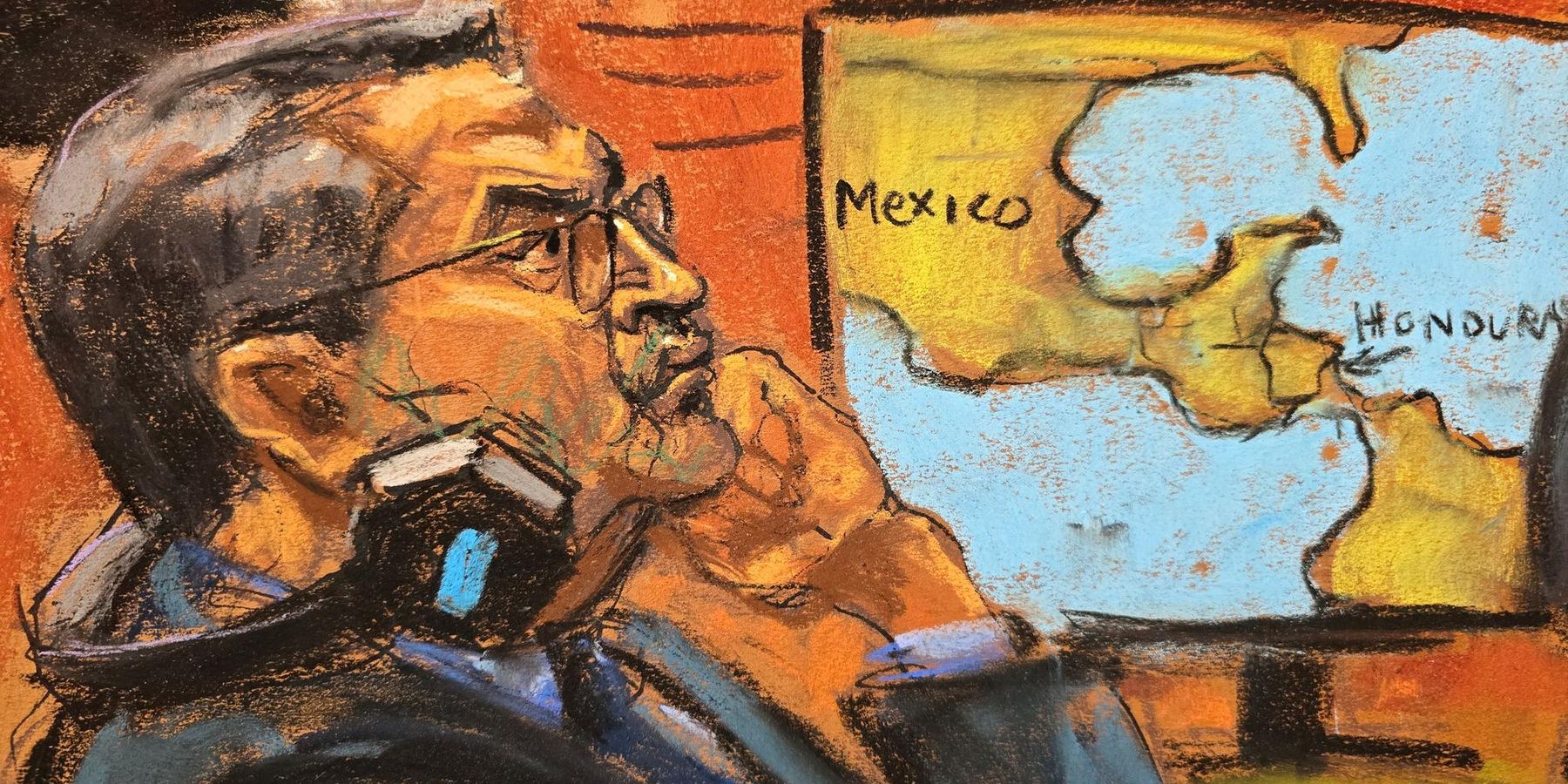
The Trump administration has literally killed more than 80 suspected drug smugglers by blowing their small boats out of the water since September, but this week the president has reportedly decided to pardon one of the biggest cocaine traffickers of them all.
If that doesn't make any sense to you, then join the club.
The news that Trump is going to pardon Juan Orlando Hernández, the former president of Honduras who was sentenced to 45 years in U.S. prison just last year came as a shocker. The White House has said repeatedly that drug traffickers are narcoterrorists who are waging war on America, justifying their killing the boats every time. Yet Hernandez was convicted of conspiring to import 500,000 kilos of cocaine into the United States and stuff it "right up the noses of the gringos" and Trump says "CONGRATULATIONS TO JUAN ORLANDO HERNANDEZ ON YOUR UPCOMING PARDON."
While president, Hernández received millions of dollars from trafficking organizations in Honduras, Mexico, and from notorious drug lords like Joaquín Guzmán Loera, a.k.a. El Chapo, who was the former leader of the Sinaloa Cartel and is responsible for the murder of some 34,000 people. In return, according to prosecutors, President Hernández allowed vast amounts of cocaine to pass through Honduras on its way to the United States.
Prosecutor Jacob H. Gutwillig told jurors during the trial that Hernández had accepted “cocaine-fueled bribes” from cartels and “protected their drugs with the full power and strength of the state — military, police and justice system.” Hernández ran the country from 2014-2022; his National Party had been in power since 2009.
Sounds like the very type of menace — or terrorist — that the Trump administration is trying to use as a justification for military action in Latin America today.
"Former president Hernández was found guilty of taking bribes from El Chapo and the Sinaloa Cartel to allow 400 tons of cocaine to flow through Honduras into the United States, essentially running Honduras like a narcostate," noted Quincy Institute research associate Lee Schlenker.
"Trump accuses Venezuelan president Nicolás Maduro of conspiring to flood the United States with deadly drugs through the dubious 'Cartel of the Suns,' but far from pardoning Maduro or praising his acolytes, like (he promises) with Hernández, Trump has brought us closer to a U.S.-led military intervention in Latin America than we've been in over 35 years by threatening air strikes against Venezuelan territory," he added.
We assume the difference here is politics. And ideology. Maduro is a socialist and doesn't want to do business with Washington. Hernandez was tolerated if not preferred by previous U.S. administrations from Obama through the first Trump White House, because he and his National Party were business friendly, anti-communist, and supported by the neoconservatives now gunning against Maduro.
While he was useful, Hernandez played the game and Washington turned a blind eye to his crimes which not only included the drugs but human rights abuses against his people via the military and police, election fraud, embezzling from the nation's social security system and World Bank Funds, and even bragging at one point that he was siphoning off international funds through phony NGOs.
Hernández left office in 2021 and wasn't indicted until 2022 (by the Biden DOJ), though he and his family were already being investigated during the first Trump tenure. His brother Tony, a former Honduran congressman, was convicted of drug trafficking in 2019 and given a life sentence. DOJ prosecutors say he "was involved in all stages of the trafficking through Honduras of multi-ton loads of cocaine destined for the U.S."
In the same day he announced his would pardon Juan Orlando Hernández, Trump said he was endorsing the National Party candidate for president, Nasry “Tito” Asfura, who is running against what he calls the "narco-communism" represented by center-left candidate Rixi Moncada of the incumbent LIBRE party. This is laughable, says Schlenker, because current president Xiomara Castro has done everything to curry favor with Trump, including "tough-on-crime policies not too dissimilar from those seen in neighboring El Salvador under Trump ally Nayib Bukele."
But Asfura and Hernandez have paid lobbyists in Washington and if you think that doesn't make a difference then we have a block of empty office space on K Street to sell you. According to Schlenker, Hernández paid D.C. lobbying group BGR Group, which was a leading donor to now Secretary of State Marco Rubio's 2016 presidential campaign, over $600,000 in 2019 to win allies in Washington as he was under investigation.
"Hernandez has strong supporters in Trump world, including convicted (and later pardoned) Trump advisor Roger Stone, who has been urging Trump to pardon Hernández for months. Rubio, for his part, has long sung Hernández's praises, thanking him for his work targeting drug trafficking, as has Rubio ally, lobbyist, and former Trump administration official Carlos Trujillo, who represents several Honduran clients who would likely stand to benefit from a return to National Party rule," added Schlenker.
Trujilo was just on Capitol Hill talking down LIBRE before he was called out by Rep. Joaquín Castro for his obvious conflict of interest.
The New York Times said Sunday's elections were already beset by fears of "fraud, mass protests and even the threat of a military crackdown," and Trump and other Washington neoconservatives weighing in is adding another layer of volatility.
For those of us picking up on news this weekend that Trump is boasting about "closing the airspace" around Venezuela only reinforces the suspicion that this is not about "narcoterrorism" at all. If Trump wanted to rid the hemisphere of drug traffickers, he wouldn't be letting them out of prison, period.
- With Venezuela, Trump poised to make mistake of epic proportions ›
- The rise and fall of loyal US client Juan Orlando Hernandéz ›
- If they are not human, we do not have to follow the law | Responsible Statecraft ›
- Guinea-Bissau: The ‘narco-state’ the US virtually ignores | Responsible Statecraft ›
- Trump's favorite drug trafficker returns triumphantly to Honduras | Responsible Statecraft ›