

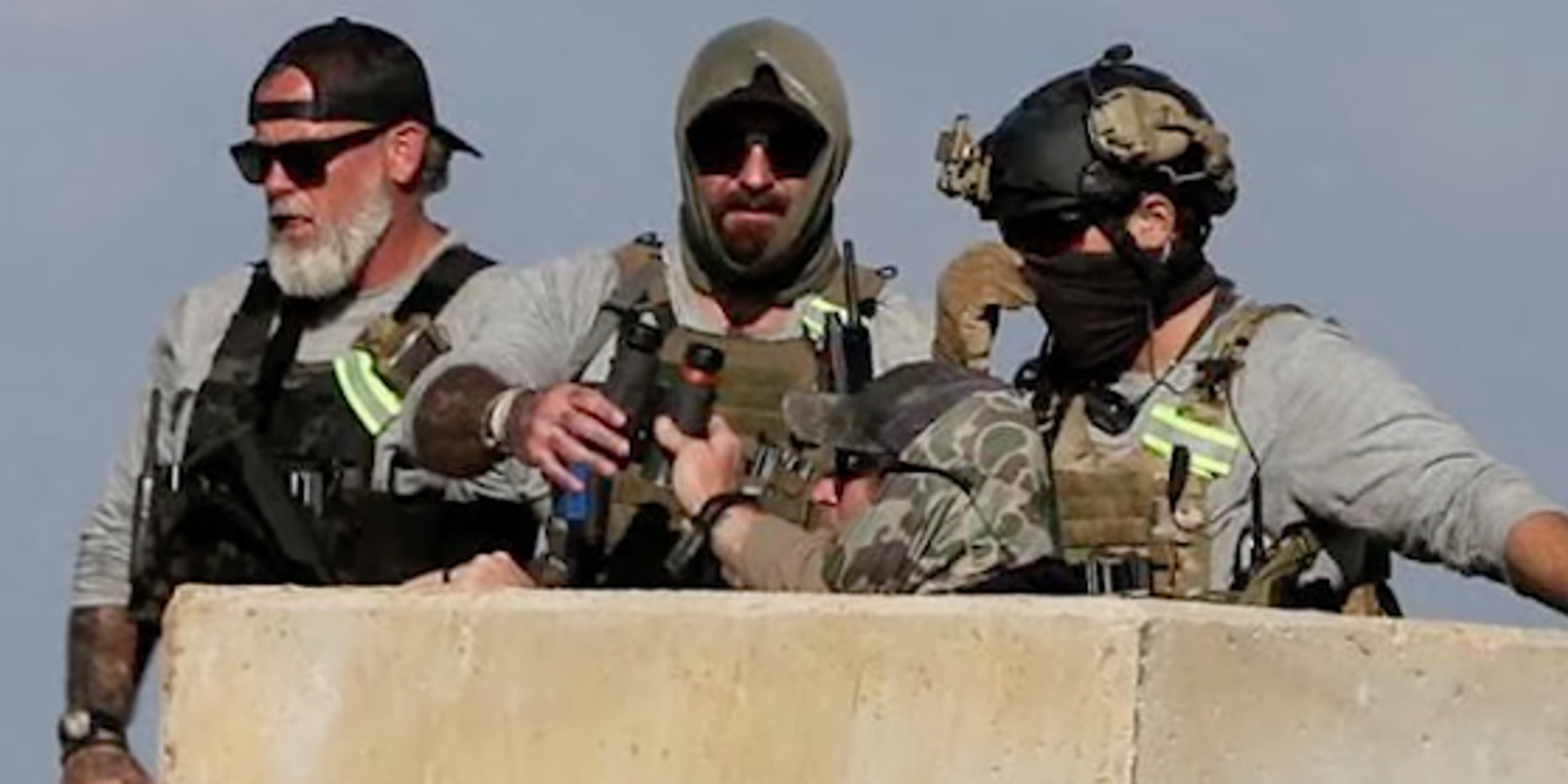
Americans working for a little known U.S.-based private military contractor have begun to come forward to media and members of Congress with charges that their work has involved using live ammunition for crowd control and other abusive measures against unarmed civilians seeking food at controversial food distribution sites run by the Global Humanitarian Fund (GHF) in Gaza.
UG Solutions was hired by the GHF to secure and deliver food into Gaza. The GHF, with the help of the PMCs claims to have provided nearly 100 million meals to Gaza. Israel put GHF in control of what used to be the UN-led aid mission.
The UN, however, has called the new model an "abomination" which “provides nothing but starvation and gunfire to the people of Gaza,” referring to the 1000 Gazans who have been killed near or at the GHF centers since May. The Israeli Defense Forces (IDF) have been accused of shooting and shelling unarmed civilians. The American contractors say they have witnessed it and have been told to use live ammunition in their own crowd control efforts
UG Solutions is one of two American contracting outfits working at the food centers. Both have vehemently denied the contractors’ claims, as has the IDF. The GHF has also put out extensive responses calling the charges categorically false.
Needless to say this raises a ton of questions about the use of American contractors in this particular conflict zone, but also about who they are. From all available information about UG Solutions, they are not operating under the banner, nor protection, of a U.S. agency contract, but of a foreign entity. This expansion of scope, I contend, makes UG Solutions a full-fledged mercenary organization and takes the industry down a very dark path.
What is a mercenary?
The use of Private Military Contractors (PMCs) in Iraq created a gray area between war fighters and private civilians filling combat roles in a war zone. The U.S., not wanting to be seen as occupiers, handed over the governance of Iraq in 2004. In theory, this meant the military mission ended, and the diplomatic mission began.
In practicality, the war raged on and diplomats needed to be protected by non-military members. Civilians working for companies like Dyncorp and Blackwater protected the people tasked with helping the nascent government of Iraq rebuild. Were they mercenaries? The short answer is: Sort of.
The United Nations uses six criteria to define “mercenary.”
Someone who:
- Is specially recruited to fight in an armed conflict
- Directly participates in the hostilities
- Is primarily motivated by private gain (promised significant compensation)
- Is not a national of a party to the conflict
- Is not a member of the armed forces of a party to the conflict
- Has not been sent by a state on official duty
Lawyers can haggle over the legal definition of each criterion but, by my count, and having worked for Blackwater in 2004-2005, PMC’s meet four of the six criteria (1, 2, 3, and 5).
Is UG Solutions the next Blackwater?
No. But they share similarities. Blackwater gained notoriety protecting diplomats in Iraq in 2003. The contract to protect the head of the Coalition Provisional Authority, Paul Bremer, led to contracts under the U.S. Department of State (DoS) protecting the diplomats, Other Government Agencies ( CIA, FBI, etc.), U.S. Senators, and anyone else who wanted to check on the progress being made in Iraq.
Ours was primarily a defensive operation where we protected people and places but had to move around the country to do so. This is also a gray area we had to move around the country with, and without, the people we protected. This meant clearing traffic using the same weapons issued to the U.S. military. Some could argue this was still defensive but the videos of us on YouTube look a lot like offensive operations.
These contracts were issued by DoS to Blackwater who then hired independent contractors (me) to work for them in Iraq. With multiple layers of separation between the grantor of the contract (DoS) and the men doing the work on the ground, it’s been said that Blackwater wasn’t a mercenary group but it hired them.
Going back to the UN definition of mercenary, I contend, this meets four of the six criteria: We were recruited to fight, participated in hostilities, were motivated by private gain, and were not members of the armed forces in the conflict.
Leaking into the gray area created by hiring PMC’s I could make an argument we were also not a national of a party to a conflict as the war was now a “diplomatic” mission between the U.S. and Iraq where Iraq requested U.S. military assistance so we weren’t technically “at war” with Iraq any longer. But hey, I got a diplomatic passport and was told by Blackwater we had diplomatic immunity so I was definitely sent by the state on official duty.
Is UG Solutions the next Wagner Group?
No. Honestly, they don’t share any similarities. Wagner is commonly referred to as a mercenary group but, by the UN definition, they are not. They are an extension of the Russian military. Granted, they recruited from prisons and have committed war crimes, but they aren’t mercenaries. Of the three companies, they are the one which can claim they are not mercenaries.
The primary difference between Wagner and Blackwater is Wagner is a military unit. They conduct offensive operations, take and hold land, and are sent to places where Russia wants to exert influence. It wasn’t until 2023 that Vladimir Putin confessed Wagner was funded by the government. They also have a rank structure and code of conduct similar to the U.S. military. Granted, they don’t seem to abide by it in the same manner as U.S. service members are regulated by the Uniform Code of Military Justice (UCMJ), but it exists. That’s more than Blackwater had.
Based on this, they aren’t any more a “mercenary army” than the U.S. military. I know this is going to ruffle some feathers but I didn’t create the criteria so don’t get mad at me.
Is UG Solutions a new kind of mercenary?
Yes. UG Solutions is a mercenary group. They meet every criterion. They are not a party to the conflict in Gaza, were recruited to participate in hostilities, were not sent by the U.S. government, are not a national of a party in the conflict, are not part of a military, and are there for personal gain. I want to make a distinction that UG Solutions, as a company, is a mercenary group. The men working for them are also mercenaries.
Similar to Blackwater, they are primarily doing defensive operations and the U.S. State Department has helped fund the GHF but they are headquartered in the U.S. working for a foreign entity, in a combat zone, for money. It’s time to call it like it is – U.S. companies are directly involved in mercenary work and trying to shield themselves under the guise of being a Private Military Contractor.
So what does this mean?
UG Solutions took the PMC model and moved it forward by contracting with a foreign entity. There is no connection to the U.S. government. No way for them to shield themselves under the American flag. Granted, their mission is ostensibly humanitarian — pointing out that the UN uses contractors for similar operations. They have a point, albeit, a flimsy one. Whistleblowers have come forward to say that they have been engaging in aggressive offensive tactics against an unarmed population of Gazans coming to the GHF sites for food.
The use of PMC’s here has evolved to the point where there is little space between contracting and mercenary work. UG Solutions has moved the line of what is appropriate for U.S. based PMCs both ethically and legally by throwing morality to the wind and working for an organization unaffiliated with the U.S. government. Politicians sit silently as sea change happens refusing to acknowledge, let alone regulate, the private companies working as military proxies. Sadly, this will continue until an incident like the ambush of four Blackwater contractors in Fallujah, Iraq, 2004 happens again.
It's time to call this out for what is: mercenary work. If we refuse to define it, we’ll never have the conversation of whether or not we should continue to use PMCs as a proxy for U.S. military and foreign policy. We owe it to ourselves to address this scope creep before it leads to the more U.S. civilians in a combat zone.
- Will contractor disgust bring down Israel's 'hunger games' in Gaza? ›
- Former Green Beret: The IDF is the GHF’s ‘client’ ›
- GHF boss gets free hand to spread his own 'disinformation' | Responsible Statecraft ›
- Aargh! Letters of marque would unleash Blackbeard on the cartels | Responsible Statecraft ›