

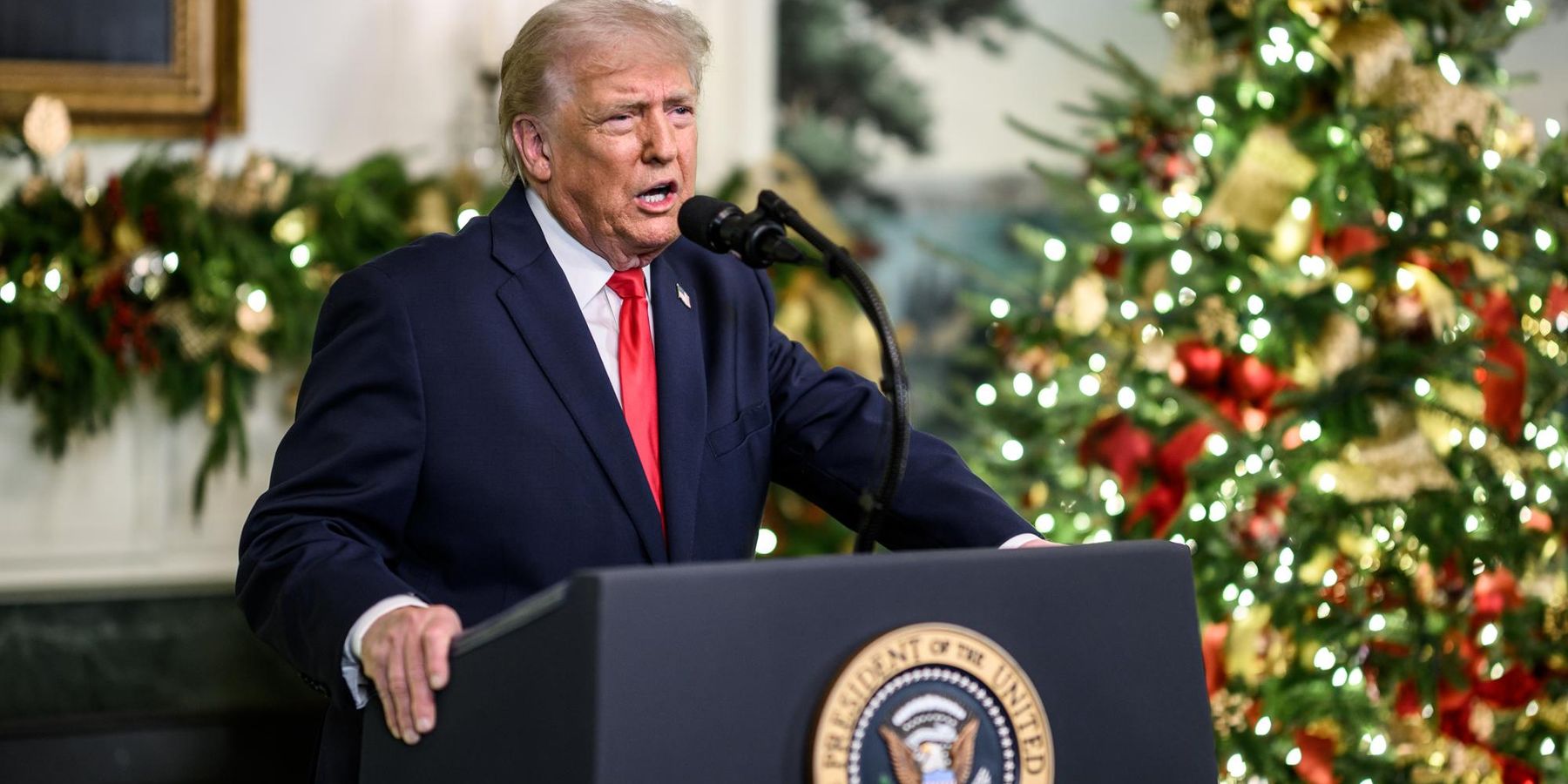
The new National Security Strategy of the United States seeks “strategic stability” with Russia. It declares that China is merely a competitor, that the Middle East is not central to American security, that Latin America is “our hemisphere,” and that Europe faces “civilizational erasure.”
India, the world's largest country by population, barely rates a mention — one might say, as Neville Chamberlain did of Czechoslovakia in 1938, it’s “a faraway country... of which we know nothing.” Well, so much the better for India, which can take care of itself.
The realpolitik of this document is breathtaking, yet the underlying logic is not stated. Indeed, as a statement of political ideology or “values,” the strategy is incoherent. It declares respect for the sovereignty of countries whose governing systems differ from ours, but then berates Europe for antidemocratic practices. It admits the end of U.S. hegemony, but then asserts hegemony over the whole Western hemisphere, citing the Monroe Doctrine as though it were holy writ.
What Ariadne's thread — if there is one — ties all this together?
It is a logic of resources, and in the first instance, of fossil fuels. With oil flowing thick and fast from Texas and reserves in Canada and Venezuela, the U.S. can exit the Persian Gulf. It could even — in principle, let's not predict that it will happen in practice — leave Israel to its own devices. Russian gas, more precisely the lack of it, has sealed the fate of Europe: Germany is deindustrializing while Britain and France, their empires long gone, are in deep decline. Sanctions having failed, Russia's eventual victory in Ukraine is now assured.
Hence it is necessary to accommodate Russia and to break America's longstanding ties to Russophobic European elites.
With China, the resource issue is rare earths and, especially, gallium, a byproduct of refining bauxite into alumina. China controls rare earths through a near-monopoly on refining, which could erode, with determined effort, over time. Gallium is different; U.S. aluminum capacity peaked in 1980, and the Chinese advantage in the underlying refining is now 90 (million metric tons) to 1. The U.S. cannot own-source gallium in adequate quantities on any timescale. As there is no substitute for gallium in advanced microchips, the U.S. military cannot now confront China and prevail. Detente is therefore necessary for America, as it is desired and accepted by China.
The remarkable recent softening of the American line toward China is the direct consequence of this material reality.
As strategy, the new order is not ironclad. So far, it has not much affected Pentagon planning, and should not be taken too seriously until bases are closed, aircraft carriers decommissioned, and nuclear weapons mothballed, while a new Navy based on regional requirements takes shape.
It is also hedged in several unrealistic ways, such as the notion, quickly quashed by China, that perhaps Japan (and Korea) might defend the “first island chain” — that euphemism for Taiwan. Equally unrealistic is the idea that Europe will step up on self-defense, with triple or more the current military spending while their economies continue to decline.
Then there is the undisguised notion that the nations of Latin America are not really countries, but dependencies and satrapies — colonies in all but name — run by caciques. That there have been, and still are, such countries in the region cannot be denied. But Mexico and Brazil, not to mention Colombia and Venezuela, as well as Nicaragua and Cuba, have other ideas. The brazen, Miami-mobster tone of this document is its most retrograde feature, scarcely removed from the years before the American Civil War, when Cuba and Mexico were seen as new frontiers for Southern slaveholders.
As economics, the Strategy is a mass of contradictions. It seeks reindustrialization while simultaneously protecting the financial system and the global dollar. It seeks technological leadership while cutting taxes, regulation, and the government's (long degraded) ability to specify what that leadership entails. It wants to build up an invincible, full-spectrum military while promoting “pro-worker” “prosperity that is widely shared.” This is the syndrome of the child who wants every shiny package under the tree. One may expect a tantrum when reality dawns, that one can't have it all.
Still, for all its defects, as an assault on the previously sacrosanct, unipolar, Eurocentric world order, the new strategy is an ice-breaker. It opens up policy space not seen in 40, 50 or perhaps 60 years — not since Reagan and Gorbachev, Nixon and Mao, or Kennedy and Khrushchev — who each in their own way tried to forestall the final nuclear confrontation. The panicked reaction of the European political leaders and of the U.S. foreign policy and Democratic Party and media elites portends a colossal struggle to keep the old order going. Thomas Friedman's vicious pastiche of cringe and cope is a telling example of what to expect.
Previous efforts at peacemaking all came, eventually, to nought. Kennedy's overtures of 1963, notably the test-ban treaty and his decision to exit Vietnam, ended with his assassination. Nixon's opening to China led to a deep relationship that only lapsed into hostilities as China emerged as a leading economic power while the 1990s-era illusion of an “end to history” and convergence to “liberal democracy” fell apart. The end of the Cold War engineered by Gorbachev and Reagan gave way, under George H. W. Bush, to claims of “victory” with the inevitable repercussion, revanche.
Yet in each of those episodes, the material advantages of the United States were stronger and its need to dominate the world greater than is true today. Since then, U.S. military capacity has eroded; an era of missiles and drones has superseded that of aircraft carriers and bases, and the technological conditions of conflict now overwhelmingly favor the defensive. And for now, the U.S. is indeed self-sufficient in energy, while the reserves it may require at some later date are nearby and not on the other side of the globe.
Those resources that must be obtained from China can be had, so long as China's terms are respected; they will not be had if China sees the United States as a military threat.
The material conditions, in short, favor peace. Neither of the other great powers — let alone the almost-unmentioned India — has delusions of world domination. Taking the world situation as it is, the U.S. can find common ground with Russia and it can live with China as a co-equal and a trading partner. The new strategy is therefore an open invitation for Taipei to settle with Beijing, and for successor governments in Berlin, Paris and London to seek terms from Moscow.
One cannot be optimistic. Adjusting our economy to achieve “pro-worker prosperity” is a task that lies ahead — and it will not be simple or free of internal conflict. No doubt those committed to coercive dominance will make every effort in the months ahead, to reverse any move toward balanced peace. Violence over Venezuela is a looming prospect.
But in the larger sphere, the global warriors are defending a world order that no longer exists, whereas the new conditions really do call for regional consolidation and multi-polarity — for a world where peace and stability are paramount.