
Follow us on social

google cta
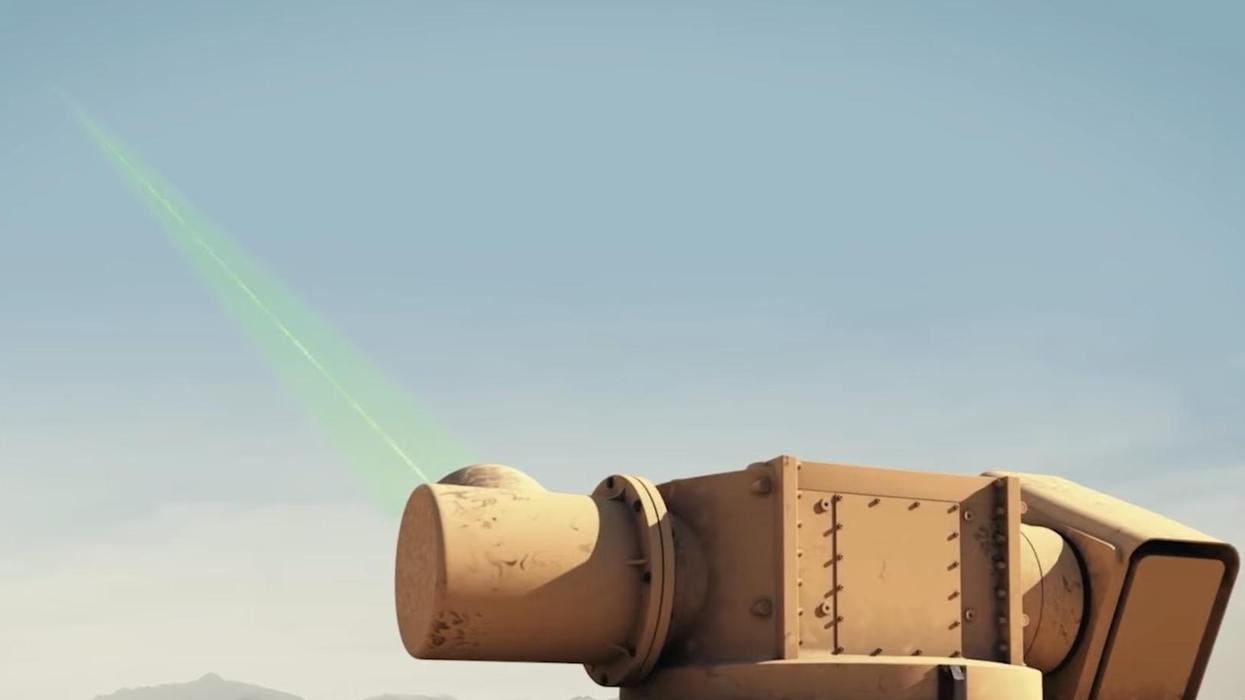
Counter drone laser tech

Report: DoD lets CBP shoot balloon with laser in airspace meltdown

The Pentagon has been testing the tech despite FAA concerns it affects aviation safety

Reporting | QiOSK
google cta
google cta

An apparent interagency dispute over testing counter-drone lasers, is wreaking havoc across parties — and airspaces — alike.

On Tuesday evening, the Federal Aviation Administration (FAA) closed the airspace surrounding El Paso International Airport, then re-opened it Wednesday morning. Transportation Secretary Sean Duffy, and DoD and White House officials blamed the closure, originally set to be 10 days long, on Mexican cartel-owned drones violating U.S. airspace. Administration officials have said the military disabled at least one drone.

But reports suggest that an interagency spat over an apparent test of a high-energy counter drone laser in the region — despite FAA concerns that the tech is risky for aviation — contributed to, or caused, the airspace closure. The Pentagon has previously tested the tech in more remote areas of the country.

At one point, reports suggest, U.S. Customs and Border Protection (CBP) — which borrowed the counter-drone laser tech from the DoD — even used it to attack what it thought were cartel-owned drones incurring U.S. airspace. In fact, CBP attacked at least one mylar balloon. (Earlier reporting has suggested the military, rather than CBP, carried out the attack.)

That mishap contributed to the FAA's closure of the airspace Tuesday night, without notifying White House, Pentagon or Homeland Security officials.

Federal agencies have largely remained silent over the controversy. When asked by the New York Times earlier today, a DoD spokesperson reasserted that the airspace closure was because the military was responding to a drone incursion.

While everything has since reopened, the confusing chain of events momentarily stoked fears of heightened tensions, if not outright conflict, with Mexico, just over the border from El Paso.

“Counternarcotics is a very difficult job, especially since cartels enjoy almost unlimited resources and have long been creative in their use of sophisticated technology. Drones are just the latest example,” Alan McPherson, a professor at Temple University who specializes in the history of U.S.-Latin America relations, told RS.

“Nevertheless, the FAA and others in the federal government need to be more forthcoming and consistent in the information they share with the public. To abruptly close an important border airport for an intended 10 days only to reopen it hours later will only fuel suspicion among the general public.”

President Trump has on numerous occasions publicly suggested using the military, specifically U.S. Special Forces, to attack Mexico’s drug cartels.

This is a developing story and will be updated accordingly.


Top Image Credit: Why Australia ordered this $125 million counter drone laser/news.com.au [YouTube/Screenshot]
google cta
Reporting | QiOSK
IRIS Dena
Top photo credit: The 86th Fleet of the Iranian Navy, including the destroyer Dena and the ship Bandar Makran, arrived at the First Naval Area of the Iranian Navy in Bandar Abbas on Saturday morning, May 20, 2023, (Fars Media/Creative Commons)

After sinking Iranian ship, did the US Navy commit a war crime?

QiOSK

Did the U.S. Navy commit a war crime?

That’s one unanswered question that lingers after the announcement Wednesday morning that an as-yet unidentified U.S. Navy submarine torpedoed an Iranian frigate that was far from its home port and had just taken part in multinational exercises hosted by India.

keep readingShow less
Tehran, Iran strikes
Top Image Credit: People run as smoke rises following an explosion, amid the U.S.-Israeli conflict with Iran, in Tehran, Iran, March 5, 2026. Majid Asgaripour/WANA (West Asia News Agency)

US used 'Claude' to strike over 1000 targets in first 24 hours of war

QiOSK

Despite a DoD ban on Anthropic over its demands that its tech not be used for fully autonomous military targeting, its AI model, Claude, is enjoying prime time use in the U.S. war on Iran.

Indeed, the U.S. military leveraged its AI targeting tools — which still employ Claude — to strike over 1,000 targets in Iran during the first 24 hours of the now rapidly expanding war.

keep readingShow less
Shanaz Ibrahim Ahmed iraq
Top photo credit: , First Lady of Iraq (Office of the First Lady)

Exclusive: Iraq's First Lady says 'this is not our war'

Middle East

As the conflict in the Middle East engulfs more countries, recent media reports alleging that the CIA is planning to arm Kurdish ground troops to spark an uprising in Iran have been met with vehement denials by Iraqi Kurdish officials.

However, while the Trump administration has denied that report, it is engaged in outreach to the various Kurdish groups to enlist their participation in an uprising against the Iranian regime. Meanwhile, after unconfirmed reports that some Kurdish groups were already engaging in cross-border attacks on Wednesday, the Iranians launched airstrikes at what they say are “anti-Iran separatist forces” in the mountains of Western Iran.

keep readingShow less
google cta
Want more of our stories on Google?
Click here to make us a Preferred Source.

LATEST

QIOSK

Newsletter

Subscribe now to our weekly round-up and don't miss a beat with your favorite RS contributors and reporters, as well as staff analysis, opinion, and news promoting a positive, non-partisan vision of U.S. foreign policy.