

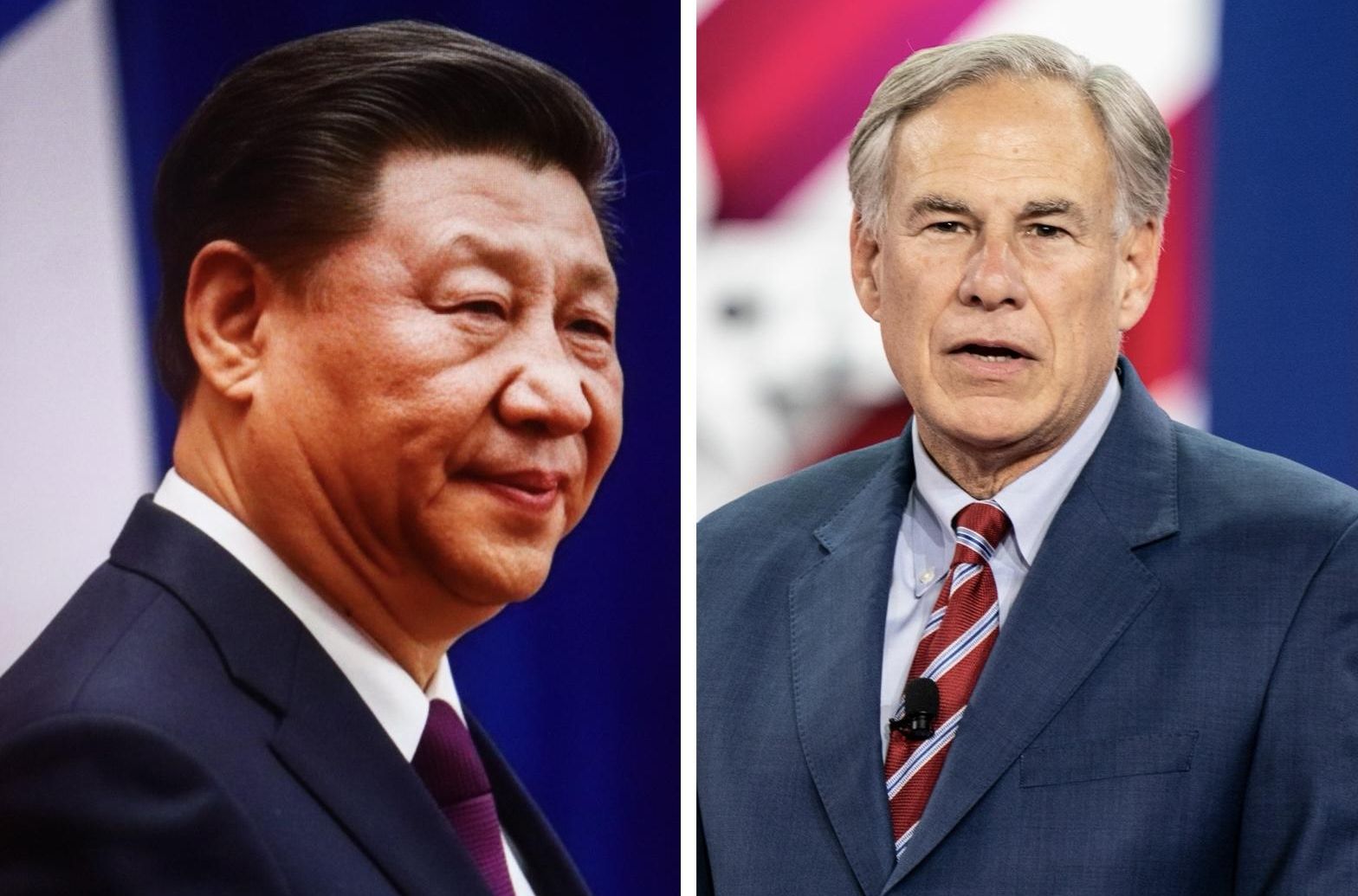
Last year, Texas banned professional contact by state employees (including university professors) with mainland China, to “harden” itself against the influence of the Communist Party of China – an entity that has governed the country since 1949, and whose then-leader, Deng Xiaoping, attended a Texas rodeo in 1979.
Defending the policy, the new provost of the University of Texas, my colleague Will Inboden, writes in National Affairs that “the US government estimates that the CPC has purloined up to $600 billion worth of American technology each year – some of it from American companies but much of it from American universities.” US GDP is currently around $30 trillion, so $600 billion would represent 2% of that sum, or roughly 70% of the US defense budget ($880 billion). It also amounts to about one-third of all spending ($1.8 trillion) by all US colleges and universities, on all subjects and activities, every year. Make that 30 cents of every tuition dollar and a third of every federal research grant.
Moreover, it seems the Chinese made better use of the purloined knowledge than we would have. Compare their growth rate to America’s, or look at Chinese cities, their high-speed railroads, and advanced industries. Then there’s the elimination of mass poverty and the 3.5 million engineers and scientists the country mints every year. Such theft must be akin to stealing emeralds from the Louvre – a zero-sum game. Not only did the Chinese get the good stuff, but they somehow prevented America from using it. How very diabolical.
Of course, the figure that Inboden cites is absurd, though I don’t doubt that the US government said it somewhere. Such claims about China (and not only China) have become routine in recent years. The tactic is straightforward. By saturating the information space with far-fetched assertions too numerous and too pervasive to rebut, disagreement, let alone dissent, becomes tantamount to disloyalty, even treason.
Yet universities obviously cannot be the secret laboratories of a national-security state. We are, by our nature, open. To the extent that we produce useful knowledge or new technologies, these naturally become the common property of the whole world. That is what “publication” is about. As for American companies, they went to China to make money. Many succeeded. That China got something out of it – at the expense of American workers, we can admit – was part of the deal. It’s called capitalism.
We’ve been here before. In the 1950s, “Who lost China?” became a national war cry as ambitious witch-hunters in Congress and elsewhere destroyed the careers and lives of US officials who knew the country firsthand. When my father was serving as ambassador to India in 1961, he cabled the State Department to argue for recognition of the People’s Republic, only to receive this epic reply: “Your views, to the extent that they have any merit, have already been considered and rejected.”
And yet, at a conference in 2003, Chester Cooper, a national-security veteran of that era, told me that even then Secretary of State Dean Rusk had privately agreed, saying, “I’m not the village idiot.” The US would have recognized the People’s Republic of China after the 1964 election had John F. Kennedy lived and been re-elected; instead, it was Richard Nixon who opened the door in 1971, and Jimmy Carter who stepped through it in 1977. I was present in the small crowd that greeted the great-but-tiny Deng as he entered the Rayburn House Office Building in 1979.
Meanwhile, the sands are shifting once again. RAND, an eminent redoubt of American national-security thought, has published a landmark paper calling for coexistence with China, and for accepting the CPC’s legitimacy. Imagine that. The authors cite similar views held by other top China hands, notably Rush Doshi, formerly of the National Security Council and now with the Council on Foreign Relations, and they carefully correct US mistranslations that made Chinese official documents and statements appear more aggressive than they were. Suddenly, highly placed voices are hinting at what many of us who watch China without the benefit of inside sources have long suspected: that the government of China is mainly concerned with governing China.
But what lies behind this apparent thaw? Recent developments in the trade war provide a clue. Recall that China recently announced export restrictions on rare earths and especially on gallium, a by-product of aluminum (and zinc) production that is essential for advanced electronics. China controls over 98% of the global supply of gallium, thanks to its aluminum capacity, which is 59% of the world total and 60 times that of the US. After a half-century of deindustrialization, the US cannot close this gap – and there are no good substitutes for gallium (nor for several other materials that China controls). China has therefore effectively lowered the boom on the prospect of US military confrontation with China.
Meeting with his Chinese counterpart in Malaysia this week, US Treasury Secretary Scott Bessent secured a one-year delay on China’s rare-earth export restrictions. With Chinese President Xi Jinping in Busan on October 29, Trump confirmed that deal. The postponement is, in effect, probation: China will assess, for a year, whether a new spirit of non-aggression, cooperation, de-escalatory rhetoric, and open trade can take hold. If not, the situation will not be better for the US a year from now, and both sides know it.
The long-term history of China’s rise and America’s decline dates back at least to the 1970s: the end of the Mao era in China, and the rise of free-market economics in the US, the high-dollar policy of Paul Volcker, and the arrival of Ronald Reagan. It is not a simple story of America being ripped off, as our president, my governor, and the alarmists in our security agencies, think tanks, and media like to claim. But we are where we are. Even our most obtuse leaders have begun to realize that the US is no longer fully in control.
Here in Texas, it would be nice if a few of us who have tracked the situation accurately for decades could reclaim our right to travel and engage professionally with China. We might then begin to reacquaint our local leaders with the real world. And – who knows? – maybe when Xi visits the US next year, we could host him at a rodeo. It wouldn’t be the first time.
This article was originally published at Project Syndicate.