


Military experts say the U.S. asset mobilization in the Middle East theater is now resembling a real staging for war, with the prevailing chatter more about "when" than "if" an attack will happen.
One of the data points catching the eye of these experts is the number of air tankers — military aircraft used to refuel combat fighters in midair — that are in or headed to the region. Open source intelligence analysts say there are at least 108 such tankers either in CENTCOM theater as of Friday (31) or in strategic locations outside that command or staging in Europe. Most are KC-135 Stratotankers, made by Boeing. (Editor's note: This information has been updated).
"Pulling the hammer back. Strikes could occur any time now," said one retired flag officer when RS asked him about the tankers.
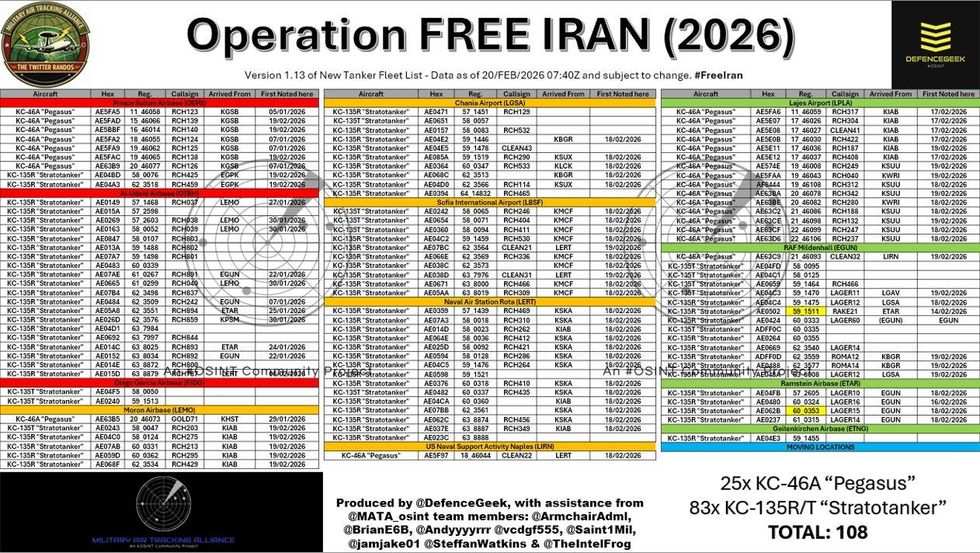
"This is a snap shot of the dynamic movement. What it tells you is we're getting ready for something here," said the retired flag officer. "There's a lot of movement. They are coming from all over the place. It's worldwide. That's always an indicator."
According to the military, there were about 149 KC-135 refuelers operating in the first phase of the March 2003 Iraq War.
"The size of these deployments ...indicates the force is preparing for more sustained operations," said Dan Grazier, retired Marine officer and senior fellow at the Stimson Center. "The strike last year against Iran's nuclear sites involved a lot of moving parts but only lasted about a day. Nearly 100 aerial refuelers in addition to carrier strike groups and fleets of fighters being moved into the region suggests there are plans for a longer operation this time around."
Experts also note that refueling capacity supports a ratio of one tanker per 6 to 10 fighters, depending on the type of combat aircraft/tanker. Estimates range from 250 or more U.S. aircraft now in the region when you include both the USS Lincoln and Ford strike groups (the Ford is on its way). Right now there are way more tankers moving than needed. Experts say that speaks to two things: that Washington is planning for sustained operations, and/or it plans on using fighters well out of range of Iran's strike capabilities.
"The departure of huge numbers of tankers to the Middle East, without concomitant massive fighter deployments, indicates that the USAF intends to base its strike aircraft out of the easy range of Iranian short-range missiles on the other side of the Middle East or even farther afield in Cyprus, Diego Garcia, etc.," wrote "Armchair Warlord" on X.
Reports Thursday outlined Trump's options (beyond not attacking, which is what the majority of Americans want), including taking out top Iranian leadership (regime change), or attacks limited to nuclear enrichment and ballistic missile facilities, which could entail sustained operations.
"Preparations of this kind mere months after the spectacular strikes against Iran's nuclear facilities suggest last year's actions against the regime weren't as successful as touted at the time," noted Grazier, referring to "Operation Midnight Hammer," which Trump declared had destroyed Iran's nuclear enrichment sites.
The retired flag officer said the number of tankers staged across far-flung air bases means we will be taking advantage of all capacity "at all ranges." That includes two tankers at our base at Diego Garcia from which two B-2 Stealth Bombers flew to attack during Operation Midnight Hammer. According to my colleague Connor Echols today, President Trump announced Wednesday that he now wants to stop the UK from turning over the Chagos Islands (home to Diego Garcia) to Mauritius, because the base may be necessary to “eradicate a potential attack by a highly unstable and dangerous [Iranian] Regime.”
Trita Parsi, executive vice president of the Quincy Institute, says it looks like Trump may have made his decision.
"It's important to understand that Trump has not engaged in any real diplomacy. Rather, the U.S. delegation has largely showed up at the meetings with demands for Iranian capitulation rather than real engagement. The meetings largely serve to check in to see if Iran is ready to submit to Trump or be bombed," he said. "This is not diplomacy. A deal can be reached, but Trump does not appear to be seriously pursuing it."
- Could Trump bomb Iran before settling on a rationale? ›
- Experts: Massive military buildup points to new US strikes on Iran ›
- SOTU: Trump threatens Iran but leaves open offramp | Responsible Statecraft ›