

This article is the first in a special series recognizing the four-year anniversary of the Ukraine War
Western travelers to Moscow often remark, with complete justification, on the sense of normalcy that the government has been able to sustain four years into the most dangerous, destructive war in Europe since 1945.
But there is another, overriding sense that became especially palpable to me on my second visit since the war began in 2022. Belying this outward commitment to business as usual is a profound social, economic, and political transformation with stark implications for both Russia and the West.
First, a few words on culture. The most pro-Western generation in Russia was the one that developed professionally and socio-economically in the aftermath of the Soviet collapse. These are people, roughly corresponding to millennials and Gen X, who identified most strongly with the Gorbachevian vision of a Europe from “Lisbon to Vladivostok.” They saw Russia as not just a European country but one whose destiny it was to integrate with European and even Euro-Atlantic political institutions. Three decades later, these hopes and dreams of the 1990s are as Greek to a generation of younger Russians who have spent their formative years living through a period of unprecedented East-West hostility.
Europe is no longer seen as an ideal to aspire to but as a distant abstraction or, certainly as far as the EU is concerned, an unremitting enemy.
More fundamentally, the West is no longer the only game in town. Russians, less from preference than by necessity, have embraced doing business with China and other non-Western countries on a massive scale. Though German cars are still the go-to for the more affluent, low- to mid-end markets are largely occupied by Chinese makes. It’s a similar story for commercial and industrial projects, with Russian and non-Western investors rushing to fill the gap left by the exodus of Western firms after 2022.
None of this is to say, contrary to the proclamations of a burgeoning cadre of “Eurasianist” thinkers, that Russia is anything other than a European country. This is neither the first nor the last time that Russians have performatively embraced non-Western identities in response to geopolitics, a phenomenon beautifully captured by Alexander Blok’s The Scythians.
Yet identities are malleable on the margins, and the performance, if repeated with enough conviction, can take on a life of its own. It has unsurprisingly become fashionable for Russians to stress those parts of their identity that are uniquely Russian and distinct from Europe; though these are markers of political rather than civilizational differences, their net effect is to formalize the geopolitical rift that took shape after the Euromaidan crisis of 2014.
Russia is a European country estranged from its European neighbors, and this prolonged estrangement is shaping its development in ways that do not benefit the West.
These drastic shifts, coupled with the Kremlin’s economic model of military Keynesianism centered on massive investments into the military-industrial sector and generous payouts for contract service in the military, have imbued Russian life with a new sense of direction that should be better understood in the West.
When it comes to consumer products, sanctions have become an impossible game of Whac-A-Mole. Most kinds of Western luxury goods, from the latest iPhone models to handbags and designer clothes, are freely available through the many parallel import schemes conceived and continually refined by Russian entities. By the time the next wave of European restrictions comes around, Russian importers will have already found new means to keep the shelves stocked with Western products in the short to medium term.
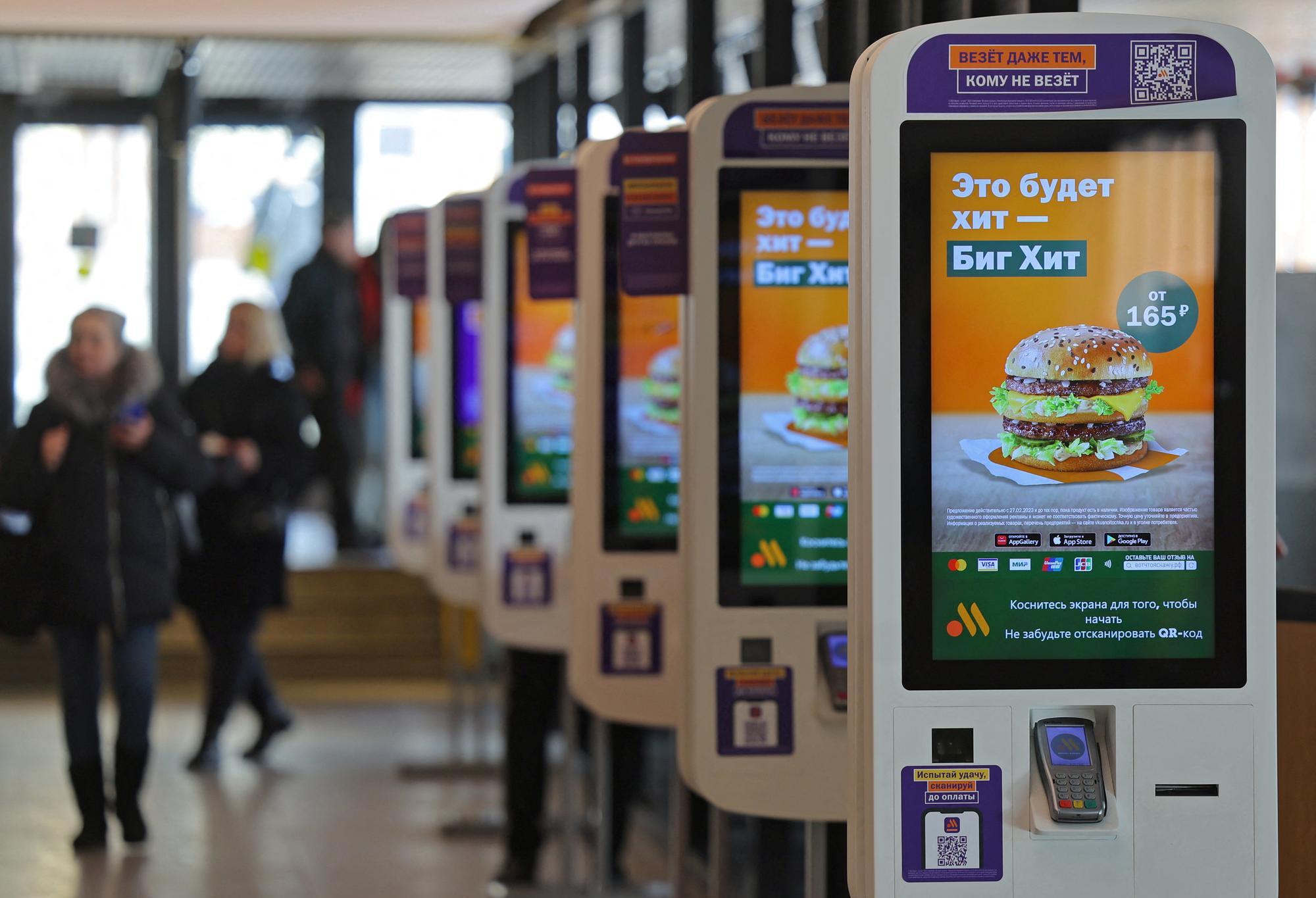
Nor is Moscow chastened by the absence of big-name Western chains. I stopped for lunch at what was the country’s first McDonald’s that opened on Tverskaya street in 1990 shortly before the Soviet collapse. The joint, like all other McDonald’s locations across the country, was rechristened after 2022 as Vkusno i Tochka, or “Tasty and That’s It,” but the menu remains broadly familiar to American tastes with such items as the “Big Hit” and “Fishburger” headlining for the identical Big Mac and Filet-O-Fish.
In fact, Moscow streets are peppered with similar rebrandings that changed little other than the name — Stars Coffee (Starbucks), Pizza Heart (Pizza Hut), Donutto (Dunkin Donuts), and Rostics (KFC), just to name a few.
Sanctions that control what brand names Russian consumers see on store shelves and city streets are more symbolic than practical. They are counterproductive insofar as they curtail Western soft power in Russia without imposing any real costs on the Russian government.
The only punitive measures that can be measured in their macroeconomic impact are the big sectoral sanctions on exports, logistics, insurance, and financial transactions. But it is important here to proceed with a degree of nuance that has yet to grace the popular debate over sanctions.
The Russian economy is simply too enmeshed in global supply chains and benefits from too many potential pathways to market access to be toppled by Western sanctions. But it is equally clear that the net sum of all the restrictions piled on Russia since 2022 is exacting a rising toll on quality of life. Many products, particularly groceries, housing prices, and numerous kinds of services like haircuts and deliveries, have become noticeably more expensive over the past year.
Russia’s VAT was hiked to 22% in 2026, which affects everyone but naturally hits lower-income earners who spend a larger portion of their paycheck on consumption the hardest. Even the well-to-do Russians I spoke to are feeling the squeeze in their everyday lives.
This brings us to the ongoing Ukraine peace talks. My colleagues and I have offered comprehensive advice on how to make progress on the issue clusters being negotiated. I want, here, to draw attention to an under-appreciated vector of U.S. leverage and how to properly utilize it.
The administration has wisely pursued a “linkage” approach to Ukraine peace talks. Namely, the White House appears to understand that the only way to reach the compromises necessary for a durable long-term peace is to broaden the agenda to include a wide range of issues in U.S.-Russia relations. It’s not just about the direct pain from sanctions — considerable as it is — but the colossal opportunity costs of everything Russia could have achieved economically if the war had never taken place.
Far from a sideshow in these negotiations, the prospect of sustained economic cooperation is one of the most powerful levers we have for ending the war on maximally beneficial terms for Ukraine and the U.S.
The West’s greatest strength lies not in its military might but in the universal appeal of its institutions, products, and services. U.S. negotiators should, as part of a peace deal, offer Moscow a roadmap for Russia’s long-term reintegration into these commercial networks with concrete proposals on energy, joint resource exploration, foreign investment, payment systems, and more.
Naturally, these agreements can and should be pursued in a way that offers tax holidays, reduced rates, grants, expedited permits and other benefits for U.S. companies. The U.S, if it paves the way in reopening Russian markets to Western entities, will be in an advantaged position to reap the rewards. Call it pioneer's prerogative.
Reestablishing commercial ties gives Russia structural reasons to abide by the terms of a peace settlement and feeds into the larger U.S. goal of promoting east-west stability after the war. It also gives Russia much-needed geopolitical options to what is otherwise its deepening involvement with China.
What’s being proposed here is not, lest there be any confusion, a rendition of capitalist peace theory. There should be no mistake that the Russia-West confrontation is first and foremost a strategic problem that must be addressed in security terms if it is to be defused. Yet the U.S. interest is not just to end the war but to do so in a way that reverses Russia’s drift away from the Western sphere and paves the way for additional forms of cooperation down the line.
A creative approach to economic linkages is among the best American tools to advance that goal.
- Why US-led sanctions on Russia are a failure ›
- Trouble in Russian economy means Putin really needs Alaska talks too ›
- What does Putin really want? | Responsible Statecraft ›
- Ukraine's Dilemma | Responsible Statecraft ›
- Putin denies economic stagnation after four years of war | Responsible Statecraft ›
- When did Western statecraft lose its fear of the unknown? | Responsible Statecraft ›