
Follow us on social

google cta
Is a breakthrough looming in Ukraine talks?

Is a breakthrough looming in Ukraine talks?

Two days in Abu Dhabi have reportedly brought both Moscow and Kyiv closer to an agreement, but so far details are scarce

Reporting | QiOSK
google cta
google cta

Russian and Ukrainian officials appear to be making serious headway toward a peace deal following a second day of direct talks in Abu Dhabi.

One indication of progress has been the positive, if cautious, comments from leaders on both sides of the table. Rustem Umerov, the head of Ukraine’s National Security and Defence Council, described the talks as “substantive and productive,” and Russian negotiator Kirill Dmitriev said “things are moving forward in a good, positive direction.” Adding to the relatively cordial atmosphere was an agreement to exchange more than 300 prisoners of war, the first such swap in several months.

But the most important indicators came from outside the negotiating room. The Financial Times reported Tuesday that Ukraine has finally reached a deal to obtain security guarantees from the U.S. and Europe, satisfying a key Ukrainian demand for a post-war settlement. Under the deal, European powers agreed to intervene militarily in order to protect Ukraine in case of “persistent Russian violations of any future ceasefire agreement,” according to the FT. American forces would only join hostilities after 72 hours, if the initial efforts to stop Russian aggression failed.

The agreement could open a path to a deal that gives Ukraine security guarantees in exchange for territorial swaps with Russia, possibly including a complete Russian takeover of the Donbas, which the Kremlin considers a key war aim. Ukrainian President Volodymyr Zelensky has generally expressed opposition to such a deal, but his people have begun warming up to the idea, with 40% of Ukrainians expressing support for it in a recent poll.

“This is going very slowly, but it is moving,” said Anatol Lieven of the Quincy Institute, adding that the current situation is “far, far better” than it was a year ago. As Lieven noted, seeming progress in direct talks has come alongside a thaw in U.S.-Russia relations, particularly when it comes to economic discussions, which could give Washington an additional carrot to incentivize Moscow at the negotiating table. This leverage could help overcome Russian skepticism toward accepting Western security guarantees for Ukraine.

Meanwhile, the U.S. and Russia have used their time in Abu Dhabi to forge ahead on a host of strategic issues that American officials had previously hoped to address only after securing a peace deal in Ukraine. On Thursday, the two great powers agreed to reestablish a high-level military-to-military dialogue channel that they abandoned prior to Russia’s full-scale invasion of Ukraine. The decision “provides a means for increased transparency and de-escalation” in times of crisis, the U.S. military said in a statement.

Perhaps most notable on this front was the revelation that Moscow and Washington were working on an informal arms control deal following the expiration this week of the New START Treaty, which placed caps on the number of nuclear warheads that each country can deploy. According to Axios, the two sides are pursuing an informal agreement whereby each side continues to observe the treaty’s provisions even after it expires.

Trump also appears to have neutralized his Republican skeptics in Congress. While many Republican lawmakers have expressed support for levying additional sanctions against Russia, congressional leadership has avoided scheduling votes to move such legislation forward. Even this week, Ukrainian officials received a cautious reception from Republicans as they made the case for additional sanctions on Moscow.

Lieven argued that the broader detente between the U.S. and Russia could be the key to reaching a final deal. “For the U.S. to make compromises on the wider relationship is really the only way that you can shift Russia from its tougher demands against Ukraine,” he said.


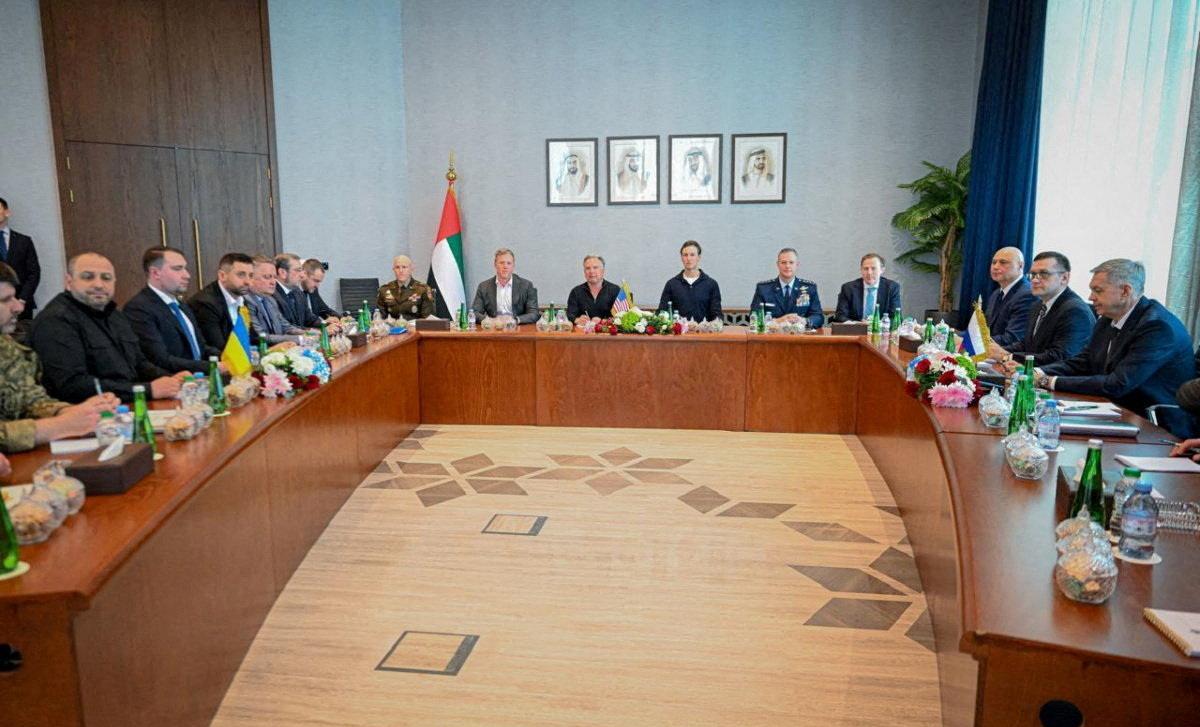
Members of the U.S., Russian and Ukrainian delegations attend the second round of trilateral talks in Abu Dhabi, United Arab Emirates, February 4, 2026. UAE Ministry of Foreign Affairs/Handout via REUTERS
google cta
Reporting | QiOSK
G7 Summit
Top photo credit: May 21, 2023, Hiroshima, Hiroshima, Japan: (From R to L) Comoros' President Azali Assoumani, World Trade Organization (WTO) Director-General Ngozi Okonjo-Iweala, Australia's Prime Minister Anthony Albanese and India's Prime Minister Narendra Modi at the G7 summit in Hiroshima, Japan. (Credit Image: © POOL via ZUMA Press Wire)

Middle Powers are setting the table so they won't be 'on the menu'

Asia-Pacific

The global order was already fragmenting before Donald Trump returned to the White House. But the upended “rules” of global economic and foreign policies have now reached a point of no return.

What has changed is not direction, but speed. Canadian Prime Minister Mark Carney’s remarks in Davos last month — “Middle powers must act together, because if we’re not at the table, we’re on the menu” — captured the consequences of not acting quickly. And Carney is not alone in those fears.

keep readingShow less
Vice President JD Vance Azerbaijan Armenia
U.S. Vice President JD Vance gets out of a car before boarding Air Force Two upon departure for Azerbaijan, at Zvartnots International Airport in Yerevan, Armenia, February 10, 2026. REUTERS/Kevin Lamarque/Pool

VP Vance’s timely TRIPP to the South Caucasus

Washington Politics

Vice President JD Vance’s regional tour to Armenia and Azerbaijan this week — the highest level visit by an American official to the South Caucasus since Vice President Joe Biden went to Georgia in 2009 — demonstrates that Washington is not ignoring Yerevan and Baku and is taking an active role in their normalization process.

Vance’s stop in Armenia included an announcement that Yerevan has procured $11 million in U.S. defense systems — a first — in particular Shield AI’s V-BAT, an ISR unmanned aircraft system. It was also announced that the second stage of a groundbreaking AI supercomputer project led by Firebird, a U.S.-based AI cloud and infrastructure company, would commence after having secured American licensing for the sale and delivery of an additional 41,000 NVIDIA GB300 graphics processing units.

keep readingShow less
United Nations
Monitors at the United Nations General Assembly hall display the results of a vote on a resolution condemning the annexation of parts of Ukraine by Russia, amid Russia's invasion of Ukraine, at the United Nations Headquarters in New York City, New York, U.S., October 12, 2022. REUTERS/David 'Dee' Delgado||

We're burying the rules based order. But what's next?

Global Crises

In a Davos speech widely praised for its intellectual rigor and willingness to confront established truths, Canadian Prime Minister Mark Carney finally laid the fiction of the “rules-based international order” to rest.

The “rules-based order” — or RBIO — was never a neutral description of the post-World War II system of international law and multilateral institutions. Rather, it was a discourse born out of insecurity over the West’s decline and unwillingness to share power. Aimed at preserving the power structures of the past by shaping the norms and standards of the future, the RBIO was invariably something that needed to be “defended” against those who were accused of opposing it, rather than an inclusive system that governed relations between all states.

keep readingShow less
google cta
Want more of our stories on Google?
Click here to make us a Preferred Source.

LATEST

QIOSK

Newsletter

Subscribe now to our weekly round-up and don't miss a beat with your favorite RS contributors and reporters, as well as staff analysis, opinion, and news promoting a positive, non-partisan vision of U.S. foreign policy.