

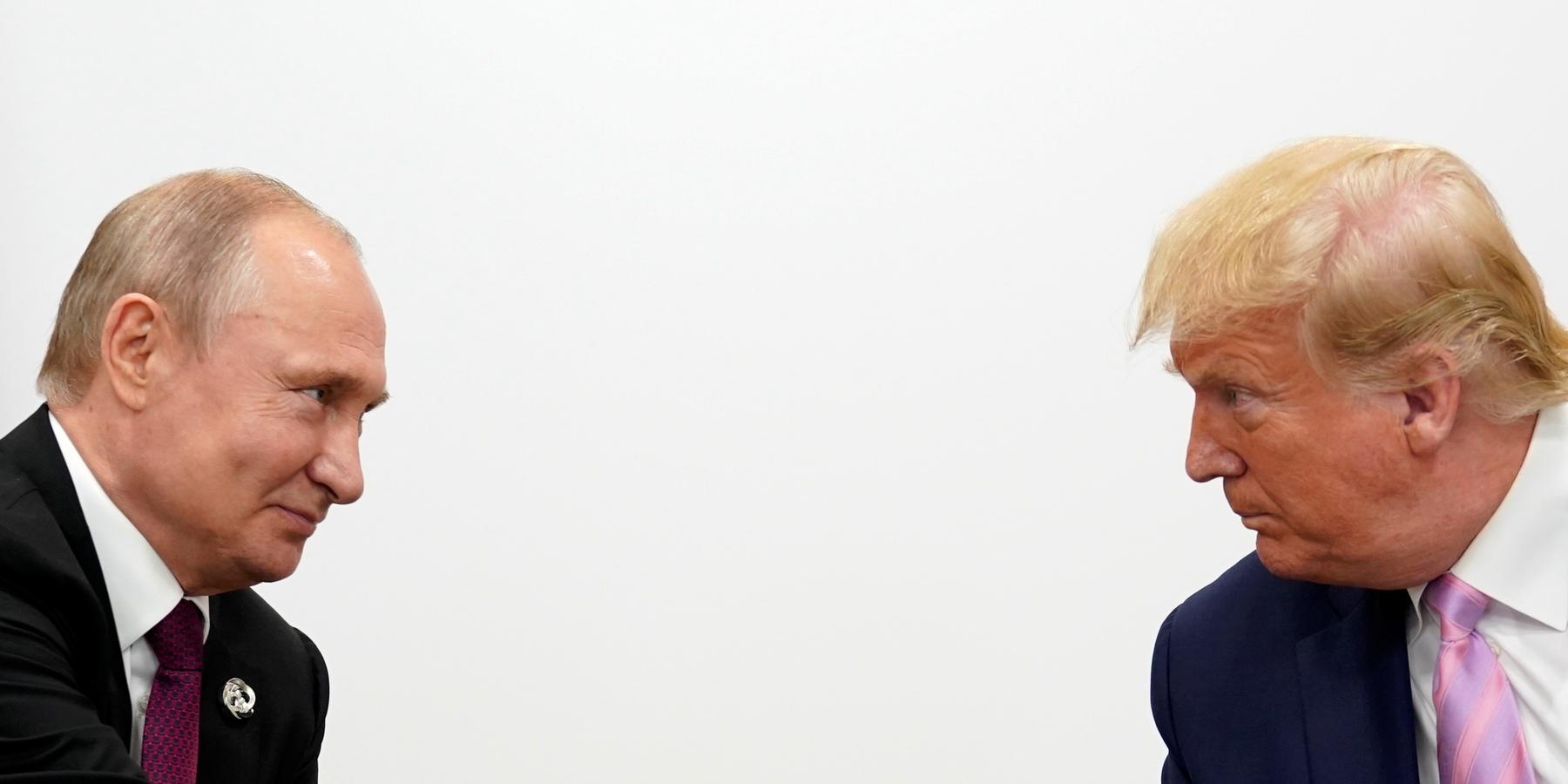
As the February 5 expiration date for New START — the last nuclear arms control treaty remaining between the U.S. and Russia — looms, the Trump administration appears ready to let it die without an immediate replacement.
"If it expires, it expires," President Trump said about the treaty during a New York Times interview given Wednesday. "We'll just do a better agreement."
But as experts tell Responsible Statecraft, allowing New START to lapse without some kind of contingency plan in place could unleash an unconstrained arms race between the world’s greatest nuclear powers.
About New START
The New Strategic Arms Reduction Treaty (New START), which went into effect in 2010, caps the number of deployed nuclear warheads the U.S. and Russia can each have at 1,550. In addition, the two countries can only maintain 700 deployed delivery vehicles, including intercontinental ballistic missiles (ICBMs) and heavy bombers, and 800 launchers (missile launchers and bombers) for those weapons, under the treaty.
New START was extended in 2021 for five years, but Russia suspended its participation in 2023, citing U.S. military assistance to Ukraine; the U.S. also partially stopped observing it. A clause in the New START treaty bars it from being formally extended again, but Russia proposed in September that both countries voluntarily maintain the treaty’s “central quantitative restrictions” on deployed nuclear warheads, and relevant delivery systems, for a year from its expiration — a measure Russia says does not require formal U.S. diplomatic engagement.
The U.S. initially seemed amenable to that idea but Trump’s recent remarks suggest disinterest in it.
Nuclear negotiations: easier said than done
Anticipating New START’s end, Trump has signaled intent to garner a “better agreement.” But experts tell RS, his own track record indicates this is easier said than done.
“If the Trump administration thinks that getting a new ‘better’ treaty after this one lapses will be easy, they are mistaken,” Jennifer Kavanagh, senior fellow and director of military analysis at Defense Priorities, told RS. “This is the same message that the first Trump administration provided when the decision was made to pull out of the JCPOA [Joint Comprehensive Plan of Action] with Iran. How did that turn out?”
“Almost 8 years later and there's no new deal, and Iran is closer to a nuclear weapon even after the June 2025 airstrikes than it was before Trump exited the agreement,” Kavanagh said.
Meanwhile, Russia and the U.S. are of different minds on what a new treaty could look like. For example, whether to prioritize reining in China’s growing nuclear stockpiles is a point of divergence. New START, a bilateral agreement, does not include China.
“The United States has pushed to include China in a trilateral [treaty] format, which Beijing rejects due to arsenal size asymmetries, and to cover novel systems and nonstrategic nuclear weapons. Russia frames potential talks around the overall strategic balance, including missile defenses and long-range conventional strike capabilities,” Stephen Herzog, professor of the practice at James Martin Center for Nonproliferation Studies (CNS), at the Middlebury Institute of International Studies at Monterey, told RS. “These priorities are difficult to reconcile.”
Simply continuing to observe New START’s weapons and delivery systems limits would set aside its critical weapons verification mechanisms, such as on-site nuclear weapons inspections and biannual weapons inventory updates, and avoid the issue of China’s expanding arsenal. But experts say that arrangement, or another informal commitment, would be better than nothing.
“Even if Trump wants a better agreement, he should offer some informal commitment for now to maintain the caps while negotiating. Walking away with nothing serves no one's interests,” Pavel Devyatkin, a non-resident fellow at the Quincy Institute and senior associate at The Arctic Institute, told RS.
“Trump is right that extending New START won't address China's growing nuclear stockpile,” Kavanagh concluded. “But this is not a reason to [avoid seeking] common ground with Russia on this issue.”
A new nuclear arms race?
With only weeks left before New START expires, even a lapse in voluntarily observing its central tenet — maintaining its quantitative limits — paves the way for an unconstrained arms race.
“Once New START is gone, there are no international arms control agreements between the world's two largest nuclear powers anymore,” Geoff Wilson, distinguished fellow and strategic advisor for the National Security Reform Program at the Stimson Center, warned RS. “There is nothing controlling what the United States and Russia can or cannot do with their nuclear weapons.”
“The stakes are high. If Trump fails to respond positively to Russia’s proposal for an interim deal to maintain the New START limits, each side likely will begin increasing the size of its deployed nuclear arsenal for the first time in more than 35 years by uploading additional warheads on existing long-range missiles,” Daryl Kimball, executive director of the Arms Control Association, wrote. “Many members of the nuclear weapon establishment are lobbying for such a buildup.”
The State Department declined to say whether the Trump administration would adhere to Russia’s proposal to keep New START’s quantitative limits; the White House did not respond to the same question.