

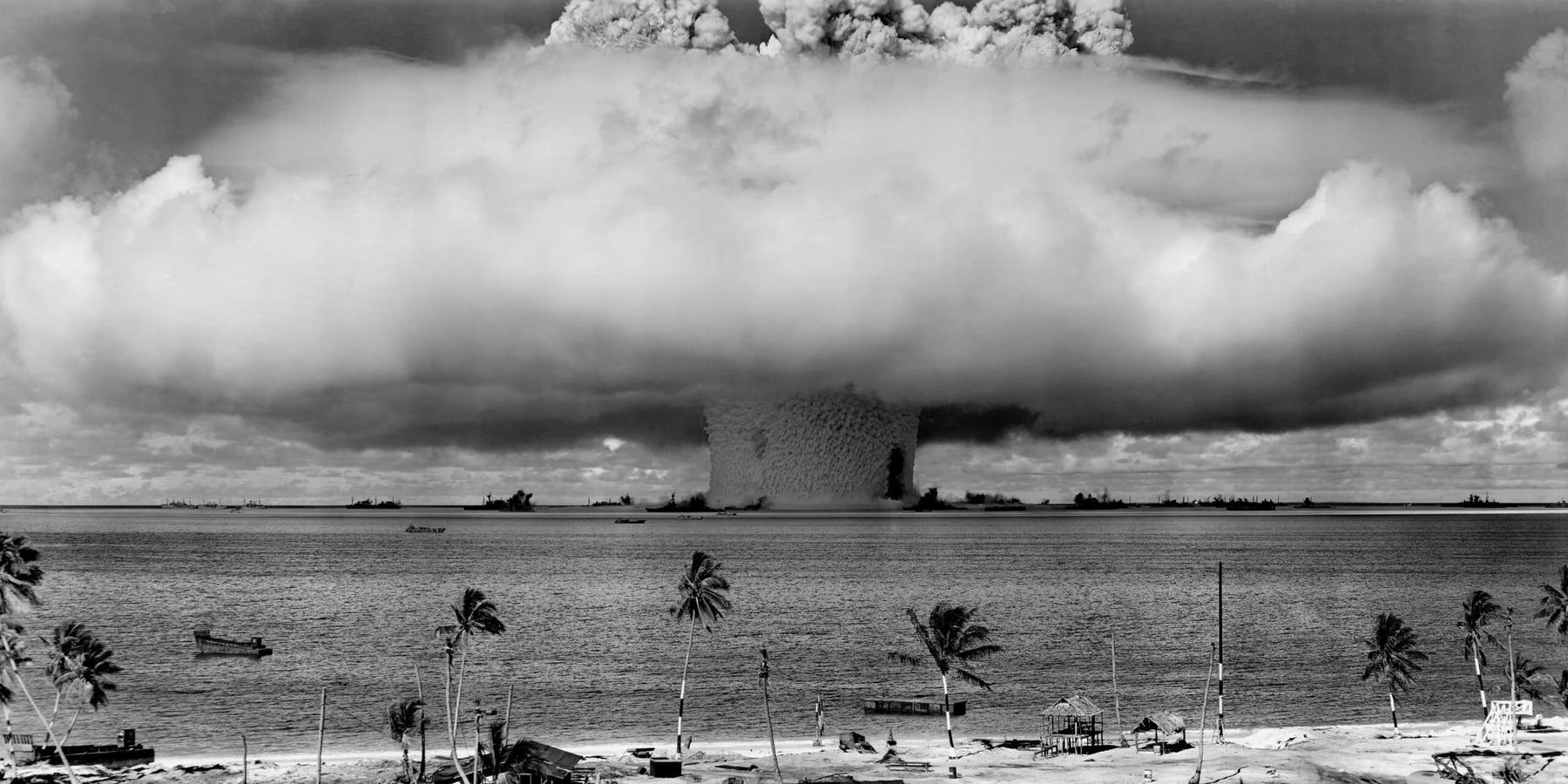
On February 13th, 2025, President Trump said something few expected to hear. He said, “There's no reason for us to be building brand-new nuclear weapons. We already have so many. . . You could destroy the world 50 times over, 100 times over. And here we are building new nuclear weapons . . . We’re all spending a lot of money that we could be spending on other things that are actually, hopefully, much more productive.”
I could not agree more with that statement. But with today’s expiration of the New START Treaty, we face the very real possibility of a new nuclear arms race — something that, to my knowledge, neither the President, Vice President, nor any other senior U.S. official has meaningfully discussed.
The decision to start a nuclear war can be made by a single individual—the President of the United States—with no requirement that he first consult with anyone. A nuclear war could also be started at any moment by Vladimir Putin, Xi Jinping, or any other leader of a nuclear weapon state. Or, it could be triggered by mistake.
A single use of a tactical nuclear weapon, either by accident or design, could trigger a flurry of escalating responses with far more powerful strategic weapons that would cause incalculable loss of life, widespread radiation poisoning, and destruction on a scale unlike anything seen in human history. We all — regardless of political affiliation — must reaffirm what Presidents Reagan and Gorbachev said 40 years ago: “A nuclear war cannot be won and must never be fought.”
For the past eighty years, the probability of mutually assured destruction has deterred the use of nuclear weapons. But in today’s increasingly dangerous and unpredictable world, with mercurial leaders like Vladimir Putin and Kim Jong Un, we cannot rely on deterrence alone. Existing nuclear arms control treaties are either no longer adhered to by Russia or the United States, or, as in the case of New START, have expired.
That represents a colossal failure of leadership by both the United States and Russia. There is no greater threat to humanity than a nuclear war, yet there are no negotiations underway to replace the treaty, nor are there discussions to consider a new generation of limits on nuclear weapons.
My colleague from Massachusetts, Senator Ed Markey, and several others in Congress, as well as the arms control community, have sought to counter this complacency. But the danger of a new nuclear arms race has received far too little attention from Congress and the Administration, and with today’s expiration of the New START Treaty, it is staring us in the face.
The United States, and our allies, must urgently seek to reinvigorate negotiations on a verifiable replacement for New START, with more effective mechanisms to prevent the development, proliferation, and use of nuclear weapons. Until then, we and the Russians should agree to continue abiding by the limits under New START. Despite our stark differences with the Russians, they have as much interest in preventing an unwinnable nuclear war as we do.
We must also invigorate discussions with China, which has some 600 nuclear weapons. That number is expected to more than double in fewer than ten years.
If the U.S. and Russia fail to replace New START despite it being in both countries’ national security interest, there are other steps that we, Russia, and China should take—short of negotiating a new treaty—to help reduce the risk of a nuclear war, whether due to a false alarm, error, or other misperception.
For example:
- Creating joint early warning centers to monitor missile launches;
- De-targeting, so any accidental launch of a nuclear armed missile lands in the ocean;
- Removing all nuclear weapons from high-alert status;
- Reducing incentives to respond quickly to an unconfirmed nuclear attack;
- Reducing the number of deployed nuclear weapons; and
- Renouncing first use of nuclear weapons and eliminating the President’s authority to launch nuclear weapons without congressional approval.
Since the 1980s, thanks to negotiators in both countries, the United States and Russia curtailed an unrestrained nuclear arms race that had led to the deployment of staggering numbers of increasingly destructive weapons that could not rationally be justified for deterrence or any other purpose. The START Treaty and New START were historic achievements.
Twelve months ago, President Trump spoke of the need for the U.S., Russia, and China to stop building more nuclear weapons. Yet while his National Security Strategy calls for “the world’s most robust, credible, and modern nuclear deterrent,” it says nothing about preventing another nuclear arms race. With respect to New START, he reportedly said, “If it expires, it expires.”
As the New START Treaty fades into history, one commentator has suggested that “one likely successor to nuclear weapons’ sole dominance on the strategic value ladder could be AI technology. . . Either AI technology itself will become the primary strategic weapon—or it will enable the rapid creation of alternatives that render nuclear arsenals increasingly irrelevant to real-world outcomes.”
It is only a matter of time—and probably far less time than we think—before the application of AI technology to warfare creates a whole new impetus for global instability. But even as AI becomes more versatile as a disruptive and destructive force, nuclear weapons and the threat of nuclear war are not going to disappear.
So, I urge President Trump to elevate nuclear arms control to the top of his national security agenda. Even the modest steps I’ve outlined to reduce the chance of a catastrophic mistake or miscalculation resulting in the use of nuclear weapons should be among our highest national security priorities.
- What will happen when there are no guardrails on nuclear weapons? ›
- Trump on New Start nuke treaty with Russia: if 'it expires it expires' ›
- Is China really testing nuclear weapons? | Responsible Statecraft ›
- US, Russia test ICBMs as nuclear talks end in deadlock | Responsible Statecraft ›