

Silicon Valley’s elite traded hoodies for Hill passes last week and planted their flag in Washington.
During a nearly 12-hour marathon Hill and Valley Forum in the Capitol Building, star-studded venture capitalists, defense technologists, and allied policymakers congratulated themselves on the promising start to the military application of artificial intelligence and autonomous weapons in the era of Trump 2.
Jacob Helberg, co-founder of the annual forum and Trump’s pick for under secretary of state for economic growth, energy, and the environment, laid out the success story of Silicon Valley’s David-to-Goliath arc in his opening remarks.
“We have the best leader in the world. President Trump is objectively and truly a sample of one…The stars have aligned. We have the builders, we have the innovators, the policymakers and leaders for a reindustrialization revolution in this country to seize this American moment,” he declared.
Helberg forgot to credit one important group: the lobbyists. During coffee breaks outside the auditorium — where old friends caught up and West Coasters complained about the early start time — attendees explained that lobbyist insiders have been crucial in closing the daylight between would-be skeptics in government and Silicon Valley’s startups.
“It’s no mistake that there’s been an infusion of Silicon Valley acolytes in Washington DC the last 6 months,” said one founder of a venture capital firm invested in defense technology companies. “Silicon Valley is recognizing that lobbying is a key conduit to get things done and sell its message to three letter agencies.”
Venture capitalists are only now beginning to hire lobbyists. Since Trump’s victory in November, Andreessen Horowitz has snapped up contracts with BGR Government Affairs, Cornerstone Government Affairs, and Trump-connected Miller Strategies to advocate on “issues related to AI,” among other items. Other major venture capital firms, such as General Catalyst and Sequoia Capital, registered lobbyists for the first time just last year.
Meanwhile, major defense technology firms such Palantir, Anduril, and Shield AI have doubled down on lobbying efforts in recent years.
Another founder of a defense technology firm told RS that by lobbying up, Silicon Valley is following in the footsteps of the “game” played by prime contractors like Lockheed Martin and Boeing. “It’s all marketing. It’s about creating a message that sells well,” they said.
And that message is resonating. Trump has signed a series of executive orders that favor some of Silicon Valley’s longtime stated goals, such as ordering the Pentagon to find commercial solutions rather than custom ones, emphasizing speed over testing, and slashing acquisition regulations. Trump also ordered the creation of a “Golden Dome” missile defense system, with three defense technology heavy hitters — Palantir, Anduril, and Spacex — reportedly eager to cash in.
If the forum was any indication, Silicon Valley is also getting buy-in from Congress. Key lawmakers such as House Speaker Mike Johnson (R-La) and Senate Armed Services Committee members Jack Reed (D-R.I.), Mike Rounds (R-S.D.), and Jim Banks (R-Ind.), all made appearances and sung the firms’ praises. “What you’re doing here is so critically important…you always have a welcome mat here at the Capitol. I hope you come by the Speaker’s office when you come individually or with your family, we’ll roll out the red carpet for you,” said Johnson.
Aided by K street’s most high-powered firms, such as Invariant, Cornerstone Government Affairs, Akin Gump, and Brownstein Hyatt, Palantir’s rise in particular has been nothing short of meteoric. An investigation by the Tech Transparency Project found that Palantir has “hired a slew of well-connected players from Congress and federal agencies, ramped up lobbying activity, and created a foundation to bankroll policy-shaping research, conferences, and public commentary,” all of which is taking place mostly below the radar.
One of the bills that Palantir’s lobbyists worked to pass was the $14 billion aid package to Israel. It’s not hard to see why; last year, the military software company agreed to a strategic partnership with Israel to supply “advanced technology in support of war-related missions,” and even organized its annual board meeting in Tel Aviv.
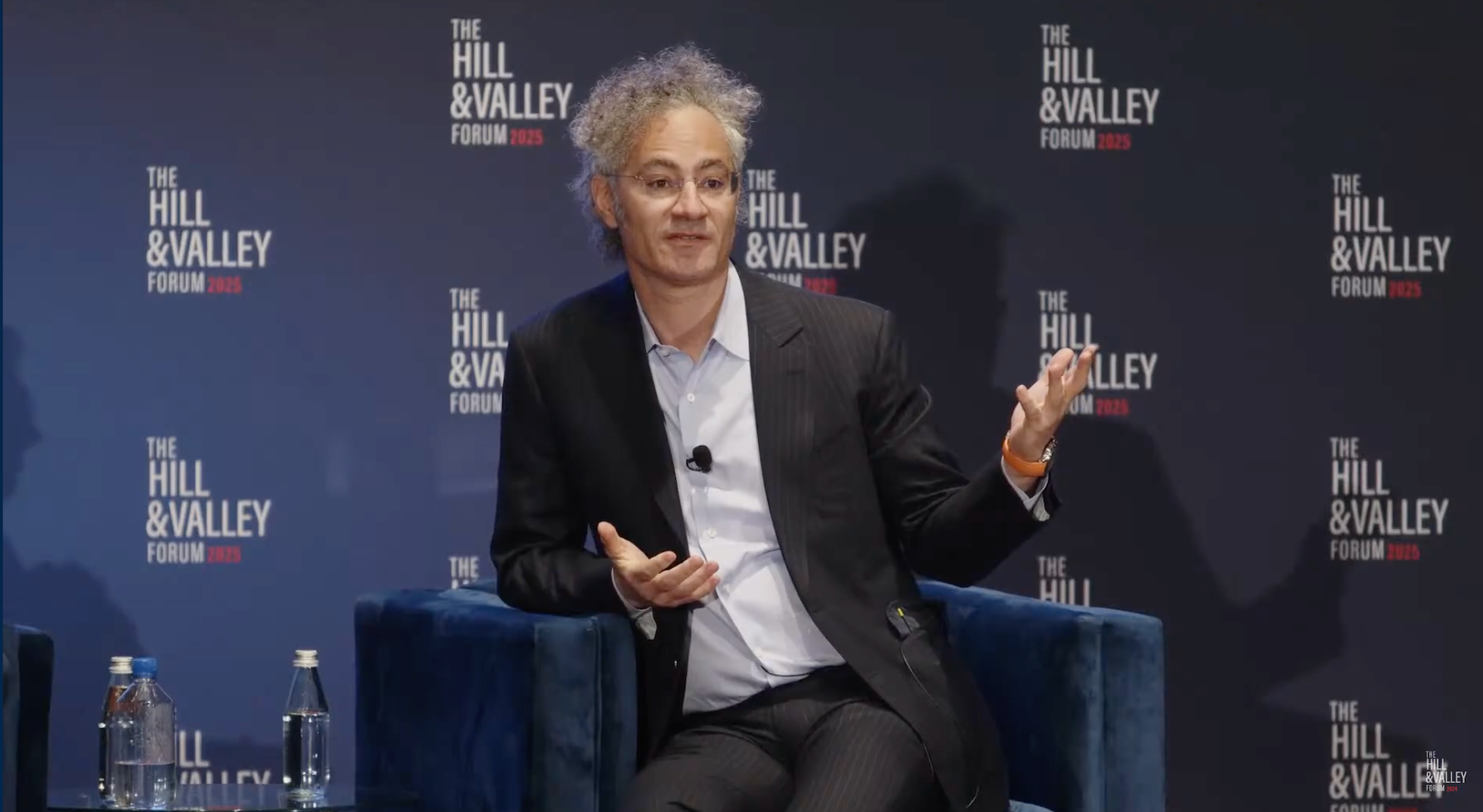
Palantir’s full-throated support of Israel has not been without controversy. Palantir CEO Alex Karp was among one of the speakers at the Hill and Valley Forum, but his panel was quickly interrupted by two protestors.
“Your AI technology for Palantir kills Palestinians.” shouted the first protestor from the Capitol Auditorium balcony.
“Mostly terrorists, that’s true,” Karp replied.
“You say mostly, so it’s okay to kill other innocent civilians?” The protestor quipped back, before security escorted her out.
Karp ended his remarks by noting that Silicon Valley firms are no longer the underdogs they used to be. “You're still shooting uphill, but shooting uphill and shooting to Mount Everest while they're dropping grenades on you is a different story,” he said.
As of this writing, the military software company currently has a market capitalization equal to Lockheed Martin and RTX combined. Firms like Palantir and Anduril still have some way to go in competing for top defense contracts, but, backed by an army of K street lobbyists, they might find more and more offices rolling out the red carpet. Grenades will certainly continue to drop — but Palantir and Co. want to be the ones throwing them.
- 20 unhinged comments heard at an AI conference in DC ›
- Big tech isn't gonna solve our problems ›
- Silicon Valley USA: Are these 'patriots' mere harbingers of doom? ›
- In Silicon Valley, Hegseth is just one link in the brave new kill chain | Responsible Statecraft ›
- As Iran war rages, defense techies still prefer talking about China | Responsible Statecraft ›
- Congress told AI is already killing people ›