
Follow us on social

google cta
Army training

New US Army force deployed to Philippines

This signals an expanding American footprint and risk of being pulled into tensions with China

Reporting | QiOSK
google cta
google cta

The U.S. Army has quietly sent a rotational force to the Philippines — a move experts tell RS signals greater U.S. military involvement in the region, amid growing tensions over the island of Taiwan.

“From the Chinese perspective…the United States is sending Army forces now to a country that's in very close proximity, to an area of obvious concern,” Dan Grazier, director of the National Security Reform Program at the Stimson Center, told RS. “We're used to seeing Naval forces, and Marine forces and [the] Air Force in that part of the world. But now we're sending the United States Army to the Philippines…really close to Taiwan, which obviously [is of] interest for the Chinese."

Led by a Lieutenant Colonel, the new rotational force is “not a major commitment” in terms of personnel, Grazier said. But, he said, “sending the Army… does show an increased level of commitment” to the region overall.

As Sarang Shidore, director of the Global South Program at the Quincy Institute tells RS, the Army Rotational Force-Philipines is “a step up as a part of a broader trendline since 2023 of an expanding U.S. military footprint in the Philippines.”

“Washington expanded U.S. military sites five to nine in April that year, and new, longer-range weapons systems have since been deployed to the country,” Shidore said.

As Shidore told RS, these ongoing U.S. military expansions into the region, which have included military exercises and missile deployments there, could pull the U.S. further into ongoing tensions there — perhaps especially over Taiwan, but also over those existing between China and the Philippines.

“Most of the U.S. expansion [as of late] seems directed toward the Taiwan contingency rather than the South China Sea flashpoint, pulling the U.S.-Philippine alliance deeper into the East Asian theater, which also includes Japan,” Shidore said. “The enhanced U.S. presence also increases the chances of the U.S. ending up as a frontline actor (rather than playing a supporting role from the rear) in China-Philippines maritime tensions, which have been on a boil for more than two years.”

The new rotational force follows other, albeit more limited or more temporary, Army appearances in the Philippines. DoD Secretary Pete Hegseth previously announced the formation of a joint task force — U.S. Task Force: Philippines — in October last year: that force consists of about 60 personnel from the Navy, Marines, and Army, but does not have any equipment or military warships, vehicles or aircraft assigned to it.

Army soldiers were also sent to the Philippines for temporary military exercises over the summer.


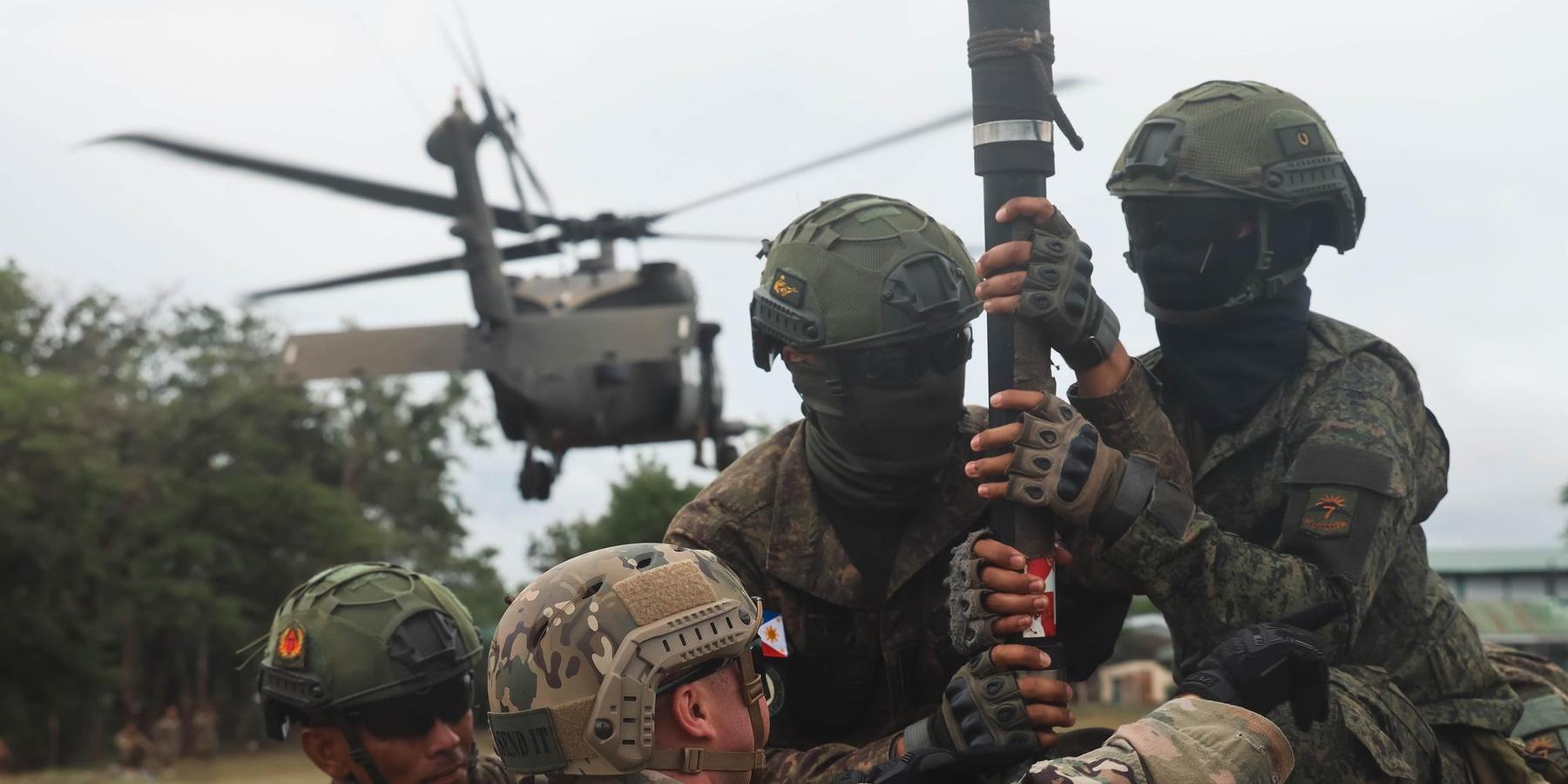
Top Image Credit: Soldiers with the Philippine Army 5th, 7th Infantry Division and U.S. Army with the Division Sustainment Brigade, 25th Infantry Division conducted combined Sling Load Tactical Operations training during Salaknib 2025 at Fort Magsaysay, Philippines
google cta
Reporting | QiOSK
G7 Summit
Top photo credit: May 21, 2023, Hiroshima, Hiroshima, Japan: (From R to L) Comoros' President Azali Assoumani, World Trade Organization (WTO) Director-General Ngozi Okonjo-Iweala, Australia's Prime Minister Anthony Albanese and India's Prime Minister Narendra Modi at the G7 summit in Hiroshima, Japan. (Credit Image: © POOL via ZUMA Press Wire)

Middle Powers are setting the table so they won't be 'on the menu'

Asia-Pacific

The global order was already fragmenting before Donald Trump returned to the White House. But the upended “rules” of global economic and foreign policies have now reached a point of no return.

What has changed is not direction, but speed. Canadian Prime Minister Mark Carney’s remarks in Davos last month — “Middle powers must act together, because if we’re not at the table, we’re on the menu” — captured the consequences of not acting quickly. And Carney is not alone in those fears.

keep readingShow less
Vice President JD Vance Azerbaijan Armenia
U.S. Vice President JD Vance gets out of a car before boarding Air Force Two upon departure for Azerbaijan, at Zvartnots International Airport in Yerevan, Armenia, February 10, 2026. REUTERS/Kevin Lamarque/Pool

VP Vance’s timely TRIPP to the South Caucasus

Washington Politics

Vice President JD Vance’s regional tour to Armenia and Azerbaijan this week — the highest level visit by an American official to the South Caucasus since Vice President Joe Biden went to Georgia in 2009 — demonstrates that Washington is not ignoring Yerevan and Baku and is taking an active role in their normalization process.

Vance’s stop in Armenia included an announcement that Yerevan has procured $11 million in U.S. defense systems — a first — in particular Shield AI’s V-BAT, an ISR unmanned aircraft system. It was also announced that the second stage of a groundbreaking AI supercomputer project led by Firebird, a U.S.-based AI cloud and infrastructure company, would commence after having secured American licensing for the sale and delivery of an additional 41,000 NVIDIA GB300 graphics processing units.

keep readingShow less
United Nations
Monitors at the United Nations General Assembly hall display the results of a vote on a resolution condemning the annexation of parts of Ukraine by Russia, amid Russia's invasion of Ukraine, at the United Nations Headquarters in New York City, New York, U.S., October 12, 2022. REUTERS/David 'Dee' Delgado||

We're burying the rules based order. But what's next?

Global Crises

In a Davos speech widely praised for its intellectual rigor and willingness to confront established truths, Canadian Prime Minister Mark Carney finally laid the fiction of the “rules-based international order” to rest.

The “rules-based order” — or RBIO — was never a neutral description of the post-World War II system of international law and multilateral institutions. Rather, it was a discourse born out of insecurity over the West’s decline and unwillingness to share power. Aimed at preserving the power structures of the past by shaping the norms and standards of the future, the RBIO was invariably something that needed to be “defended” against those who were accused of opposing it, rather than an inclusive system that governed relations between all states.

keep readingShow less
google cta
Want more of our stories on Google?
Click here to make us a Preferred Source.

LATEST

QIOSK

Newsletter

Subscribe now to our weekly round-up and don't miss a beat with your favorite RS contributors and reporters, as well as staff analysis, opinion, and news promoting a positive, non-partisan vision of U.S. foreign policy.