

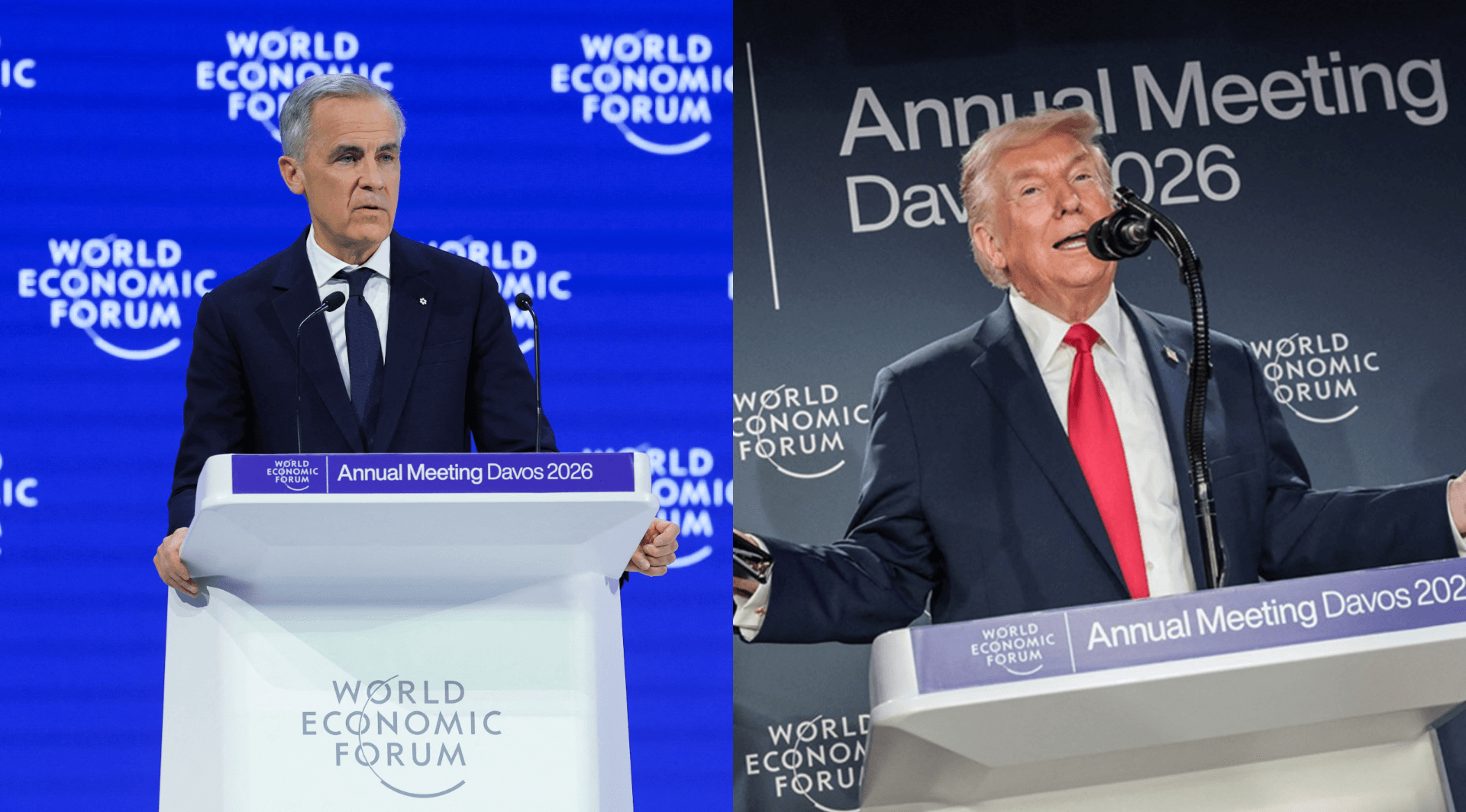
Two speeches dominated Davos this year. The first came from Canadian Prime Minister Mark Carney, who delivered a eulogy of the so-called rules-based international order (RBIO) led by the United States. Invoking Czech dissident Václav Havel’s concept of “living within a lie,” Carney referenced Havel’s parable of a greengrocer who upholds the lie of communism by placing a political slogan in his shop window each morning. If he were to remove it, the lie would begin to crumble. In Carney’s telling, today’s middle powers face a similar choice to stop pretending the world is operating under business as usual.
According to Carney, for years Western governments have avoided confronting the growing gap between the rhetoric and reality of the RBIO. Weak states were punished, while powerful ones enjoyed impunity. Unlike Havel’s greengrocer, however, the Global North had real agency in sustaining this charade and did so because it was materially beneficial. The arrangement was held together through economic integration. But, as economic coercion is increasingly wielded against Washington’s own allies, that glue is dissolving. Rather than defending the old order, Carney pronounced it obsolete, calling instead for shifting, issue-based coalitions and a more openly multipolar world. The speech enjoyed wide praise internationally and at Davos itself.
Enter Donald Trump.
President Trump delivered a rambling address that oscillated between self-congratulation, lightly veiled threats toward Canada, overtly racist remarks about Somalia, and repeated assertions that Europe still needs American power and protection. This last point may be the most relevant to Davos, which is itself a meeting of the powerful elite of the world. Trump’s performance underscored Carney’s critique more than it challenged it. And yet, the Davos scene itself looked familiar. CEOs arrived by private jet and helicopter. Climate panels ran alongside excess. Global South representatives pulled punches, eager to maintain their place at the table.
Despite Carney’s insistence that the world “shouldn’t mourn” the passing of the RBIO, his speech functioned as both a eulogy and a warning. Absent cooperation, states will retreat inward, building power alone. “A world of fortresses will be poorer, more fragile and less sustainable,” warned Carney. Trump, by contrast, embraced the fortress outright. His speech stripped away any remaining pretense that U.S. power is bound by rules rather than raw power.
Still, it is unclear what has changed. The United States and Denmark remain in negotiations over Greenland, now framed around sovereign U.S. basing rights rather than outright acquisition. Global economic integration has not collapsed. European leaders, despite their public unease, continue to signal a willingness to accommodate Washington. But something unprecedented did occur. For the first time, a prominent Western leader openly questioned the hypocrisy and, in some cases, the underlying fiction of the RBIO — all while speaking at the very forum that has long embodied both its lofty ideals and its deepest hypocrisies.
Critics rightly point out that numerous events, from the invasion of Iraq to the world’s complicity in the destruction of Gaza, should have moved world leaders to publicly doubt the RBIO. But international law and norms were always secondary to stability and economic growth for the Global North. This is why the fight over Greenland and the threat of tariffs against European allies is what finally triggered world leaders to question it. Whether that questioning leads to long-term changes in the world order remains to be seen.
- A farewell to Oz: Trump’s strategy for a multipolar world ›
- Trump: We got a $1.5 trillion military budget. He’s (kinda) right. ›
- Davos fracas hints at how Europe could fight economic warfare too | Responsible Statecraft ›
- Canada is not interested in White House boot licking. So what? | Responsible Statecraft ›
- We're burying the rules based order. But what's next? | Responsible Statecraft ›
- Middle Powers are setting the table so they won't be 'on the menu' | Responsible Statecraft ›