

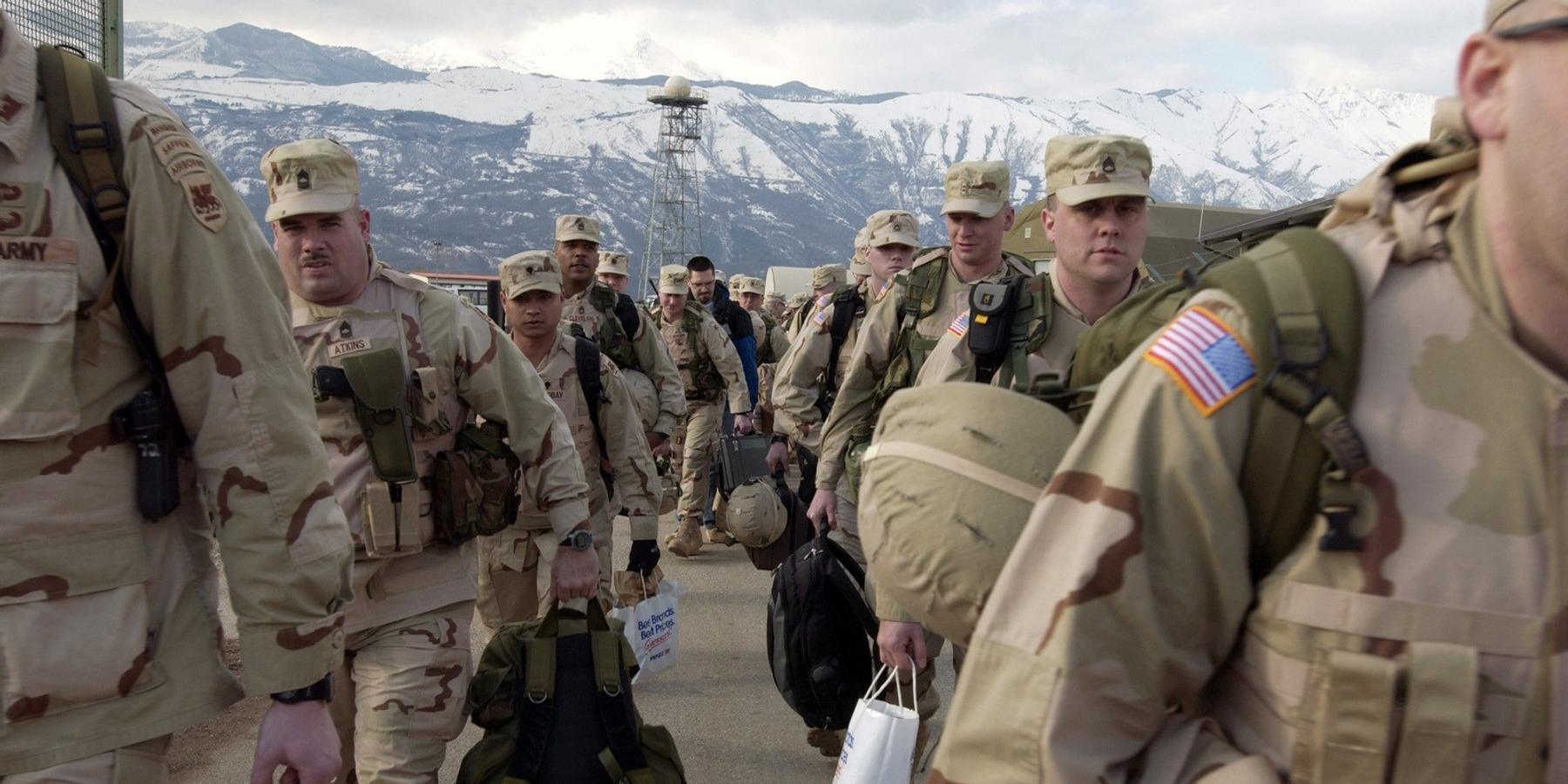
“One should never assert a power that he cannot exert,” said British statesman and wordsmith Winston Churchill. My hometown football coach expressed a similar thought: “The man with an alligator mouth and a hummingbird ass” would get more than his share of whippings.
The U.S. military today has a hummingbird’s ass. Despite decades of sky-high military spending, our force is incapable of defeating a peer or near-peer adversary in today’s complex, dangerous world. If we continue on our alligator-mouth-sized trajectory, the consequences will be catastrophic.
The gap is apparent in three critical requirements to win a war: manpower, material, and money. We cannot generate sufficient forces or replace material losses at scale, and we are $38 trillion in debt, with $1 trillion annual budget deficits projected ad infinitum.
Manpower
Until 1973, the U.S. military met its personnel needs through a mix of volunteers and conscription in both war and peacetime. The move to an All Volunteer Force (AVF) resulted from the most unpopular and unfair draft in American history – the Vietnam War. The AVF was a political solution, not a strategic one.
Over the last five decades, the AVF has seen success and failure tied to economic conditions and perceived risk. It benefited greatly from the fall of the Soviet Union, allowing active forces to shrink from 2.3 million to 1.3 million, and women’s participation, which rose from a 2% legal cap in the early 1970s 24 to 17.7% across the active duty and reserves as of 2023 according to the Department of Defense.
The AVF was decisively tested in 2003. It failed. The wars in Iraq and Afghanistan demanded more manpower than the AVF could provide, despite lowered enlistment standards — no longer requiring a high school diploma or GED, lowering aptitude test requirements, waivers for mental health and criminal record — and unprecedented enlistment bonuses that disproportionately attracted working class and middle class Americans.
Rather than exercising its constitutional authority to compel service, the government relied on repeated deployments of active and reserve forces. The result: tens of thousands of service members and families broken by suicide, PTSD, traumatic brain injury, amputations, substance abuse, and more than 7,000 combat deaths.
This abuse of the force makes it unlikely that wartime manpower needs could be met through volunteers. Young Americans’ propensity to serve fell from 15% percent to 9%t; the portion eligible dropped from 30%to 2%; and the U.S. birth rate has dropped to a new low of 1.6 babies per woman. Fewer citizens, from a smaller pool, are willing or able to serve.
The top reasons Americans give for not enlisting: fear of death, fear of serious injury, and leaving home. Americans struggling to afford daily life are not studying maps of distant places for future wars, or dreaming of battlefield glory.
The alternative is reinstating the draft, but the likelihood of success is low, raising a dangerous question: What if we had a war and no one showed up?
Material
In the 1990s, the U.S. government consolidated its military-industrial base, believing a smaller number of suppliers could be more efficient and responsive. By decade’s end, 107 firms became 5: Boeing, Lockheed Martin, RTX, General Dynamics, and Northrop Grumman.
These five survivors are enormously profitable, wielding unprecedented power with Congress and the Pentagon and fulfilling the warning by President Eisenhower of a dangerous Military-Industrial complex.
This consolidation made us vulnerable. As the 2025 National Security Strategy acknowledges, America lacks the industrial capacity to produce modern systems and munitions at scale and must rapidly adapt to low-cost, high-volume warfare.
Ukraine is a devastating example of our material shortcomings. The U.S. has transferred more than 3 million 155mm artillery rounds – 1250% of current annual production. Rebuilding that inventory will take two years.
Replacing sophisticated weapons systems is more difficult. Restoring stocks of the Javelin antitank missile would take five and a half to eight years to replenish; the HIMARS guided rocket, two to three years, and the Stinger anti-aircraft missile, six to 18 years.
The Navy now operates only four shipyards, ensuring sunk warships will take years to replace. The Air Force faces similar challenges. Further complicating this problem for both branches is their lack of access to the rare-earth materials required for sophisticated weapons systems. Manpower remains a parallel crisis. The Navy is short 14,000 enlisted sailors; the Air Force 1,800 pilots, including 1,100 combat pilots.
Forming a capable factory workforce is another hurdle. In a 2025 survey, 80% of Americans said the country would be better off if more people worked in factories, yet 73% said they personally would not be better off doing so.
No amount of optimism can overcome these facts.
Money
Wars throughout history have always been expensive, often crippling or destroying great nations.
Today, the U.S. is $38 trillion in debt, with trillion-dollar annual budget shortfalls projected for the future. Interest payments alone approach $1 trillion annually.
The Pentagon is a major contributor to this debt, officially consuming nearly $1 trillion annually while failing eight consecutive financial audits. Other budget areas contributing to the real cost of “defense” — the Department of Veterans Affairs, the nuclear budget, and the Department of Homeland Security — drive costs to $1.5 trillion per year. Our defense budget eclipses the next eight nations combined.
There’s little to show for it. Since World War II, the U.S. has won one war, tied another, and lost three: a win in the 1990-91 Gulf War, a tie in Korea, and losses in Vietnam, Iraq, and Afghanistan. Our National Security Strategy is based on insanity – doing things the same way but expecting different results.
Seeking Truth
“War is hell,” said General Sherman during the Civil War. For many Americans, war remains abstract since it’s not come home since then. For those in Gaza, Kyiv, or Tehran, war is hell.
Wishful thinking won’t stop new technologies from bringing war to our shores. Truth and security can be sought via the following method.
Any time Congress considers committing U.S. forces to armed conflict, it must answer the following questions, drawn from the Powell doctrine, in an open forum so that Americans know what’s being done in their name.
1. Is a vital national security interest threatened?
2. Do we have a clear, obtainable objective?
3. Have the risks and costs been fully and frankly analyzed?
4. Have all other non-violent policy means been fully exhausted?
5. Is there a plausible exit strategy to avoid endless entanglements?
6. Have the consequences of our actions been fully considered?
7. Is the action supported by the American people?
8. Do we have genuine, broad international support?
I would add two more:
9. How many U.S. troops will die, and from what socio-economic quintile(s) will they come?
10. Will Congress impose an up-front war tax to pay for the conflict without adding to the national debt?
Had we followed this guide, would we have invaded Iraq or stayed in Afghanistan? Would we have taken “ownership” of Venezuela, or considered military action against Greenland, Canada, or Iran? Likely not.
Should America continue to bully weaker nations, more powerful nations could intervene, risking a war that could end this 250‑year democratic experiment, or worse for civilization, trigger nuclear armageddon.
Winston Churchill said, giving credit to Shakespeare, “Cry havoc...and let slip the dogs of war.” Or, as my football coach would say, “When shit hits the fan, no one’s in control.”
It’s time to face facts: we’re sleepwalking into fights we cannot win.
- Yes, US generals should be fired ›
- Getting the defense budget right: A (real) grand total, over $1.4 trillion ›
- To end Myanmar's brutal civil war, the US will need China's help | Responsible Statecraft ›