The Bunker appears originally at the Project on Government Oversight and is republished here with permission.
When it comes from the Trump White House
Stop reading now if you don’t like math.
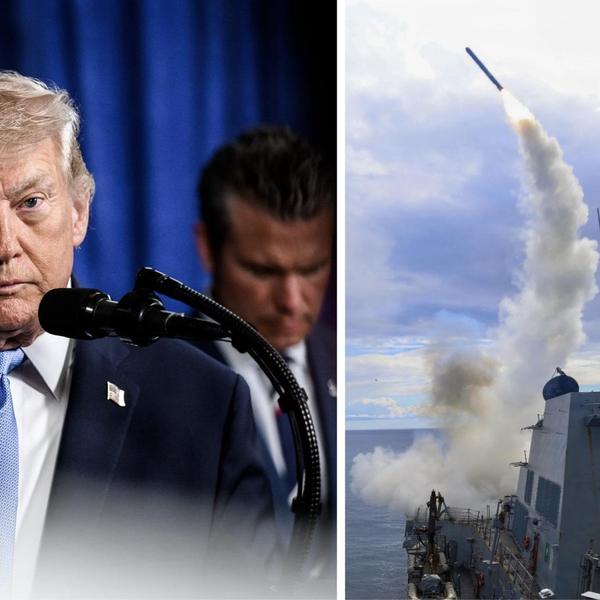
There were plenty of headlines over the weekend about how President Donald Trump delivered on his pledge to try to boost U.S. defense spending to $1 trillion (PDF) in 2026. But — surprise! — he did it with smoky mirrors and sketchy math. In reality, Trump is seeking “only” $893 billion for the Pentagon next year. But, like a carnival huckster with a good SAT math score, the administration added $113 billion contained in a separate, one-time Republican congressional reconciliation bill. That pushes the total sought to, um, $1.01 trillion. Coincidence, or sideshow sales job? You decide!
That bit of May 2 legislative legerdemain is why Republican anger over the trillion dollars topped muted Democratic opposition to the historically high budget proposal. The Trump administration “is not requesting a trillion-dollar budget,” griped Senator Roger Wicker (R-MS), who chairs the armed services committee. Senator Mitch McConnell, (R-KY), who chairs the appropriations committee’s defense subcommittee, agreed. Such “accounting gimmicks” will leave the U.S. military impoverished, he said, unable to counter “China, Russia, Iran, North Korea, and radical terrorists.”
Both senators accused Trump of the worst possible sin: coming up with a military budget not much different from Joe Biden’s. Given a supine Congress and the ridiculous caterwauling calls that the nation is starving its armed forces, the view from here is that lawmakers will approve Trump’s request. Then they’ll ladle on some extra lard for good measure. Trump’s top defense priorities include his Golden Dome missile shield (and no, that Madison Avenue moniker officially doesn’t refer to the presidential pate), nuclear weapons, and ship-building.
Mind you, national security has been costing the country well north of a mind-blowing $1 trillion annually recently, assuming a full and complete accounting (something else that’s stealthy at the Pentagon, which has never passed an audit). For example, the Department of Veterans Affairs — which, for some strange reason, isn’t part of the U.S. military budget — now spends $350 billion a year.
Three days before Trump’s announcement, the Government Accountability Office reported that the Pentagon itself acknowledged it found “confirmed fraud” totaled $10.8 billion between 2017 and 2024. “The full extent of fraud affecting DOD is not known,” the GAO said, “but is potentially significant.”
But not to worry. When you’re spending a trillion dollars a year, no matter where it comes from, you don’t have to fret much about waste.
Projected cost of U.S. nuclear forces skyrocket
The U.S. government plans to spend $946 billion through 2034 to buy and operate the nation’s nuclear weapons. That’s a 25% hike over 2023’s estimated cost for the decade ending in 2032, the Congressional Budget Office reported April 24. And that 2023 cost of $756 billion was $122 billion more (19%) than the 2021 projection. Let’s call it ICBMnflation.
The latest estimate includes $357 billion to operate the nukes we’ve got, and $309 billion to buy new ones and the platforms — largely subs, bombers and missiles — to deliver them. That doesn’t include all of the stunning 81% cost growth associated with the troubled Sentinel ICBM program now under development (and it’s getting worse). CBO estimates the U.S. will also spend $79 billion improving command and control of its nuclear forces over the coming decade, and $72 billion for upgrades to its nuclear-weapon labs.
CBO also is padding the cost estimates of the Pentagon and Department of Energy (which builds the nation’s nuclear weapons) by $129 billion. “That amount represents CBO’s estimate of additional costs that would be incurred over the 2025–2034 period if the costs for nuclear programs grew at roughly the same rates that costs for similar programs have grown in the past,” the CBO report said (taxpayers might ask why the Defense Department doesn’t do that on its own).
This insane spending on weapons that no sane person wants fired is taking place as the U.S., China, and Russia are engaged in a stubborn showdown over the size and shape of their nuclear arsenals. “There’s no reason for us to be building brand-new nuclear weapons,” Trump said in February. “You could destroy the world 50 times over, 100 times over. And here we are building new nuclear weapons, and they’re building nuclear weapons.”
Stop dilly-dallying and start doing, Mr. President, before it’s too late.
The Army gets its latest marching orders
Defense Secretary Pete Hegseth lobbed a 4-page memo (PDF) into Army HQs April 30 designed to obliterate inefficiency and maximize killing. “To build a leaner, more lethal force, the Army must transform at an accelerated pace by divesting outdated, redundant, and inefficient programs,” he ordered, “as well as restructuring headquarters and acquisition systems.”
Good luck with that, SECDEF!
The Bunker’s all for a better, cheaper Army, but the memo is simply a wish list handed down from the E-ring. Like so much Pentagon-brass boilerplate, there’s no roadmap showing how to get it done. Hegseth’s mandate to fold Army Futures Command into the service’s Training and Doctrine Command isn’t sufficient, R. D. Hooker, Jr., a retired Army colonel now at Harvard, told Defense One. “This is probably a move in the right direction, but much more detail is needed to fully assess,” he said, adding: “Overhauling the entire acquisition process is the more fundamental need.”
That’s for sure. After all, it was only seven years ago — during Trump’s first term — that Army Futures Command was created as the key to the Army’s, well, future. “Our Futures Command will have a singular focus: to make Soldiers and leaders more effective and more lethal today and in the future,” General John M. Murray, first head of Futures Command said as the new outfit stood up in 2018.
Here's what has caught The Bunker's eye recently
→ One purge here, one purge there…
As the Trump administration continues to cashier and otherwise thin the ranks of its senior military officers, the Xi administration is doing the same in China, and risking their trust, Phillip C. Saunders and Joel Wuthnow of the Pentagon’s National Defense University wrote May 5 in the New York Times.
President George H.W. Bush said the U.S. had “kicked the Vietnam syndrome once and for all” after the 1991 Persian Gulf War. But Casey Chalk argued in The Federalist April 30 that the nation actually continues to suffer from a Vietnam hangover 50 years after the war in Southeast Asia wrapped up.
→ Finally, even more trillions!
Global military spending hit $2.7 trillion in 2024, a 9.4% hike and the steepest since 1988, the Stockholm International Peace Research Institute said April 28, in its annual accounting on the financial costs of waging and readying for war.
A trillion thanks for stopping by The Bunker this week. Consider forwarding this on to curious citizens so they can subscribe here.