
Follow us on social

google cta
Pete Hegseth

Hegseth: 'Defense' is out, 'killing people and breaking things' is in

Reporting | QiOSK
google cta
google cta

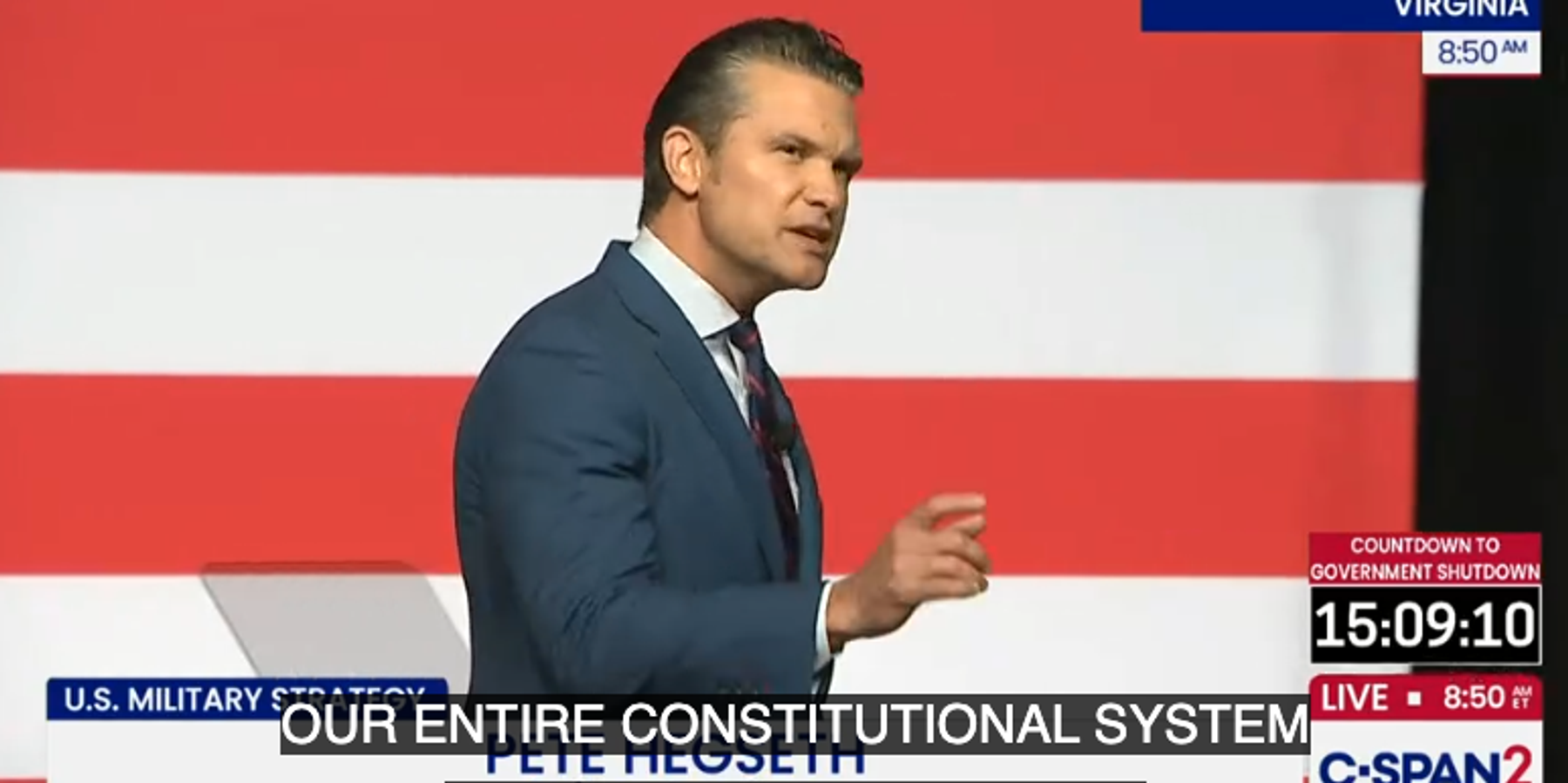
There were no "firings" or "loyalty oaths" but what Secretary of Defense (War) Pete Hegseth called a "liberation" for "America's warriors" as he spoke to more than 800 generals and admirals brought in for a mandatory meeting in Virginia this morning.

"A few months ago, I was at the White House when President Trump announced his liberation day for America's trade policy. It was a landmark day, while today is another Liberation Day, the liberation of America's warriors in name, in deed and in authorities," Hegseth told his audience against the backdrop of a huge American flag.

After a long lead up about how the Trump administration was stripping from the military all elements of diversity, equity & inclusion (DEI) programs and re-focusing the institution on "the M" (the military) — "we have entire departments across the government dedicated to diplomatic, informational and informational and economic lines of effort. We do the M nobody else does, and (we) need to master it in every domain and every scenario. No more distractions, no more political ideologies, no more debris — Hegseth explained what being a "warrior" for the United States really means." Apparently, it is no longer "national defense."

"We are preparing every day. We have to be prepared for war, not for defense. We're training warriors, not defenders. We fight wars to win, not to defend. Defense is something you do all the time. It's inherently reactionary, and can lead to overuse, overreach and mission creep. War is something you do sparingly, on our own terms and with clear aims. We fight to win. We unleash overwhelming and punishing violence on the enemy."

To this end, the warrior is also "reactionary" in which someone (in the Pentagon? In the rest of the government?) tells them who the enemy is and then they unleash the pain.

"We also don't fight with stupid rules of engagement. We untie the hands of our war fighters to intimidate, demoralize, hunt and kill the enemies of our country. No more politically correct and overbearing rules of engagement, just common sense, maximum lethality and authority for war fighters," he said. "It's very simple yet incredibly powerful."

Hegseth told this audience of top brass that if his words made their hearts sink, they should do the right thing and resign. If it makes their hearts soar, then "you are hereby liberated to be an apolitical, hard charging, no nonsense, constitutional leader that you joined the military to be."

Afterwards, Trump signed an executive order declaring the "Department of War" name change and is expected to address the convocation in Virginia shortly.


Top photo credit: CSPAN screen grab
google cta
Reporting | QiOSK
Trump's war is a gift to Iran’s hardliners
REUTERS/Imran Ali

Shi'ite Muslims hold posters of Iran's new supreme leader, Mojtaba Khamenei, alongside late Iranian Supreme Leader Ayatollah Ali Khamenei, as they take part in the religious procession marking the death anniversary of Imam Ali, son-in-law of Prophet Muhammad, during the fasting month of Ramadan, in Karachi, Pakistan, March 11, 2026.

Trump's war is a gift to Iran’s hardliners

Middle East

When the United States and Israel launched strikes on Iran on February 28 — an escalation that has already brought new suffering and uncertainty to millions of ordinary Iranians — the central debate quickly turned to whether the Islamic Republic might collapse. Some analysts argued that decapitating Iran’s leadership could produce rapid regime change, perhaps resembling the leadership removal in Venezuela earlier this year. Others warned that Iran’s political system was far more resilient.

Yet the more important point may lie elsewhere. Given the Islamic Republic’s internal dynamics, war could produce the opposite of what many expect. Rather than weakening the regime, the war may strengthen its most committed supporters — the ideological networks often labeled “hardliners” in Western media — while marginalizing the broader political middle, inside and outside the system, that favors non-violent and gradual change.

keep readingShow less
As Iran war rages, Washington opens a new front in Ecuador
Top image credit: Ecuadoran security forces patrol the streets of Manta, Ecuador. (IMAGO/Agencia Prensa-Independiente via Reuters Connect)

As Iran war rages, Washington opens a new front in Ecuador

Latin America

As the world’s attention is focused on the U.S. and Israeli war on Iran, the United States has, with little fanfare, opened another front in its expanding campaign against so-called “narco-terrorism” in the Western Hemisphere.

Since this new "war on drugs" began last year, U.S. military strikes on alleged drug-smuggling boats, as well as a direct military intervention in Venezuela, have claimed the lives of more than 250 people. Now, Ecuador, a country on the northwestern edge of South America, has become the latest site of Washington’s reinvigorated “war on drugs.” This escalation risks making the United States complicit in the human rights abuses of a government that is steadily dismantling its own country’s democracy, including by suspending the nation’s largest opposition party.

keep readingShow less
Israel’s push for Somaliland base raises fears of wider war
Top image credit: Israeli Foreign Minister Gideon Saar and Somaliland President Abdirahman Mohamed Abdullahi participate in a joint press conference during Saar's visit to Somaliland on January 6, 2026. (Screengrab via X)

Israel’s push for Somaliland base raises fears of wider war

QiOSK

Bloomberg reported Wednesday that Israel is in talks with Somaliland officials to form a strategic security partnership, which might include granting Israel access to a military base or other security installation along the Somaliland coast from which it can launch attacks against Yemen’s Houthi rebels.

With war raging in the Middle East, the Horn of Africa is a particularly important geoeconomic and geopolitical puzzle piece. Its location near the Bab el-Mandeb strait, which connects ships traveling through the Red Sea with the Gulf of Aden and the Indian Ocean, makes it a strategic location from the perspective of global shipping, 10% to 12% of which travels through the strait annually.

keep readingShow less
google cta
Want more of our stories on Google?
Click here to make us a Preferred Source.

LATEST

QIOSK

Newsletter

Subscribe now to our weekly round-up and don't miss a beat with your favorite RS contributors and reporters, as well as staff analysis, opinion, and news promoting a positive, non-partisan vision of U.S. foreign policy.