

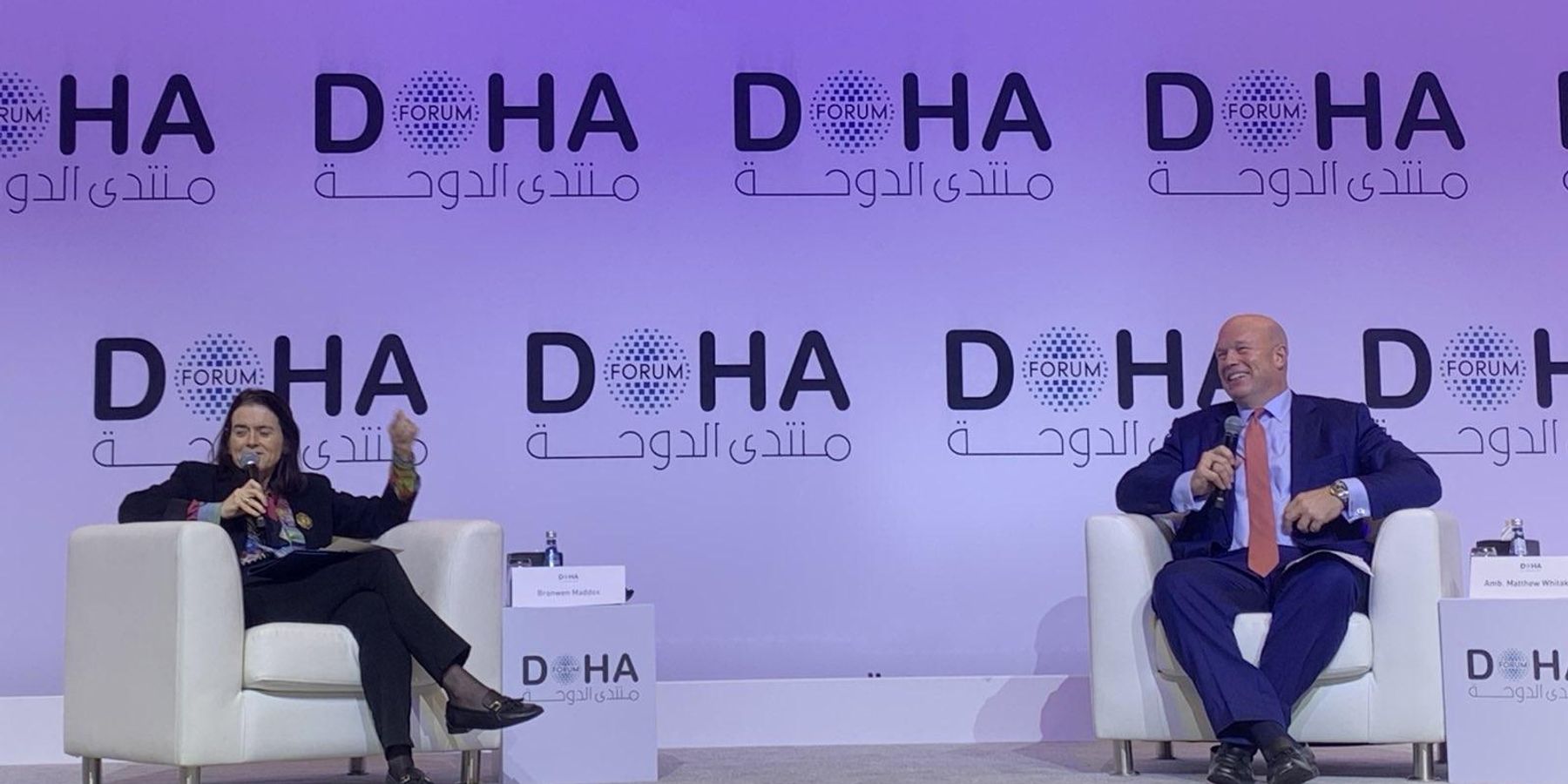
Europeans at the Doha Forum in Qatar were quite clear in their disdain for President Donald Trump's National Security Strategy and his peace plan for Ukraine, but his ambassador to NATO Matthew Whitaker came out swinging in favor of both, unabashedly telling an audience Saturday that U.S. partners need to step up if they want continued support from Washington and not to criticize the sausage (peace deal) while it's being made.
“There is a recognition (in the NSS) that the U.S. cannot be the world police, we can’t be this rapid deployment force to go everywhere for everyone,” Whitaker said when asked about the release of the much-anticipated document, which is essentially a guide to Trump’s posture and goals for U.S. foreign policy across the globe over the course of his second term. In it, Whitaker shared, the U.S. is “refocusing on our priorities.”
That, too, apparently means an expectation that Middle East allies will be spending more — 5% — on their defense too, he added.
The NSS document is heavy in its attention on the Western Hemisphere, which was expected as Trump and his team have said often enough that they want an updated Monroe Doctrine (with a “Trump corollary”) to bring foreign policy and national security back to our own “backyard,” including meeting threats to the “homeland.” The document urges accelerated U.S. economic expansion, which means thwarting rivals (China, without mentioning China) and working alongside “established friends” in Latin America, repositioning U.S. military to meet “urgent threats” including mass migration and drug trafficking.
On Europe the document is big on self-sufficiency:
The days of the United States propping up the entire world order like Atlas are over. We count among our many allies and partners dozens of wealthy, sophisticated nations that must assume primary responsibility for their regions and contribute far more to our collective defense.
The NSS also takes aim at what the administration calls the undemocratic behavior of the EU as well as its inability to handle its own migration problems:
The larger issues facing Europe include activities of the European Union and other transnational bodies that undermine political liberty and sovereignty, migration policies that are transforming the continent and creating strife, censorship of free speech and suppression of political opposition, cratering birthrates, and loss of national identities and self-confidence.
The buzz about these aspects of the NSS at the Doha Forum, on stage in panels and among participants in the hallways teeming with international guests, was undeniably negative. Whitaker was asked about the administration’s apparent hypocrisy on free speech (one moderator asked what kind of “free speech” was advocating for ABC to lose its broadcasting license). They asked if Trump was cutting Ukraine loose, and whether he thought Europe and Ukraine could fight another Russian invasion of Ukraine without the U.S.
“The likelihood is low (that Russia will start a war with NATO countries),” Whitaker said to this question, “but Russia is very reckless and you can’t predict what they will do.” He said with NATO partners stepping up alongside the U.S., “(we) make sure we don’t demonstrate an inch of weakness … (we’re) a dramatic force to be reckoned with.” He also noted that their "Article 5 commitment is iron clad."
Speakers representing places like Poland and the EU and Ukraine itself cast doubt on Washington’s ability to get a fair or “just” deal for Ukraine. Like Kaja Kallas, vice president of the European Commission, who told a panel Saturday morning that “we should not walk into the traps.” She said we need to get away from the point at which Russia is “just pretending to negotiate and to the point that they need to negotiate,” suggesting the West keep fueling the fight.
After a Polish questioner suggested that the deal was already skewed and that Europeans were not being brought fully into the process, Whitaker said that wasn’t true. The NSS itself says:
As a result of Russia’s war in Ukraine, European relations with Russia are now deeply attenuated, and many Europeans regard Russia as an existential threat. Managing European relations with Russia will require significant U.S. diplomatic engagement, both to reestablish conditions of strategic stability across the Eurasian landmass, and to mitigate the risk of conflict between Russia and European states.
It is a core interest of the United States to negotiate an expeditious cessation of hostilities in Ukraine, in order to stabilize European economies, prevent unintended escalation or expansion of the war, and reestablish strategic stability with Russia, as well as to enable the post-hostilities reconstruction of Ukraine to enable its survival as a viable state.
"Poland is a great friend to the United States,” Whitaker said to the questioner. “We are trying to end this war in Ukraine and you don’t go into the butcher stop while the sausage is being made and say you don’t like the look of the sausage.”
- Fantasy plan has NATO, US heavily involved in Ukraine peacekeeping ›
- Right now NATO could not win a war with Russia ›
- 'In Trump we trust': Arab states frustrated with stalled Gaza plan | Responsible Statecraft ›
- Trump's 'Monroe Doctrine 2.0' completely misreads Latin America | Responsible Statecraft ›
- Euro-elites melt down over NSS, missing — or ignoring — the point | Responsible Statecraft ›
- A Farewell to Oz: Trump’s Strategy for a Multipolar World | Responsible Statecraft ›