

Hamas and Israel are reportedly moving toward negotiating a "phase two" of the U.S.-lead ceasefire but it is clear that so many obstacles are in the way, particularly the news that Israel is already calling the "yellow line" used during the ceasefire to demarcate its remaining military occupation of the Gaza Strip the "new border."
“We have operational control over extensive parts of the Gaza Strip, and we will remain on those defence lines,” said Israeli military chief Lieutenant General Eyal Zamir on Sunday. “The yellow line is a new border line, serving as a forward defensive line for our communities and a line of operational activity.”
Israel also says it has no current plans to talk to Hamas directly. Prime Minister Benjamin Netanyahu said Sunday that he will begin stage two of the ceasefire by talking to U.S. President Donald Trump at the end of the month and the first order will be to ensure that Hamas fulfills its “commitment” to the plan, which calls for demilitarization of the enclave.
Hamas said it is willing to discuss the "freezing or storing or laying down" of its arms during the negotiations of the second phase, but said it will not before forced by an international stabilization force (ISF) to do so. Israel has said it will not withdraw until Hamas disarms. A debate is also roiling among outside powers about whether an ISF will go in before or after Hamas disarms, and whether that ISF will be responsible for disarmament. All of which creates a logjam and endless uncertainty while adequate aid is still not getting into the Gaza Strip and over 347 Palestinians have been killed by Israeli military since the ceasefire was signed in October.
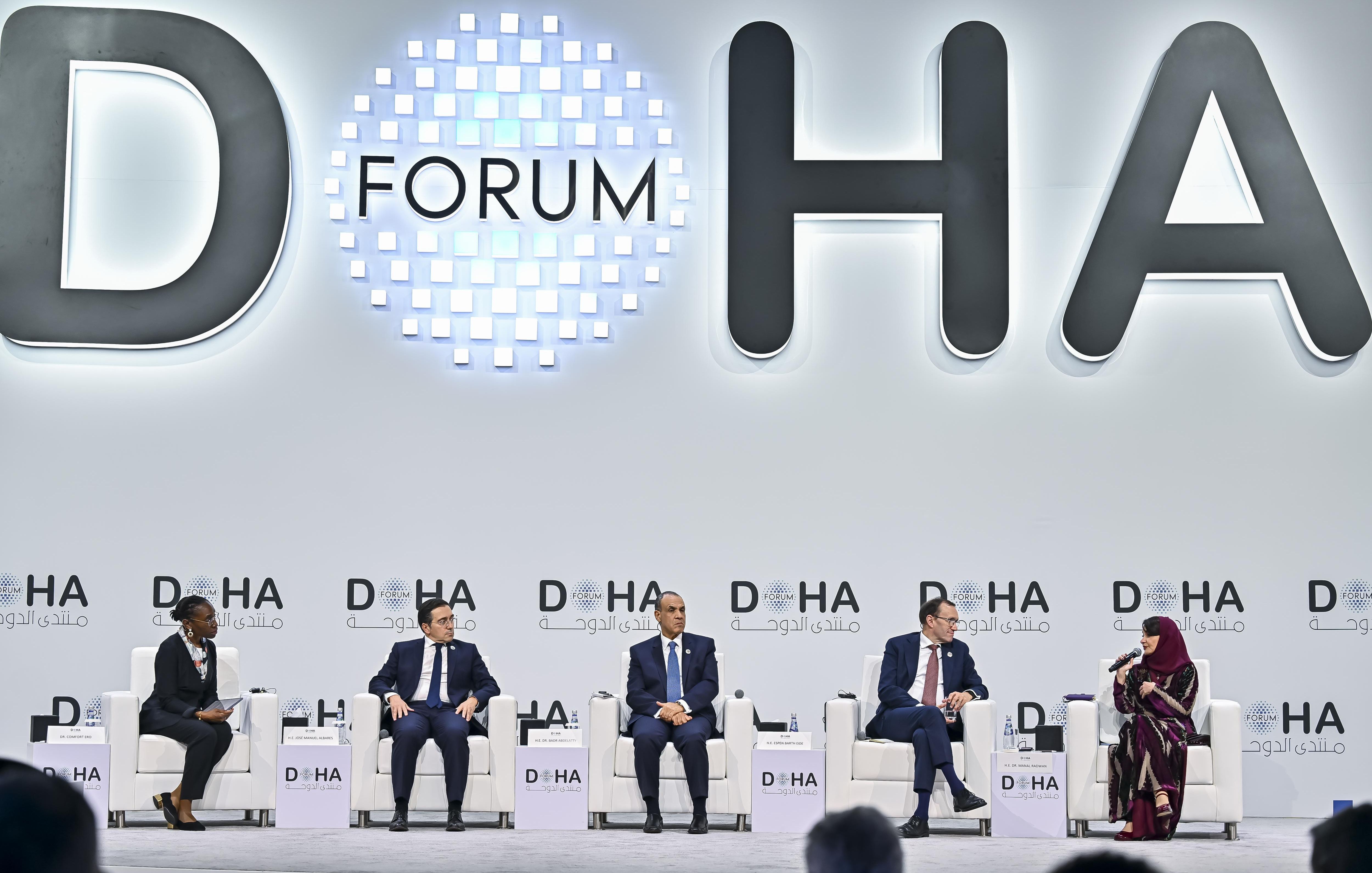
The situation was evoking a lot of debate, and no little pessimism at the Doha Forum in Qatar this weekend, an annual international convocation of an estimated 6,000 people, including state leaders, think tanks, NGOs, journalists, diplomats and academics. While most of the sessions were billed on other matters, Gaza was invoked in dozens of on-stage conversations and foreign ministers weighed in on what they largely see as a crisis in stasis. Some blamed Israel, others criticized "parties" without naming Israel or the U.S., others warned that as a regional community they were losing sight of the established goals.
“Now we are at the critical moment. … A ceasefire cannot be completed unless there is a full withdrawal of the Israeli forces (and) there is stability back in Gaza,” said Qatari premier and foreign minister Sheikh Mohammed bin Abdulrahman Al Thani, on Saturday.
Israel doesn't want Turkey involved in the ISF but according to its foreign minister at the Doha Forum, his country is ready to provide troops and is willing to help bring the ISF together and move quickly. “Disarmament cannot be the first stage in this process,” Hakan Fidan said. “We need to proceed in the correct order and remain realistic.” He added that the ISF’s first goal “should be to separate Palestinians from the Israelis.”
Egypt’s foreign minister, Badr Abdelatty, in his own remarks at the Forum, agreed. “We need to deploy this force as soon as possible on the ground because one side, Israel, every day is violating the ceasefire, but claims the other side is responsible so we need monitors along the yellow side in order to verify and monitor,” he said, adding that the mandate “should be peace monitoring not peace enforcement.”
The confusion over the specifics of the mission, how it should be configured, when it should be deployed, and who should be deployed is precisely why other countries are not as keen to move yet. Espen Barth Eide, Norway's foreign minister, summed it up. “The different parties can say ‘I will do my part but only when he has done its part,' so we need to get the board of peace and the ISF in place this month because it is very urgent."
But "thousands of details, questions are in place," Fidan added, acknowledging the challenges.
“We have seen this movie before,” said Manal Radwan, Minister Plenipotentiary at the Saudi Foreign Ministry, who spoke on Saturday, warning that the arguments over details were forcing partners to lose sight of the ultimate goals. “There is a war in Gaza, then there is an engagement by the international community, then there is a search for humanitarian assistance, and then political fatigue, and then we forget about it — only to see another more violent cycle of violence erupt.”
She was concerned that the issue of Palestinian statehood, which is in the framework of Trump's plan is getting sidetracked. “If we do not ensure the security and the political aspiration of Palestinians being fulfilled, then there is no plan in the world that will be able to drive us not only from one stage to the next, but also to prevent another spiral of violence,” she said.
While one observer, Ahmad Elterk, director of the London based Arab Lawyers group, told RS that he believed the Saudi minister's remarks were shared by leaders in other Arab states, and that "we cannot reach any proper agreement until we reach a final solution for the Palestinians, and to have a viable state for the Palestinians." Others said most Arab observers were waiting, ultimately, for what the Americans will do.
For their part, the few U.S. officials who did attend the Doha Forum did not come to talk about Gaza or Israel, so they lent little insight or nurtured much confidence. Tom Barrack, U.S. envoy to Turkey and Syria, made headlines when he said that in the Middle East, "we’ve never had a democracy — I don’t see a democracy anywhere — Israel can claim that it’s a democracy, but in this region, really what has worked the best, whether you like it or don’t like it, is a benevolent monarchy.” Matthew Whittaker, U.S. Ambassador to NATO, talked about what he was brought into to talk about, Europe and the Ukraine War.
On the sidelines, William Lawrence, who works at the National Council on U.S.-Arab Relations, sensed a bit of "schizophrenia" among the crowd, in which they were "hopeful" that the Trump administration would follow through on his peace plan, but pessimistic over what seemed to be unsurmountable obstacles, and even more so, that the administration didn't have the "political will" to put in the hard work that needed to be done.
"I don't see grounded optimism, I just see 'in Trump we trust,'" said Lawrence. "They are hopeful but they're not seeing the ingredients of something more, yet."
- NATO ambassador: don't hate on the sausage before it's made ›
- Tucker Carlson to Qatar premier: why did Israel bomb you? ›
- Congress, you have a chance to implement Trump Gaza plan right | Responsible Statecraft ›
- Phase farce: No way 'Board of Peace' replaces reality in Gaza | Responsible Statecraft ›