

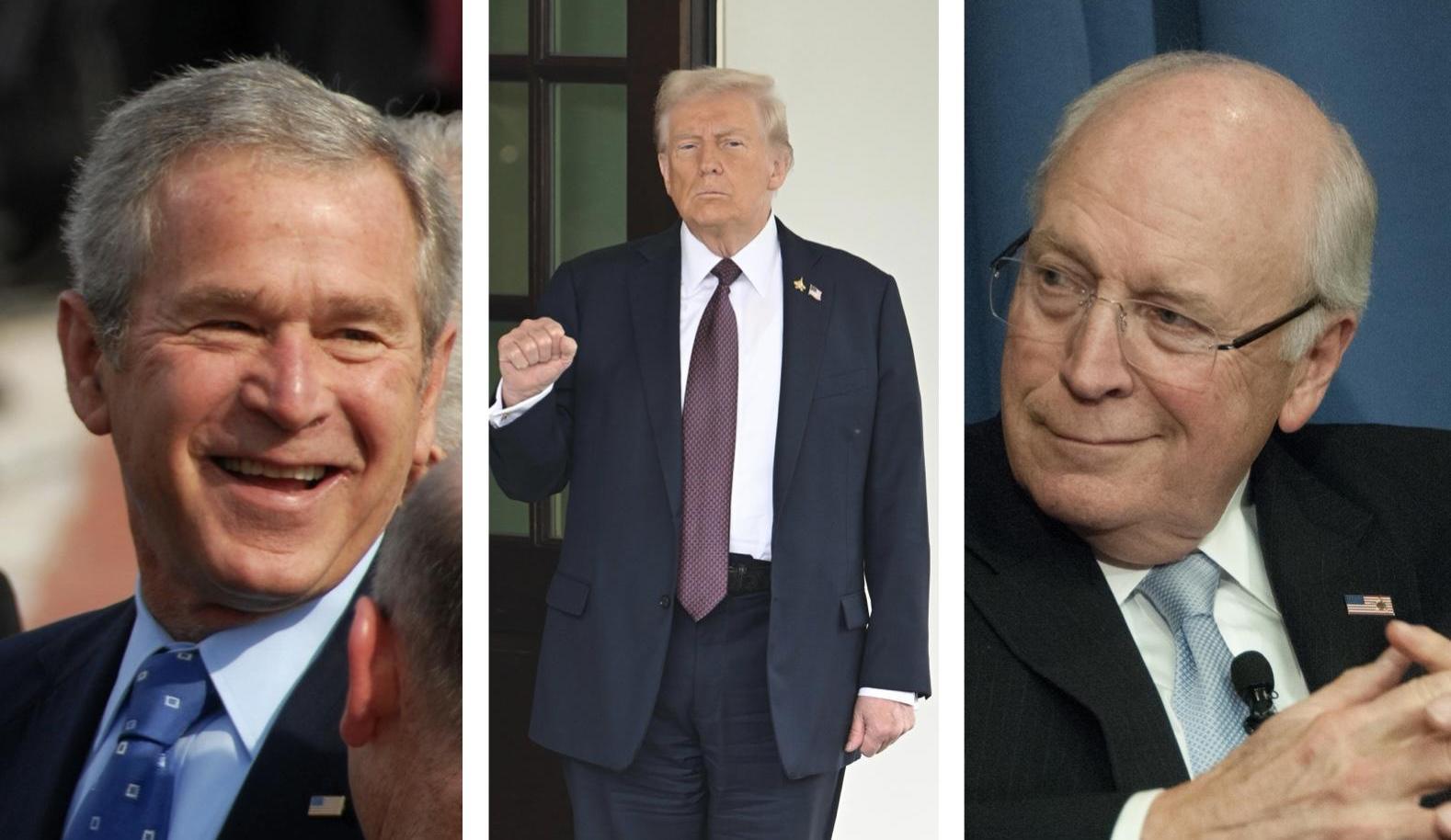
Earlier this month, Republican Congressman Thomas Massie mocked the idea of a potential U.S. regime change war with Venezuela, ostensibly over drug trafficking.
"Do we truly believe that Nicholas Maduro will be replaced by a modern-day George Washington? How did that work out? In Cuba, Libya, Iraq, or Syria?"
"Previous presidents told us to go to war over WMDs, weapons of mass destruction, that did not exist,” he added, taking a direct dig at President George W. Bush. Now it's the same playbook, except we're told that drugs are the WMDs."
In 2016 Trump ran for president as the anti-Bush, slamming the Iraq War justifications on the Republican primary debate stage. “Obviously, the war in Iraq was a big, fat mistake, all right? They lied. They said there were weapons of mass destruction. There were none, and they knew there were none,” Trump said then.
Now Team Trump talks about fentanyl being a WMD and teases war. Massie had a point in comparing Trump to Bush and Dick Cheney in more ways than one.
Here are four ways the Trump administration appeared to go full Bush in 2025.
1. Venezuela has ‘WMDs’
Even though Trump once accused the second Bush administration of lying about weapons of mass destruction in Iraq, the president is now whipping out the same canard to justify U.S. military actions against Venezuela, which his administration has carried out to great controversy.
Signing an executive order in December that classifies fentanyl as a WMD, Trump said, “No bomb does what this is doing,” noting the significant number of overdose deaths caused by the synthetic opioid in the United States.”
“So we’re formally classifying fentanyl as a weapon of mass destruction,” the president declared.
Never mind the fact that Venezuela is not the primary source of fentanyl. In fact, the Drug Enforcement Agency (DEA) has said “Mexico and China are the primary source countries for fentanyl and fentanyl-related substances trafficked directly into the United States,” while “India is emerging as a source for finished fentanyl powder and fentanyl precursor chemicals.”
“The simple fact is we are headed to a regime change efforts in Venezuela based entirely on a false pretense (flimsier than WMD),” wrote Breaking Points podcast host Saagar Enjeti, comparing the situation to the lead-up to the Iraq War..
“Speaking of wars being over, how about the folks in the admin doing a bad remake of Iraq? Cause that went so well,” Republican Senator Rand Paul shared on X, just before Christmas. adding, “They even brought out the greatest hits, like seizing oil and ‘weapons of mass destruction.’”
The Daily Show’s Jon Stewart — who spent much of his early career deriding Bush and Cheney and the war — was floored that Trump would deploy this line of reasoning, saying in a recent monologue, “You guys have the balls to tell us that the pretext for Iraq was bullshit, and that war was a mistake, and we’re not like that, and also Venezuela has weapons of mass destruction and we have to stop them?”
2. 'Narco-Terrorists’
During the Afghanistan and Iraq wars, many Republicans in the Bush-Cheney era insisted the U.S. was fighting not mere “terrorists” but “Islamofascists.” President Bush himself used the phrase “Islamic fascists.”
It was a label intended to make America’s enemies more evil and ubiquitous, numbering beyond even the al-Qaida terrorists who caused 9/11, which meant the war could be as far reaching as the Bush administration wanted.
Similarly, the Trump administration doesn’t just wage war on run-of-the-mill drug traffickers these days, it now targets “narco-terrorists” — raising the specter of 9/11 — and says the traffickers are selling drugs to wage war on the United States. Writer Martin DiCaro explained the greater significance of this after American forces reportedly killed two survivors of a U.S. boat strike:
“The term ‘narco-terrorist’ is meant to dehumanize and desensitize. Their conduct — murder, terrorism, and poisoning Americans’ bodies — morally disqualifies them and, therefore, justifies extraordinary punishment. The possibility that harmless fishermen are blown to pieces must not weaken our leaders’ resolve to defend the nation.”
Di Caro added, “The boat strikes may be illegal and appalling, but the Trump administration’s conduct follows a long historical pattern, where America’s enemies operate outside the acceptable boundaries of civilization, and Washington's heavy-handed response can be justified by notions of national security, economic interests, racial superiority, or basic human decency — or all four simultaneously.”
Democratic Congressman Ro Khanna pleaded with the defense secretary and vice president, both Iraq War veterans, in November. “(Pete Hegseth) and (JD Vance) you were sent to fight a war that was based on a lie.”
“Now you are asking Americans to trust intelligence for a war in Venezuela,” he added. “What happened to you?”
3. Using ‘war on terror’ standards
Much of how the Trump administration conducts itself is reminiscent of Bush-Cheney, the Patriot Act, and the national security state after 9/11.
As Elizabeth Beavers observed in Responsible Statecraft in November:
“The original decision to treat the 9/11 attacks not as crime but as warfare, and to launch a literal ‘war on terror’ in response, remains the primary post-9/11 legal innovation on which so many abuses are made possible. Under this global war paradigm, the Obama administration carried out ruthless drone killings, including one that targeted a U.S. citizen, and justified the strikes with a mish-mash of legal standards that applied rules of war outside of actual war zones, and expansively interpreted what constitutes an’“imminent threat’ and resulting ‘self-defense’ powers.
“Every post-9/11 president has claimed wide authority to use military force so long as it serves a vague ‘national interest,’” Beavers added. “We can see echoes of this in the Trump administration’s insistence that the small Venezuelan boat blown up by the U.S. military posed an ‘immediate threat to the United States,’ that the strike complied with the laws of war, and was ‘in defense of vital U.S. national interests.”
Sen. Rand Paul chided the administration in October, “When you kill someone, you should know, if you’re not at war, not in a declared war, you really need to know someone’s name at least,” Paul said. “You have to accuse them of something. You have to present evidence. So all of these people have been blown up without us knowing their name, without any evidence of a crime.”
4. Bombing Iran
One foreign policy action taken by the Trump administration in 2025 might have even out-Bushed, Bush: A military strike on Iran.
Former Trump adviser John Bolton as well as the many neoconservatives and their friends who once staffed the Bush administration have been aching for direct U.S. military action against Iran for a long time. The late John McCain even once famously made that wish into a song.
“I’ve never been, and don’t intend ever to be, a supporter of Donald Trump. But I wish the president and his administration well in this crisis,” wrote Never Trumper hothead and top Bush-era neocon Bill Kristol on June 13
In June, Trump gave them their wish.
What Trump didn’t do, thankfully, is pursue a regime change war in Iran which is what hawks have long desired most. As Congressman Khanna said in July, “The reality is, people want regime change in Iran, and they are egging this president on to bomb. I hope cooler heads will prevail.”
In May, President Trump had blasted “interventionalists” and “neocons” during a major speech in Saudi Arabia. But after the Iran strike, The New Statesmen’s Freddy Hayward asked if Trump was instead indeed “the last neoconservative.”
“Like Bush, Trump may become a president who was elected to fix America but ends up ordering troops to the Middle East,” he wrote. “This war has become a test of whether the neoconservative age is over.”
***
Some of Trump’s top staff postings played right into the hands of the old Cold War warrior and neoconservative guard, which had generally made up the Bush-Cheney national security establishment in the early 2000s. Some of the president’s more radical ideas, like rebuilding Gaza, uncannily hew to proposals that neoconservatives like Elliott Abrams had put forward for the post-war territory.
Unfortunately, these are not the only examples of this “America First” president sounding more like “Mission Accomplished” in 2025.
Do not be surprised if 2026 brings more.