

Maximum pressure has long been President Donald Trump’s stance towards the government of Nicolás Maduro in Venezuela — he slapped crippling sanctions on the country during his first term — but in recent days the administration has pushed the stakes even higher.
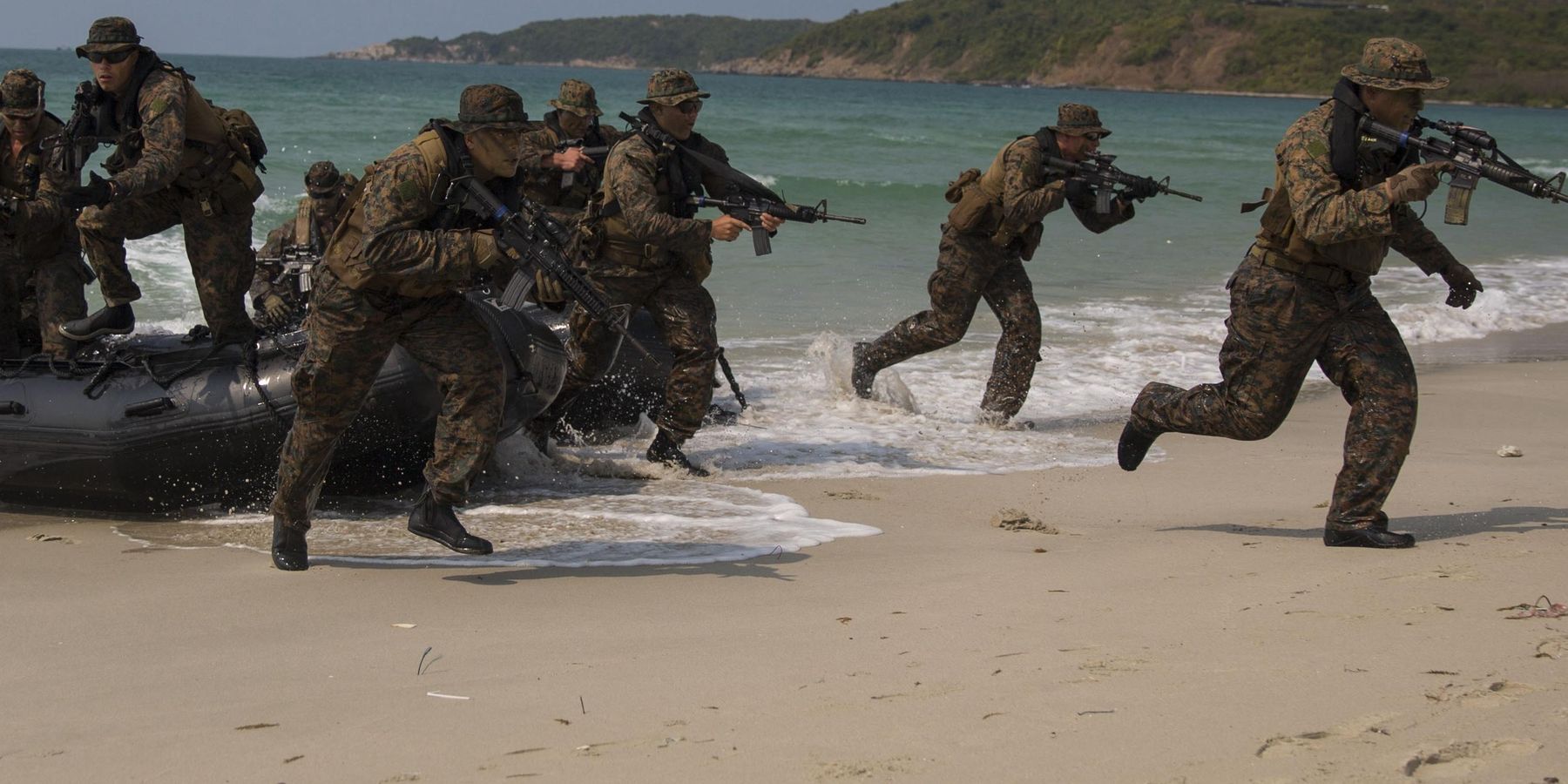
The Caribbean is currently hosting an astonishing quantity of American naval and air assets, including four Arleigh Burke–class destroyers, a guided missile cruiser, an attack submarine, a Marine Amphibious Ready Group, and a flight of F-35 multirole fighters.
These are ostensibly deployed as part of an antinarcotic and drug interdiction operation, but the volume of firepower employed for what is normally a relatively sedate task has created broad suspicion at home and in Venezuela that a military intervention against the Bolivarian Republic is on tap. Maduro recently sent a letter to the United Nations stating that he expected an “armed attack” against his country in “a very short time.”
His concerns have probably not been assuaged by the formation of a new Joint Task Force last week (again ostensibly for anti-narcotics operations) in SOUTHCOM under the II Marine Expeditionary Force, precisely the kind of unit that would be deployed in a Venezuelan military intervention, still less by the recent New York Times report that Trump has authorized lethal covert operations by American intelligence agents within his borders.
The administration has made its interest in removing Maduro quite clear: it views him as the head of a narcoterrorist organization that is responsible for exporting crime, drugs, and illegal immigrants to the United States. Secretary of State Marco Rubio has declared that Maduro is not the legitimate president of the country, due to his government’s obvious falsification of results in the 2024 election, and the Justice Department doubled the bounty for his capture to $50 million.
But while Maduro is, without a doubt, a usurper of the presidential office and a tyrannical dictator, he is no less the president and head of state of Venezuela. Ideological harangues about the sanctity of democracy will no more remove him from power or render his government moot than American disapproval of the Chinese Communist Party could affect the democratization of Red China, something both sides are well aware of. Removing Maduro will require more than sanctions, threats, or pressure: it will require war, and that possibility looks increasingly likely with each passing day.
While ending Maduro’s dictatorship would certainly be a boon to the Venezuelan people, the intervention comes with a number of costs and risks American policymakers should bear in mind and carefully weigh against the potential benefits of intervention. There is no free lunch in geopolitics.
The most obvious costs are those of the initial invasion. The American invasion of Panama in 1989, to overthrow the government of General Manuel Noriega, was carried out by a force of some 27,000 U.S. troops, 23 of which were killed and hundreds more wounded. Venezuela is vastly larger than Panama, and while its military is very poorly equipped, it likewise dwarfs the forces that were available to Noriega. The Center for Strategic and International Studies estimates an invasion of Venezuela would require nearly 50,000 troops, some of which will not return home. Any American government should be extremely conscientious about the causes on which it spends the lives of American soldiers.
The real risks of such an operation, however, come after the invasion. Toppling Maduro’s government is one thing; there is no real chance that the impoverished and corrupt Venezuelan armed forces can put up a serious fight against the American military. But occupying and rebuilding the country is another, as the U.S. learned to its chagrin in the Middle East.
While Venezuela is no Afghanistan — it has a relatively unified population, an organized opposition, and a prominent leader in María Corina Machado capable of stepping in and assuming the reins of government — there are still very serious challenges an incoming government will face.
The largest risk are the cartels operating in the region. While Maduro does strategically permit cartels to operate within Venezuela at times, Venezuela does not have the entrenched cartel problems of neighboring Colombia. Cartels operate networks that transport drugs through Venezuela to the U.S. and elsewhere, but control little territory and do not produce a significant amount of drugs in the country. The Venezuelan government continues to crack down on cartels that appear to be making themselves overly comfortable; Maduro has no interest in permitting the growth of significant challenges to his authority, including cartel quasi-states like those in Colombia and Mexico.
Once a U.S. invasion takes place, however, the enforcement power that limits cartel activity in Venezuela will vanish in an instant. One of the foundations of Maduro’s political power is his iron grip of the country’s military, law enforcement, and intelligence services. All are regularly and thoroughly purged of disloyal and seditious elements, and their leadership bought off with positions of power and lucre in government and industry. An American invasion would shatter them as institutions, and an incoming government would need to reconstruct them basically from scratch. Occupying U.S. troops could help fill the gap, but they are unlikely to be able to project power and enforce the laws far beyond major urban areas, a situation that could allow cartels to massively expand their power in the rural areas of the country, especially in the Amazon and the regions bordering Colombia.
Worse still, an American invasion offers the cartels the opportunity to posture themselves as anti-imperialist resistance movements and absorb elements of Maduro’s support in the country — support they are often already tapped into through networks of patronage and corruption. Units from the ostensibly Marxist National Liberation Army, a major drug cartel in Colombia, already frequently travel through Venezuelan territory in between fights with other cartels and the Colombian military; a regime change risks plunging Venezuela into the same permanent drug war Colombia has been embroiled in for decades — one American forces are likely to be personally engaged in during the occupation and reconstruction of the Venezuelan government.
Given that the stated objective of the Trump administration’s military expansion in the Caribbean is to crack down on the drug trade into the U.S. from Venezuela, few things would be more counterproductive than feeding cartel expansion in northern South America.
An intensified Venezuelan drug war could also contribute to the flow of Venezuelan illegal immigration, another major complaint the U.S. has had against the Maduro government. Cartel brutality and conflict has been a major driver of illegal immigration all over central and south America, and it would be a cruel irony if narcos in Amazonas replaced narcos in Caracas as major contributors to the American illegal immigrant population.
The Trump administration is approaching a decisive moment in its Western Hemisphere policy. Eventually it will have to settle American relations with Venezuela. Policymakers must weigh carefully the costs and benefits of military intervention and take into account the serious risks inherent to occupation and nation-building — because if we muck it up this time, we can’t just pull out and leave the Taliban to their own devices. This one’s in our own backyard, and we’ll be paying the cost of any missteps for years to come.
- Grenell vs. Rubio: Team Trump's competing Latin America visions ›
- Trump’s attempt to get rid of Maduro has failed. What now? ›
- Is Rubio finally powerful enough to topple Venezuela's regime? ›
- Will Trump really attack Venezuela? | Responsible Statecraft ›
- Bolivia shocker: dark horse comes out of nowhere to win presidency | Responsible Statecraft ›
- Hegseth dropped big Venezuela easter egg in Quantico speech | Responsible Statecraft ›
- Invading Panama and deposing Noriega in 1989 was easy, right? | Responsible Statecraft ›
- Doubt is plaguing Trump’s Venezuela game | Responsible Statecraft ›
- US weapons stocks booming, CEOs gloating after Maduro toppled ›