

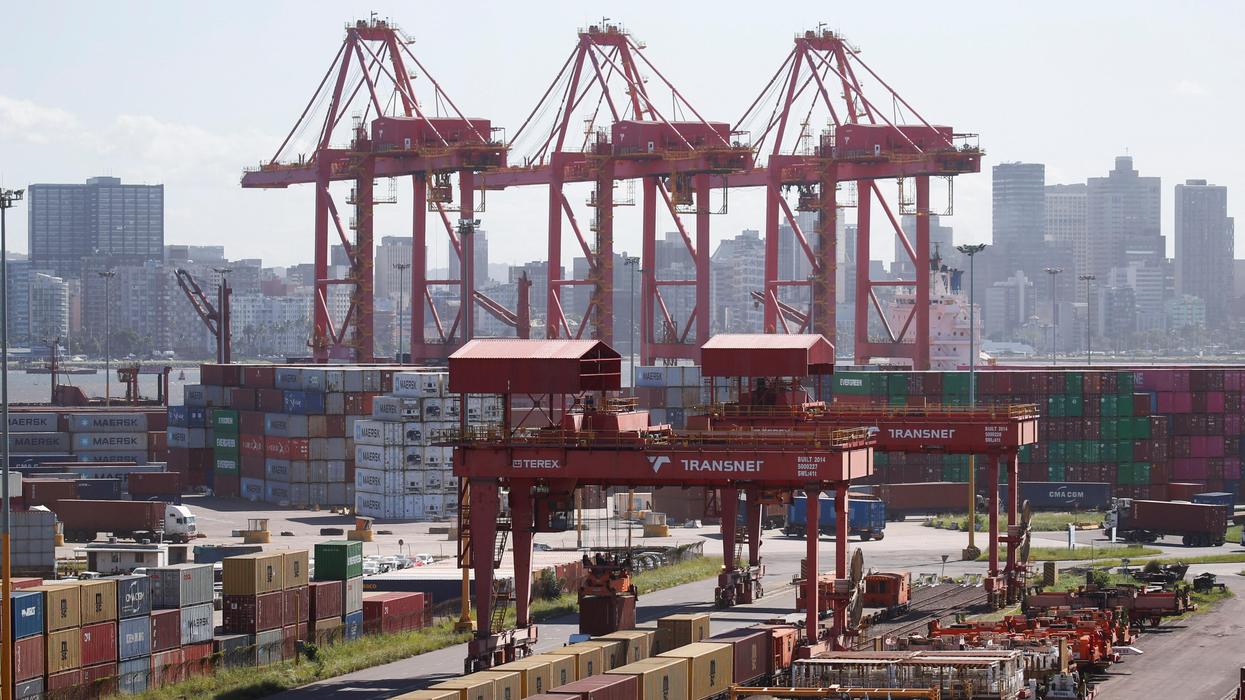
Included in the massive $1.2 trillion spending package signed by President Trump yesterday is a provision for the short-term renewal of the African Growth and Opportunity Act (AGOA). AGOA, which first became law in the waning days of President Bill Clinton’s final term in office in 2000, provides duty-free access to the U.S. market for over 1,800 goods exported to the U.S. from countries across sub-Saharan Africa.
AGOA’s short-term renewal caps a topsy-turvy period for the preferential trade agreement. Many Africa watchers assumed in the early months of Trump’s second term that the trade agreement — which, before yesterday, had last been renewed in 2015 — would expire at the end of September without any effort by the administration to renew it.
This view was largely derived from the fact that AGOA seems to contrast with Trump’s wider trade policy of trying to get other countries to reduce their barriers of entry for American goods. The act only explicitly eliminates tariffs on goods exported from sub-Saharan Africa to the United States, not for goods being exported from the United States to sub-Saharan countries. Trump has long stated his desire to end asymmetric trade agreements by increasing American barriers to entry while forcing other countries to reduce their trade barriers for American-exported products.
Yet, in the days before AGOA’s expiration, Trump surprised much of the policy world by coming out in favor of its one-year renewal while negotiations take place over the details of its long-term future.
After its expiration in September, two competing bills were presented in Congress for its short-term reauthorization. The first was presented by Senator John Kennedy (R-La.), which would have renewed the agreement for two years through 2027. A second bill was presented in December by Representative Jason Smith (R-Mo.), which would have extended the agreement temporarily through the end of 2028.
Though quite similar, one of the key differences between the two bills is that Kennedy’s included a forced review of the bilateral U.S.-South Africa relationship. This came after last year’s public scuffle between President Trump and South African President Cyril Ramaphosa. During the argument, Trump accused the South African government of expropriating land from white South Africans without fair compensation. Also, there being no evidence of this, Trump accused the South African government of failing to stop a genocide against the country’s white population.
The AGOA renewal signed into law yesterday does not include a mandated review of the U.S.-South Africa relationship.
Although Smith’s three-year renewal bill passed the House of Representatives on January 12, it stalled in the Senate as Trump’s team reiterated their request to Congress for a one-year, rather than a three-year, AGOA renewal. In line with this request, a provision was added to the spending bill that would extend AGOA just through the end of 2026. It provides retroactive benefits for AGOA-eligible goods that were exported from sub-Saharan countries to the United States during the period between AGOA’s expiration in September and before the start of the new year.
With AGOA’s short-term reauthorization official, debates over its long-term future will now kick into gear.
A question that is certain to come up has to do with whether AGOA-eligible countries should be immune from Trump’s broader tariff policy. As it currently stands, AGOA’s breadth has been hobbled by the sweeping tariffs Trump has placed on countries across the world, including many that would otherwise receive duty-free access to the American market through AGOA. Thirteen of the 30 countries currently eligible to receive AGOA benefits face tariffs of 15%, while South Africa faces a 30% tariff on its exports to the United States. These duties supersede AGOA’s preferential trade benefits, meaning that AGOA is essentially defunct for countries forced to contend with these tariffs.
Another piece of the broader debate over AGOA’s long-term renewal will center on whether the next iteration of the act will provide American exporters some sort of preferential trade benefits to the sub-Saharan market. Trump has long blamed one-sided preferential trade agreements for hurting America’s trade balance. The president argues that a reduction in barriers for American exporters will benefit American industry — and thus Americans working for firms selling to foreign customers — by increasing exports and leading to a fairer trade regime that rebalances American trade.
In line with this thinking, U.S. Trade Representative Jamieson Greer said, “AGOA for the 21st century must demand more from our trading partners and yield more market access for U.S. businesses, farmers, and ranchers.”
- House passes sweeping ‘duty free’ pact for African imports ›
- Trump's surprising swing in favor of sweeping 'duty free' Africa trade ›