

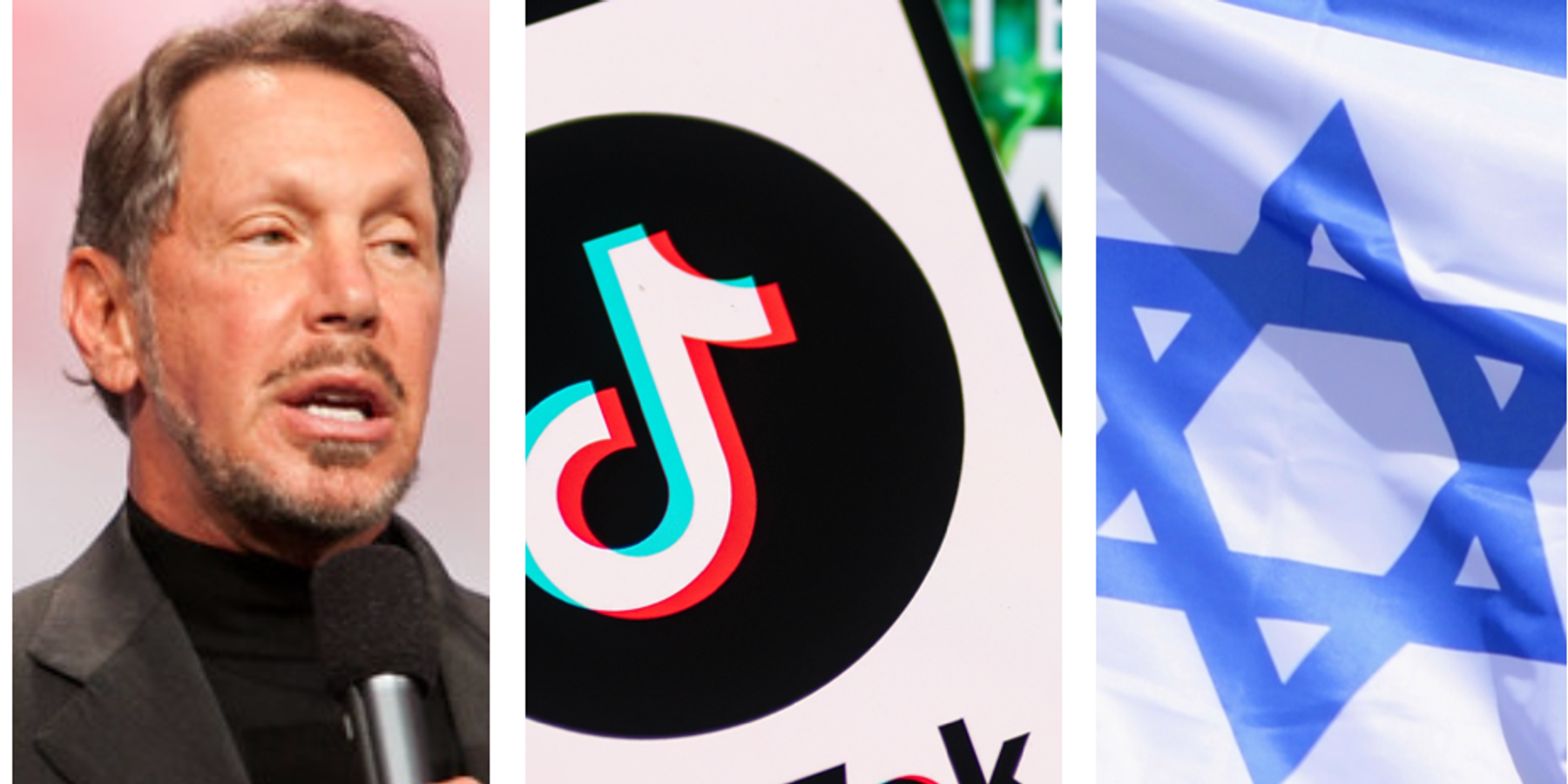
A year ago, powerful critics in Congress and the tech world were complaining that TikTok was promoting anti-Israel messaging and were suggesting it needed to be shut down.
Turns out it didn't need to be eliminated. TikTok is a message force multiplier after all, and only requires, apparently, the right people to own it. Like Oracle co-founder Larry Ellison, the second richest man in the world and the single biggest private donor of the Israeli Defense Forces, who has referred to the state of Israel as his own. He has direct stakes in a head spinning galaxy of news, television and Hollywood media companies, mainly through the recent Paramount Skydance Corporation takeover, a mega conglomerate now run by his son David Ellison (who is reportedly on the cusp of making vigilantly pro-Israel journalist Bari Weiss a top exec at newly-acquired CBS). Ellison the elder also is a major stakeholder in X and Tesla.
Add Rupert Murdoch, head of media conglomerate NewsCorp (Fox News), a perennial critic of "anti-Israel bias" in the media who in 2024 said Israel is "alone on the front line of Western democratic civilization." Also Ellison's right-hand at Oracle, Israeli-American Safra Catz, great friend of President Trump, who has traveled to Israel several times since Oct. 7, 2023 in support of its war and continued Oracle partnerships there, and in a July appearance in Israel told an an audience that "we (Oracle) are on the side of freedom. We are on the side of democracy." She followed that with "some of the best people in the world are here in Israel, and there's no question about that. And everyone knows it. Some of the big winners will be here. Mark my words.”
Throw into this mix billionaire Jeff Yass, a top GOP donor and current TikTok investor whose philanthropy is connected to a carousel of pro-Israel outfits that have funding ties to the IDF and AIPAC, plus explicitly anti-Muslim campaigns that among their issues, advocate for U.S. confrontation with Iran.
All of these individuals and more are reportedly part of a mega deal to buy TikTok for $14 billion. The details are here. Trump says the full roster of private U.S. investors (China's Bytedance can only own a 20% stake) will be announced in a "matter of days." But Forbes says Ellison's "Oracle, private equity firm Silver Lake and MGX, an AI-focused investment firm established by the government of Abu Dhabi" will have a whopping 40% stake in the new TikTok. Oracle is reportedly to get 15% and be named the app’s “security provider.”
The $14 billion deal is being called a "fire sale" by some observers who point out that Elon Musk paid triple that for Twitter in 2022. This highly suggests that this transaction is more about geopolitics and ideology rather than a financial gain for investors. Aside from its more than 1.5 billion regular users world-wide, TikTok has now become where 30% of Americans get their news. Now, not only will American companies like Oracle, which has numerous government tech contracts spanning defense, intelligence, and civilian agencies, have access to TikTok's user data, it will also have control of the algorithms that manage the kind of news, the messaging and images, that all of those users see.
“This was not a fair-market transaction,” said Milton Mueller, a professor at Georgia Tech specializing in digital governance, in Newsweek. “It’s a politically determined restructuring." Some might say, with the constellation of GOP and MAGA supporters in the reported investor mix, this has the makings of a new Trump-friendly megaphone. But it is so much more. In essence, like Safra Catz says, the big "winners" will be in Israel.
- TikTok investor Jeff Yass wants to shape US foreign policy too ›
- Israel wants to train ChatGPT to be more pro-Israel | Responsible Statecraft ›
- TikTok investor: 'Embed the love and respect for Israel' in the US | Responsible Statecraft ›
- Who are the 'influencers' Israel is paying $7k per post? | Responsible Statecraft ›
- Oracle execs: Love Israel or maybe this isn't the job for you | Responsible Statecraft ›
- From CBS to TikTok, Pro-Israel Ellisons now in the driver's seat | Responsible Statecraft ›