

The government led by Syrian President Bashar al-Assad has high stakes in Israel’s ten-week-old war on Gaza, which has already spilled into Syria. Israel has bombed the Damascus and Aleppo airports, as well as outposts in Syria’s rural areas under the pretext of deterring Iran and regional militias backed by Tehran from using Syrian territory and infrastructure to potentially attack Israel amid further escalation.
Ultimately, the conflict in Gaza advances, but could also set back, Damascus’s interests at a time when Assad’s regime is trying to recover from more than a decade of brutal warfare inside Syria. Damascus must carefully navigate the fallout from Israel’s bombardment and ground invasion of Gaza.
Assad's opportunities
The Assad regime committed serious war crimes and other abuses in its efforts to maintain power since the 2011 Arab Spring. Just last month a French court issued an international arrest warrant for Assad and others in the Syrian government and military for alleged use of chemical weapons. Yet Damascus is trying to capitalize on the outrage across the Islamic world and much of the Global South by Israel’s bloody military campaign in Gaza and the seemingly unconditional support it has received from the United States.
“The major benefit that Syria is likely to see from the Gaza war is the damage it will do to America’s prestige and standing in the Arab world,” said Joshua Landis, director of the Center for Middle East Studies at the University of Oklahoma, in an interview with RS. “Biden’s unflinching aid to Israel in its effort to kill Palestinians in Gaza will diminish Washington’s ability to rally Arab and Muslim countries against Syria and Iran,” he added.
There is less focus on the Syrian regime’s human rights abuses now that the world is paying much closer attention to the Gaza crisis. “After over a decade of war, which witnessed unprecedented brutality and barbarism, Damascus was poised to argue that Israeli brutality and barbarism cleansed some of its own deeds,” according to Joseph A. Kechichian, a senior fellow at the King Faisal Centre in Riyadh.
Damascus is also thrilled to see the expansion of the U.S.-brokered Abraham Accords to normalize relations between Israel and Arab states come to a screeching halt. Going back to President Hafez al-Assad’s era (1970-2000), Damascus has vehemently opposed Arab states formally recognizing Israel, beginning with Egypt in 1979. Within this context, the fact that the Gaza crisis makes Saudi-Israeli normalization very unlikely for the foreseeable future is positive from Damascus’s perspective. The fact that the peace treaty between Jordan and Israel is more vulnerable today than at any time since it was signed in 1994 is also a source of satisfaction to the regime.
“The war in Gaza is reviving the relevance of the resistance front in the Arab world,” according to Landis. “Not only the Syrian opposition, but the Arab world more generally has scoffed at the impotence of the resistance front in recent years. Today, Arabs are again rooting for resistance. The Abraham Accords and American diplomacy look too anti-Arab and too pro-Israel,” he explained.
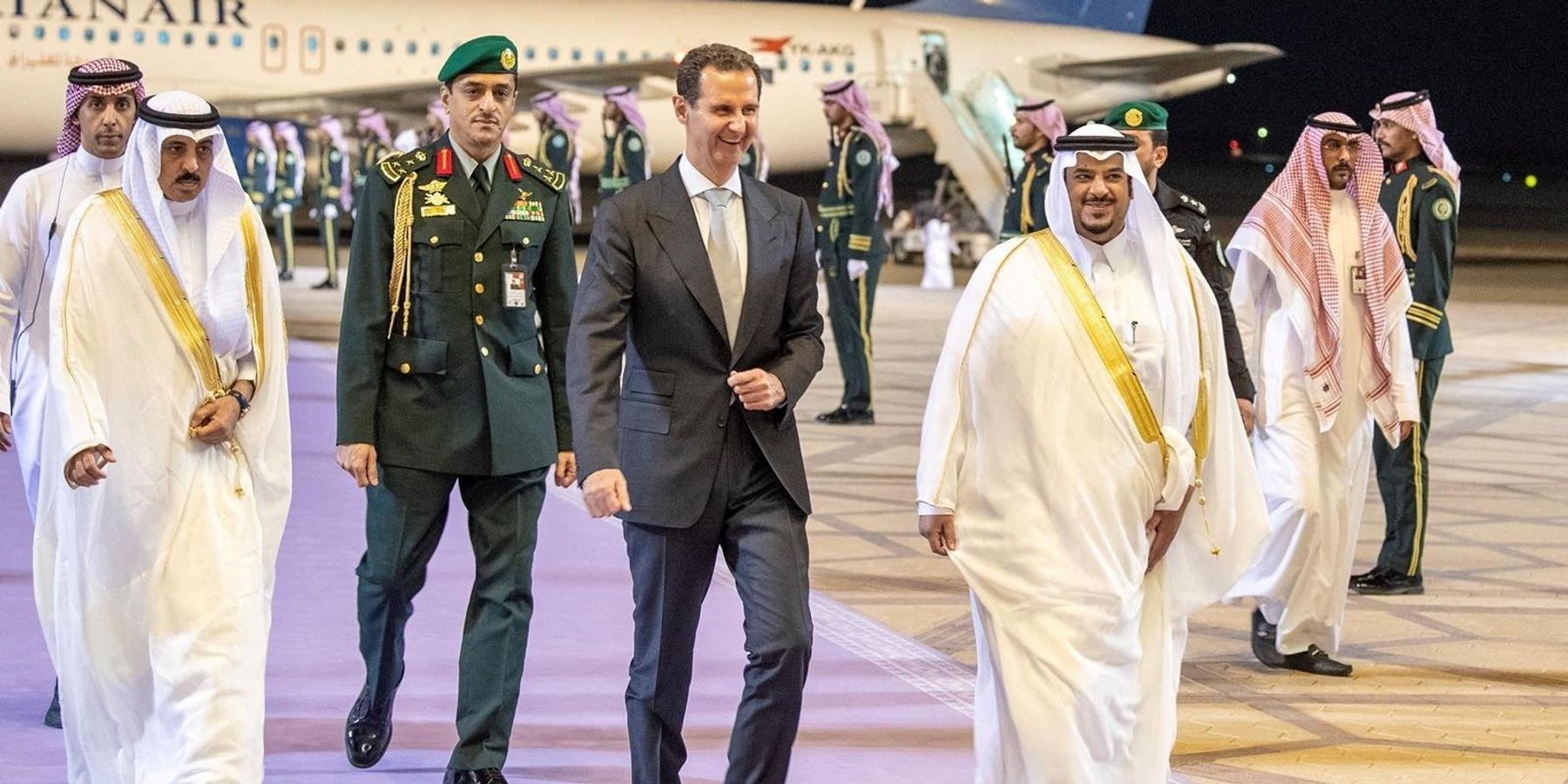
The Gaza crisis is not only further solidifying Syria’s decades-old alliances, but also accelerating the process of reconciliation between Assad and his former enemies in the Middle East, such as Saudi Arabia. This was underscored by Assad’s participation in the joint Organization of Islamic Cooperation-Arab League emergency summit on Gaza held in Riyadh on November 11.
"[Assad] is trying to reposition himself as a member of the club after having been excluded and treated as a pariah between 2011 and 2022,” said Karim Emile Bitar, who teaches international relations at Saint Joseph University of Beirut, in an interview with RS.
The Riyadh summit marked the second time that Assad addressed the Arab League since his country’s readmission to the group in May. While speaking in the Saudi capital, he warned that the failure of Arab states to take concrete action against Israel would deprive the summit of any meaning. Assad also declared that no country in the region should be engaging Tel Aviv in any “political process” until Israel agrees to a ceasefire in Gaza.
“Beyond the irony that Assad’s speech represented—after all, Syrians, including children and civilians, were targeted with chemical weapons in the ongoing war in the hapless country — [he] did not mention that his forces destroyed hospitals and besieged and bombed Palestinians who previously sought refuge in Syria,” Kechichian noted.
Threats to Syria
While the war in Gaza bolsters Assad’s efforts to escape his pariah status, especially among Arab states, it also poses threats. With Damascus focused on circumventing western sanctions and luring foreign investment for Syria’s reconstruction, Assad’s government is particularly concerned about the war’s potential escalation into a wider regional conflict.
“Assad is desperate for foreign investment as well as internal investment,” according to Landis. “Syrians desperately need stability. This war reminds everyone that investing in the Middle East is risky. Syria has become the battle ground on which regional disputes are hashed out,” he told RS.
The war has reinforced the importance of the Iran-led “axis of resistance” in the Middle East and Syria’s key role in it. According to Javad Heiran-Nia, the director of the Persian Gulf Studies Group at the Center for Scientific Research and Middle East Strategic Studies in Iran, “Syria plays the role of logistics in this war and is the main route of sending weapons and equipment to Hamas and Hezbollah,” he told RS.
“Iranian forces are also present in Syria, and in this war, Iran moved its forces in Syria from northern Syria and areas like Aleppo to southern Syria. Therefore, attacks on American positions in Syria are aimed at implementing Iran's threat against America and Israel in order to prevent the war from spreading to other regions on the one hand and increasing the costs of increasing American military forces in the region on the other hand,” added Heiran-Nia.
Given Syria’s situation as a war-torn country with parts of its territory under foreign military occupation, Damascus itself must understand that it is particularly vulnerable to attack.
“[Assad] knows that he could be the weakest link if Israel proves incapable of dealing a severe blow to Hamas and incapable of attacking Hezbollah in Lebanon. Some Syrians think that Israel could be tempted to try to attack the Syrian regime, to deprive Iran of one of its foremost allies,” said Bitar.
Yet the same factors that led Israel to forgo moves to topple the government in Damascus during the Syrian civil war, when it was far more fragile, remain relevant. The uncertainty about any successor regime helped stay Israel’s hand at the time, and the same considerations may induce similar caution now.
- US troops in Iraq and Syria aren't 'keeping the peace' ›
- Why the Kremlin may be sweating the war in Israel and Gaza ›
- Is carnage in Gaza bringing Iran and Saudi Arabia closer? | Responsible Statecraft ›
- Is Israel expanding territorial control toward Syria? | Responsible Statecraft ›
- Shotgun wedding? Israel and Syria go to the altar. | Responsible Statecraft ›