

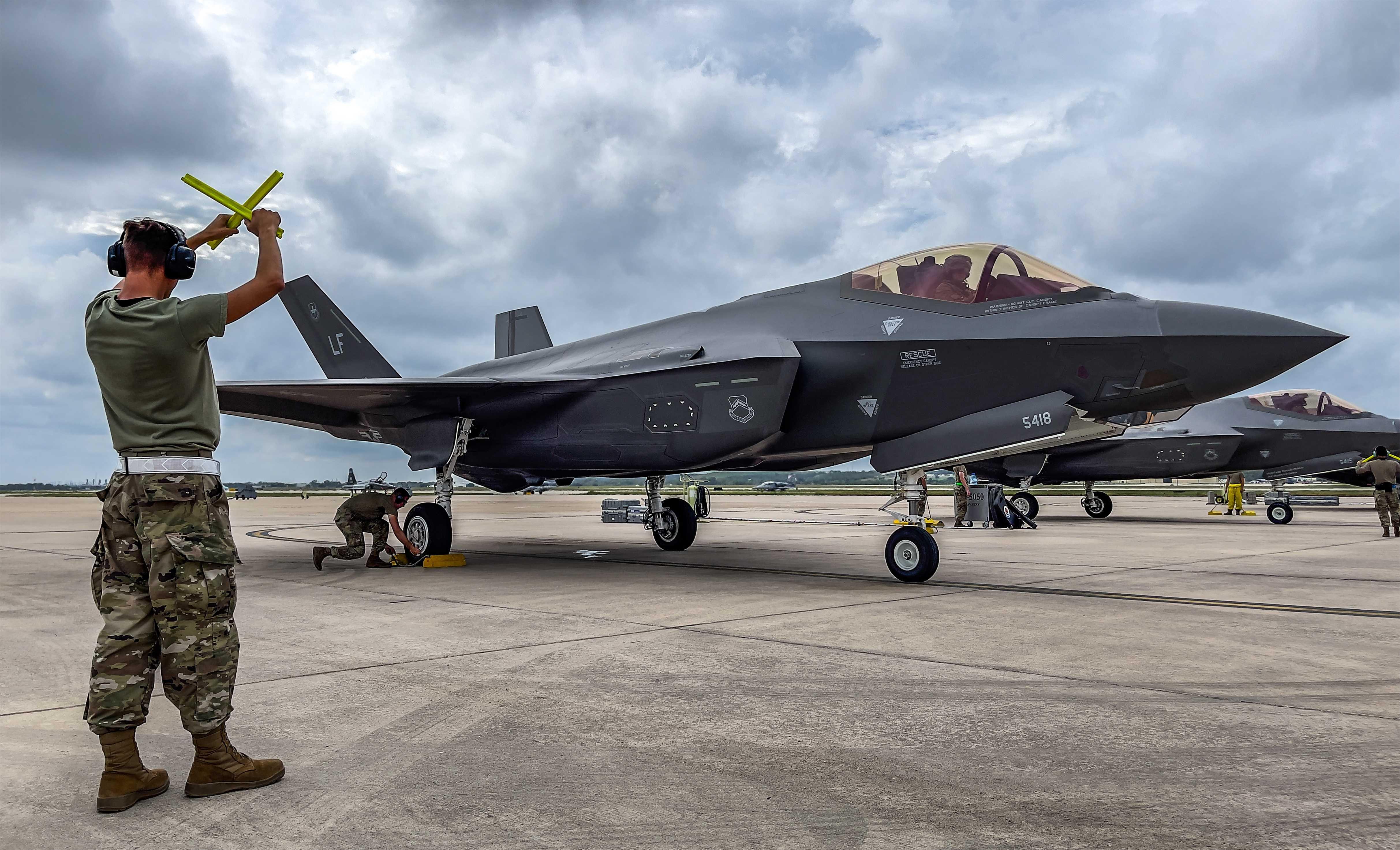
Are the military services babying the F-35 to obscure its true costs while continuing to get enormous sums of taxpayer funding for a plane that has consistently failed to live up to performance expectations?
From the very beginning, the F-35 program has been plagued by hundreds of billions of dollars in cost overruns and repeated schedule delays.
Moreover, even as promised capabilities have been delayed by well over a decade, billions poured into fixes haven't resolved ongoing reliability issues, crippling its operational effectiveness, and rocketing the program cost to over $2 trillion dollars — 400% more in inflation-adjusted dollars than its 2007 Government Accountability Office estimate.
The plane’s extreme unreliability has resulted in full mission capable rates (FMC) of only 36.4% , 14.9%, and 19.2% for the F-35A, F-35B, and F-35C, respectively. For F-35Bs and F-35Cs, only the newest planes have full mission availability rates above 10%.
Unsurprisingly, the services and Lockheed Martin don’t really like to talk about FMC; instead, they like to focus on mission-capable (MC) rates of roughly 50%. While much lower than the 90 percent promised by Lockheed Martin and its service partners, it certainly sounds much better than the dismal FMC rates. But MC is a very deceptive measure, and the services know it, as “mission capable” aircraft need only be capable of flying non-combat missions, such as training, ferrying, or public relations, etc.
But the MC deception is only part of the equation when it comes to just how little bang-for-the-buck taxpayers are getting for their dollar.
Strong circumstantial evidence, coupled with emerging data and the services’ long history of stonewalling when it comes to problems associated with major programs, suggest that the U.S. military services , as well as prime contractor Lockheed Martin, have been babying the F-35s to obscure just how unreliable and expensive they would be if not being nursed along.
This coddling of the F-35 lowers some costs and pushes other costs into the future, keeping current year expenses as low as possible. This makes the program look like it is more efficient and effective than it really is, improving the chances of selling and delivering more F-35s while decreasing the chances the program will be curtailed or even canceled.
Major maintenance cost factors
There are three major drivers of wear and tear on an aircraft like the F-35: how many missions (sorties) it carries out, how many flight hours it accumulates, and how it's flown during a mission.
Missions/Sorties are the best predictors of maintenance-related costs. While accumulated flight hours are often discussed when it comes to aircraft age and maintenance, studies have shown that the number of sorties, on average, is a better predictor of the wear and tear on an aircraft. This is because each sortie involves the stresses of taking off and landing, as well as subjecting the engine to thermal cycles, the primary culprit when it comes to engine wear.
Once the plane is flying, its wear is minimal unless subjected to aggressive maneuvering and engine use. Hence, when it comes to minimizing wear, for the same number of flight hours, fewer sorties of longer duration will produce less wear than more sorties of shorter duration, 100 two-hour sorties vs. 200 one-hour sorties.
Flight hours and operating costs. While in most cases, the number of sorties will be a better predictor of when maintenance will be required, more flight hours still equal more maintenance. So, if you can keep the hours down, the absolute cost of maintaining the plane will be less. For context, modern fighters like the F-16 routinely flew 250–350 hours per year in their prime, but F-35s average only about 195 hours annually — well below their original targets of 250–316.
To note: the June 2025 Congressional Budget Office found that F-35 availability and hours being flown are “lower, in some cases much lower, than those of other fighter aircraft of the same age.” Interestingly, even at 17-years of age, legacy aircraft such as F-16s and F-15s blow away the mission readiness of brand-new F-35s, even though they are flying more hours annually.
Indeed, we know the hours flown each year by the F-35A and F-35B declined markedly over the first seven years of their lifetimes. This means aircraft just a few years old are being flown less than brand new planes and consequently being subject to less daily wear and tear, conveniently pushing the cost of replacing engines and other expensive depot-level work down the road, even as the services continue to buy new F-35s under what some, including myself, would call false cost metrics.
But beyond cost shifting, overall fewer hours being flown means less in-the-air training “stick time.” And while flight simulators are helpful, there is no substitute for training in a real plane, being subject to real flight forces. Sadly, due to unreliability and cost per flying hour, F-35 pilots are not getting the stick time they need to truly excel.
How the planes are flown during sorties matters. While the services do not typically report how the planes are actually being operated during a sortie, babying vs. pushing it to the limits of its airframe and engine will dramatically impact how much maintenance is required. Due to operational security concerns, exactly what non-combat operational limits are placed on the pilot and his plane is not available. But we do know now that there are very tight limits on how often and how long the F-35B and F-35C are permitted to go supersonic due to the damage done to their stealth coating and perhaps even structure during supersonic flight.
F-35 retrofits and upgrades kick costly engine overhauls down the road. By building and fielding aircraft even before final designs were complete, the F-35 program took concurrency to a level never seen before. This multibillion-dollar concurrency experiment resulted in an unprecedented number of retrofits and hardware modifications for early batches of F-35s — work that can take more than a year to complete for each affected plane. But while the plane is offline, it isn’t being used, so again, any necessary engine overhaul and associated maintenance costs will be kicked like a can into the future.
Putting it All Together
Consider a brand-new F-35A delivered to an Air Force squadron. In its first few years, it is assigned to training units where it generates many short-duration sorties of 1.5 hours or less, while generating over 200 or more flight hours per year. From there, it gets assigned to an operational squadron, flying fewer sorties of longer duration, but still racking up enough hours not to have a big negative impact on the fleet-wide average. Reduced sorties mean less monthly maintenance costs and less wear on the engine.
Then in year five and six, it undergoes refits and rework that take it out of service for a total of 12 months. While out of service it is not contributing hours and sorties, but it also is not putting wear on its engine, pushing a multi-million dollar engine overhaul out by another year. This cost shifting makes the program look better than it is. By year eight it is flying just over 150 hours per year, while the Air Force is counting on newer planes to keep the averages up.
While this kind of micromanagement can reduce maintenance costs due to fewer sorties and hours, it also shifts major costs into the future and depends on new planes to maintain average flight hours and sorties at a high rate. Once new planes stop entering the fleet, the number of hours and sorties pilots will be able to fly will have to be reduced to keep costs from going through the roof.
We don’t have the smoking gun, but…
Ultimately, due to legitimate operational security (OPSEC) concerns, the services won’t reveal full details on how the F-35 sorties and hours are being micromanaged or limitations and restrictions on how F-35 pilots are allowed to operate the aircraft. But we do know that the 2024 CBO report adjusted overall estimated sustainment costs for the F-35 program from $1.1 trillion to $1.58 trillion, while stating F-35s will be flying 21% less hours going forward due to reliability issues.
This is exactly what one would expect from the kind of cost shifting pattern we have described. What’s more, we can be sure sophisticated opponents like China and Russia have seen this report and have doubtlessly conducted in-depth analysis exposing the F-35’s inability to conduct high-tempo operations over a sustained period against a peer competitor, who, unlike opponents such as Venezuela and Iran, will regularly create situations in which we aren’t controlling the timing and tempo of our responses.
This lack of robustness also ensures that our pilots are shortchanged in skills development relative to what they could count on from a more reliable fighter.
By micromanaging F-35s, the true depth of their shortcomings can be concealed/minimized, helping to sustain support for a program diverting enormous resources from potentially more effective alternatives. It’s time to stop wallowing in sunk cost emotionalism and put a stop to buying planes whose reliability and costs make them a national security liability.