

Earlier this week, Donald Trump made the bold claim that he’s responsible for ending eight wars since taking office this past January — in other words, nearly one war each month of his presidency.
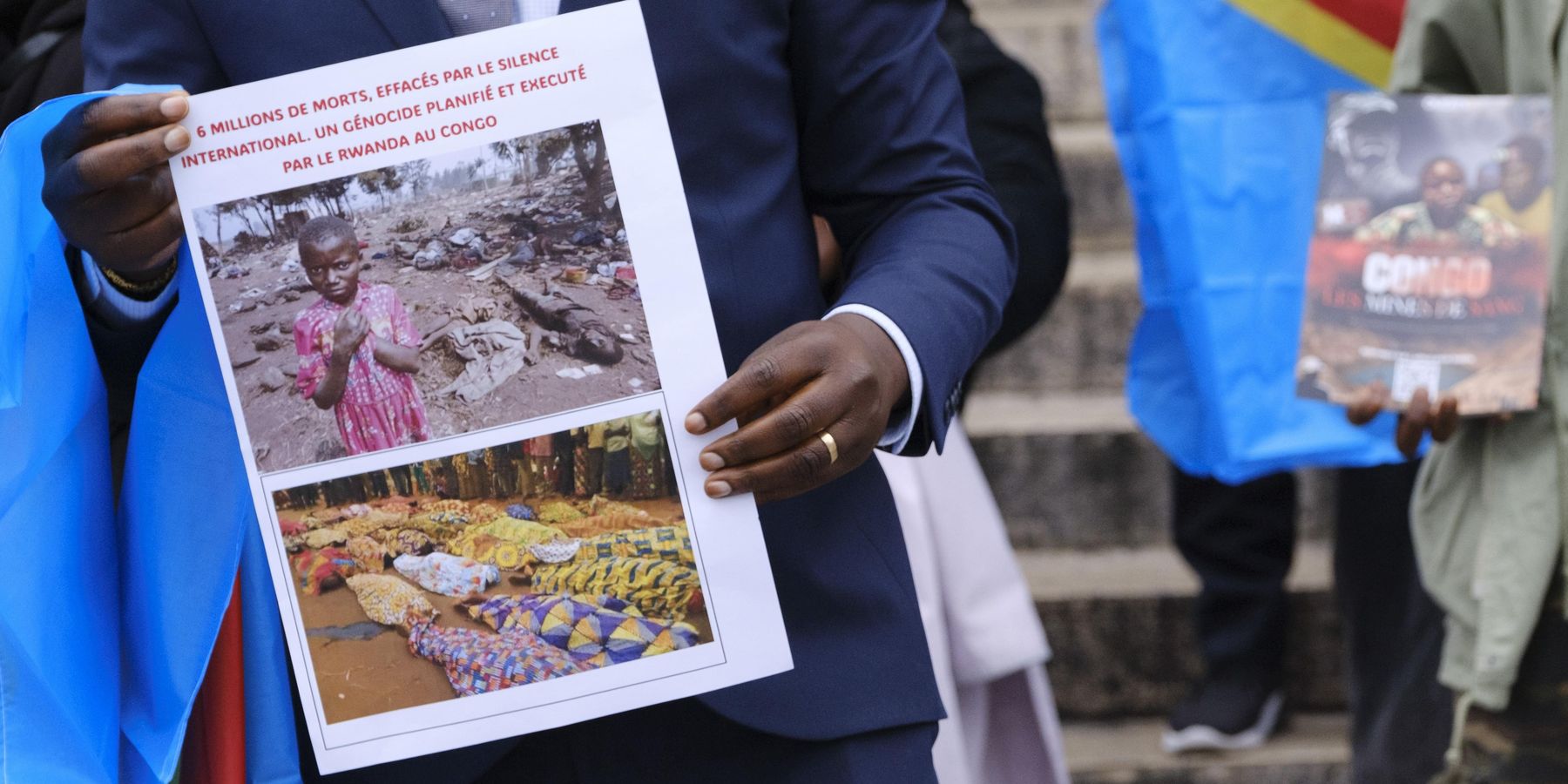
Among the wars on his list is the decades-long conflict between the Democratic Republic of Congo (DRC) and Rwanda, which has mired central Africa since the days of the Rwandan genocide in the 1990s in a quagmire conflict involving over one hundred armed groups.
But despite Trump’s claim, the DRC-Rwanda conflict is not yet over. And despite belligerent actors taking some positive steps to bring about a lasting peace — including Tuesday’s announcement that the Rwanda-supported M23 rebel group and the DRC have agreed on a mechanism to monitor a fragile ceasefire — the war remains an active conflict between the two neighbors and their allied groups.
In June, the foreign ministers of both the DRC and Rwanda sat together in the Oval Office to sign a peace agreement brokered in part by the United States. During the public event, the leaders from both countries lavished praise on the role Trump and his administration had played in securing this deal, and each expressed hope that this would serve as the first major step in ending the conflict.
Though the deal served as a positive step for all parties and great publicity for a White House eager to be seen as brokering peace in conflicts across the globe, there was a glaring omission in the agreement that threatened the durability of the peace from the onset.
The Rwandan-supported M23 rebel group — which is the primary belligerent against the DRC and its allies — was not included in the deal’s negotiations and was not a party to the inked agreement. The M23 has said that any deal between the DRC and Rwanda is merely an agreement between those two countries, and does not apply to them.
The success of the agreement, therefore, depends on getting M23 to agree to end its hostilities towards the DRC. This would happen if Rwanda tried to rein in the group by stopping or limiting its supply of materials to M23 and ending its logistical support for the group’s operations.
In the weeks following the signing ceremony, the DRC and M23 engaged in discussions in Doha, Qatar, mediated primarily by the Qataris. The talks led to an initial ceasefire and a framework agreement for a long-term peace deal between the two sides on July 19, which stated that negotiations for a final, long-term peace deal would begin on August 8 and conclude with an agreement signed no later than August 18.
But since the July 19 agreement, fighting has continued between the M23 rebels and the DRC, as well as with the many other rebel groups a part of the conflict.
As evidence that M23 is not the only major group involved in the war, on July 27, the Allied Democratic Forces (ADF) — another armed group fighting against the DRC — killed at least 40 Christians worshiping at a Congolese church. This came days after the ADF killed 82 civilians in eastern Congo.
And between July 10 and July 30, M23 was responsible for killing at least 140 people near the Virunga National Park in eastern DRC, including at least 14 people cut down by machetes. This is in addition to at least 319 people killed by M23 between July 9 and July 21 across four villages in eastern DRC.
In both sets of attacks, M23 continued to fight and kill for days after the July 19 ceasefire agreement was signed. Earlier this month the DRC government accused M23 of killing “hundreds” of people through “assassinations and summary executions” in September — weeks after the initial ceasefire agreement was adopted.
Long-term negotiations have sputtered. August 18 came and went without a final peace deal, as disagreements between the two sides on whether the initial framework required the M23 to fully withdraw from territory it had conquered proved to be an impasse in negotiations.
With the war continuing past stated deadlines, earlier this week the United Nations’ (UN) special envoy for the Great Lakes region of Africa, Huang Xia, said that while the peace efforts to end the war “are commendable and promising, they have not yet delivered on their promises: the agreed ceasefire is not being respected.”
In a major positive step towards a permanent ceasefire and lasting peace, on Tuesday the DRC and M23 agreed to form a monitoring body which will oversee the ceasefire between the two sides. The agreement came after weeks of negotiations primarily mediated and hosted by Qatar, with the United States also participating in discussions. The monitoring body is composed of representatives from the DRC, M23, and the 12-member regional body for that area known as the International Conference on the Great Lakes Region. In addition, representatives from Qatar, the United States, and African Union will be a part of the monitoring team.
This monitoring body is one of two steps required before the two could start negotiating the long-term peace deal, per the July framework agreement. The other is a prisoner swap. Although it was agreed to in September, the exchange has yet to take place.
Ending a war in which many rebel groups have joined rival factions to fight in a decades-long conflict stemming from a genocide is far easier said than done.
Trump’s focus on peace is in the right place. But his claim that his administration has successfully “ended the war” disintegrates in the face of continued fighting and killing in the eastern DRC. More work will be required from the president’s team to propel this process over the finish line.