

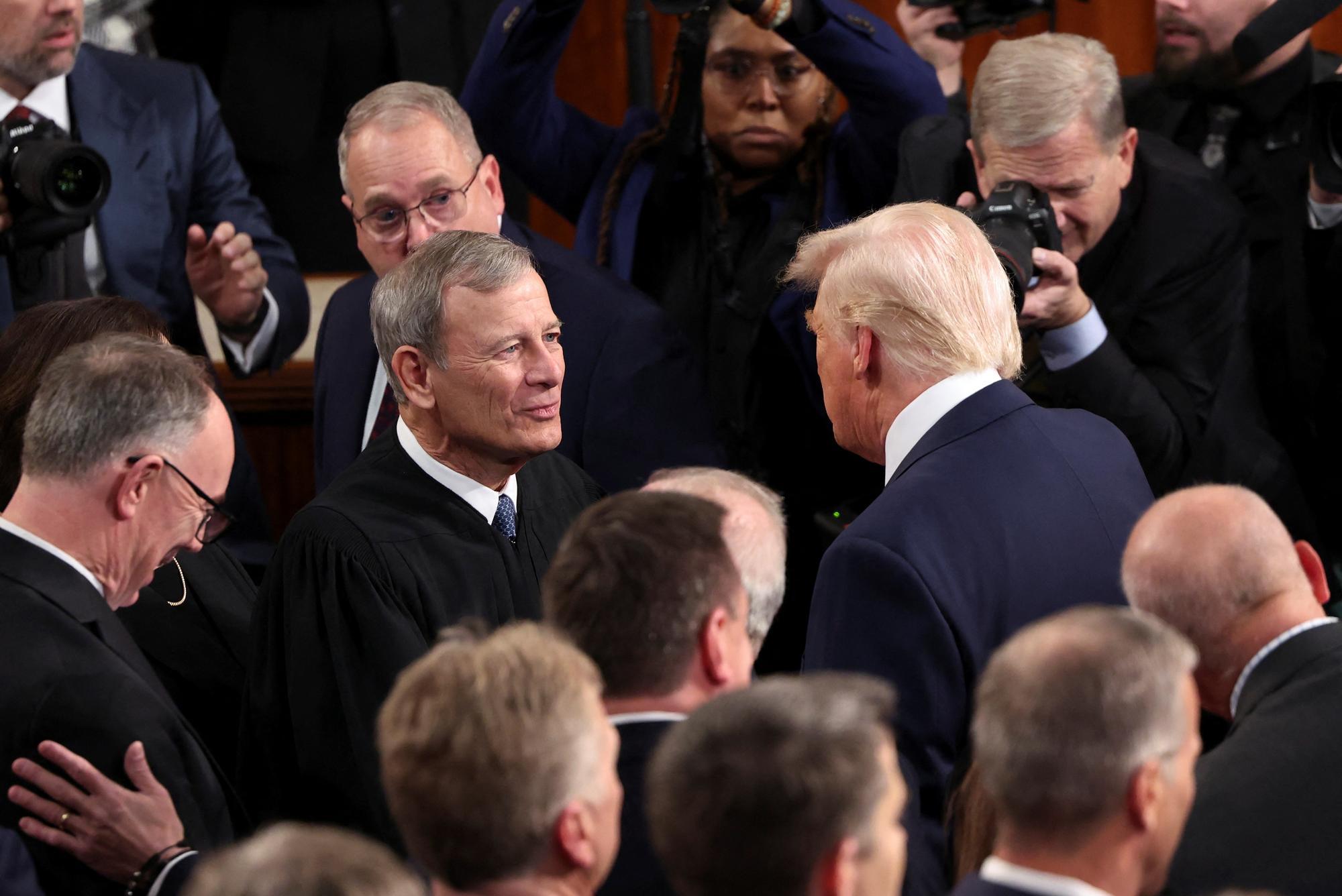
In a 6-3 decision, the Supreme Court today ruled against the White House on a key economic initiative of the Trump administration, concluding that the International Economic Emergency Powers Act (IEEPA) does not give the president the right to impose tariffs.
The ruling was not really a surprise; the tone of the questioning by several justices in early November was overwhelmingly skeptical of the administration’s argument, as prediction markets rightly concluded. Given the likelihood of this result, it should also come as no surprise that the Trump administration has already been plotting ways to work around the decision.
Tariffs have been the administration’s signature economic policy, and Treasury Secretary Scott Bessent referred to them as such when he defended their use on the eve of the Supreme Court hearings. At the time, he also noted that the administration has other legislative rationales to impose them should the court rule against the White House. And indeed, the administration just announced a global tariff of 10% under a section of the 1974 Trade Act designed to counter balance of payments difficulties.
These tools (known by their section numbers to trade law aficionados) include Section 301, which targets “unfair trade practices,” and Section 232, which invokes considerations of “national security.” Both those tools have been used by this and previous administrations, with Section 301 being the rationale for a multiyear battle between the U.S. and the European Union about their respective (alleged) subsidies to Boeing and Airbus.
The U.S. has also invoked the national security rationale in the past, hitting imports of oil from Iran and Libya in the 1970s and 1980s. But the use of Section 232 fell out of favor until Trump used it to justify broad tariffs on steel imports in his first term. Thus far, in his second term, he has used Section 232 to impose tariffs on products ranging from autos to bathroom vanities, with a number of investigations still continuing. Among other things, the protectionist approach to bathroom vanities might suggest a somewhat expansive vision of national security.
Tariffs under Sections 232 and 301 both require a period of investigation by the Commerce Department or U.S. Trade Representative before they can be put into effect. This makes them different from the IEEPA authority invoked by President Trump when he imposed tariffs for varied and sundry reasons on countries in the Global South, as in the case of the tariffs levied against Mexico for fentanyl, Brazil for "persecuting a former President" of that country, and India for importing Russian oil.
IEEPA authority was also the rationale behind the “reciprocal tariffs” of Liberation Day, an extraordinarily sweeping attempt to remake the global trading system and force countries seeking access to America’s markets to invest in production sites in the U.S. One big question is whether the SCOTUS ruling leaves the administration with other tools to achieve such an end. Among untried trade tools until now, Section 122 allows tariffs to remedy persistent trade imbalances, but such tariffs expire after 150 days unless Congress votes to extend them. This may prove to be an issue as six Republican representatives recently jumped ship in a vote that aimed to revoke the administration’s tariffs on Canada with a 219-211 majority. However, the measure may not pass the Senate, let alone survive a veto.
There is, however, one other clause: Section 338 of the 1930 Smoot-Hawley Act, which allows tariffs of up to 50% against any country that “discriminates” against the U.S. And indeed, in its calculation of the original Liberation Day tariffs, the administration already used a simple failure to achieve a perfect bilateral balance of trade as evidence of non-tariff barriers. As noted here by Clark Packard, a trade expert at the Cato Institute, Section 338 might come the closest to replicating President Trump’s use of IEEPA as a broad-spectrum trade tool.
It might thus be too soon to sound the all-clear on U.S. trade policy when it concerns an administration determined to use market access to the U.S. as both a swiss army knife and a sledgehammer.
- Bolsonaro's son: I convinced Trump to slap tariffs on Brazil ›
- In Garcia, SCOTUS risks handing Trump a ‘loaded weapon’ ›
- The Supreme Court did Trump a favor in Southeast Asia | Responsible Statecraft ›