

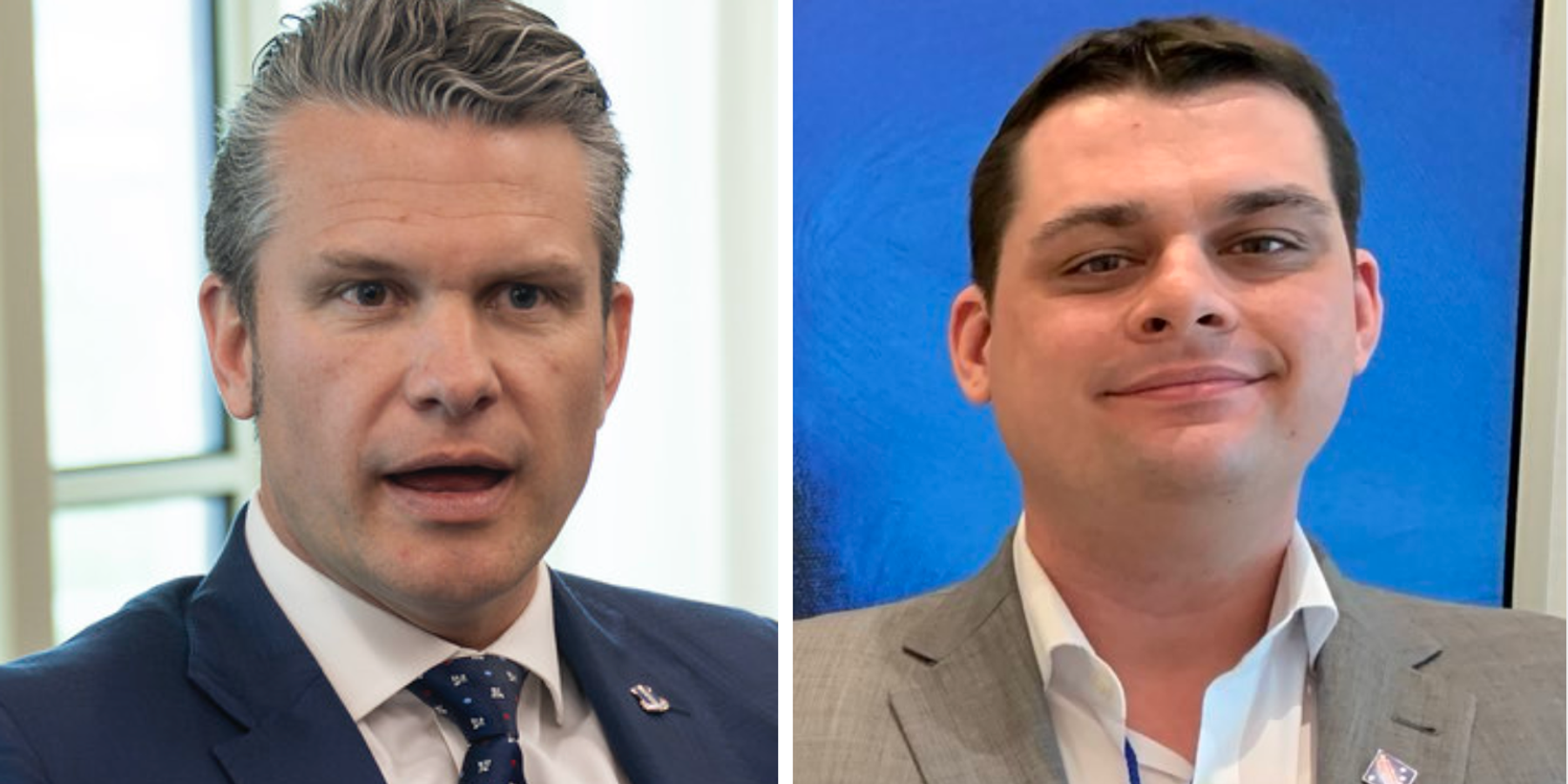
Dan Caldwell, an Iraq War veteran who left his role at Defense Priorities to serve as senior advisor to new Defense Secretary Pete Hegseth, released a joint statement with Hegseth deputy chief of staff Darin Selnick and Colin Carroll, the chief of staff to Deputy Defense Secretary Stephen Feinberg, on Saturday. All three had been terminated, according to reports on Friday.
Released on X, it reads:
We are incredibly disappointed by the manner in which our service at the Department of Defense ended. Unnamed Pentagon officials have slandered our character with baseless attacks on our way out the door. All three of us served our country honorably in uniform - for two of us, this included deployments to the wars in Iraq and Afghanistan. And, based on our collective service, we understand the importance of information security and worked every day to protect it. At this time, we still have not been told what exactly we were investigated for, if there is still an active investigation, or if there was even a real investigation of “leaks” to begin with. While this experience has been unconscionable, we remain supportive of the Trump-Vance Administration’s mission to make the Pentagon great again and achieve peace through strength. We hope in the future to support those efforts in different capacities.
The three men had been put on administrative leave earlier this week pending a leak investigation that reportedly revolved around military plans for the Panama Canal, a second carrier headed to the Red Sea, Elon Musk’s visit to the Pentagon in which he was supposedly getting briefed by top brass about military plans for confronting China, and the pause in cyber-intelligence for Ukraine. Details about the investigation were thin leading to all sorts of speculation about whether the three were being unfairly targeted or serving as "sacrificial lambs" for others in the Office of Secretary of Defense.
Interestingly, the leak investigation seemed to have nothing to do with the massive embarrassment caused when National Security Advisor Mike Waltz somehow invited notorious never-Trumper Jeffrey Goldberg, editor of The Atlantic, into a Signal chat in which Waltz, Hegseth and other top aides were talking about U.S. airstrikes against Yemen in real time. No one has seemingly taken the fall for that public relations catastrophe and likely breach of the Federal Records Act, as yet.
Reports are already emerging that Joe Kasper, Defense Secretary Pete Hegseth’s chief of staff, might have been the antagonist that led to the investigation and termination of Caldwell, Selnick, and Carroll. According to POLITICO, "some at the Pentagon also started to notice a rivalry between Kasper and the fired advisers."
“Joe didn’t like those guys,” said one defense official. “They all have different styles. They just didn’t get along. It was a personality clash.” As of Friday, Kasper himself was being shipped out of his role and into another one at the agency, according to POLITICO.
Caldwell was a longtime colleague of Hegseth at Concerned Veterans of America. Of course one wonders if Caldwell had been targeted for his positions, as he has played an active role in supporting a more realist and restraint-oriented national security policy, particularly in the areas of the Middle East and Ukraine. This is particularly salient as it has been reported that there is an open clash among Trump's inner circle over whether he should take a more diplomatic path towards Iran rather than opt for war.
Other such realists had been the target of smear jobs as "isolationists" and/or anti-Israel, in recent months, including Elbridge Colby, who was just confirmed as Under Secretary of Defense for Policy, Mike DiMino, Deputy Assistant Secretary of Defense for the Middle East, and Daniel Davis, who said he lost an opportunity to work for Director of National Intelligence Tulsi Gabbard after Jewish Insider magazine and other neoconservative voices called him out for his opposition to the war in Gaza and warnings about military conflict with Iran.
Update 4/20: Former chief DoD spokesman John Ullyott penned an op-ed in POLITICO Sunday night, in which said there "has been a full-blown meltdown at the Pentagon — and it’s becoming a real problem for the administration." He said he was a big supporter of Hegseth's candidacy for the job, but pointed out a number of wrong turns by Hegseth including the way Signalgate was handled. There are also new embarrassing revelations like another reported Signal chat regarding Yemen airstrikes that also included the Secretary's wife and brother. Also, a reported meeting with foreign defense officials in which his wife, a former FOX News reporter, was in attendance and sensitive information was discussed.
He said the purge of Hegseth's "closest advisors of over a decade" — Caldwell and Selnick — was "strange and baffling." He suggested the entire leak investigation was some sort of elaborate set-up.
While the department said that it would conduct polygraph tests as part of the probe, not one of the three has been given a lie detector test. In fact, at least one of them has told former colleagues that investigators advised him he was about to be cleared officially of any wrongdoing. Unfortunately, Hegseth’s team has developed a habit of spreading flat-out, easily debunked falsehoods anonymously about their colleagues on their way out the door.
He ended the piece suggesting it was time for a change at the top in order to save the President's national security agenda.
"The president deserves better than the current mishegoss at the Pentagon. Given his record of holding prior Cabinet leaders accountable, many in the secretary’s own inner circle will applaud quietly if Trump chooses to do the same in short order at the top of the Defense Department."