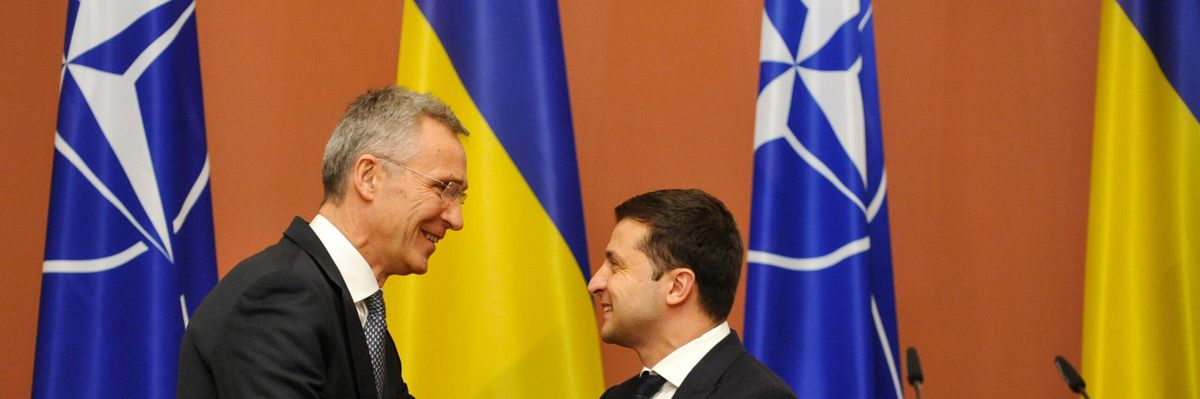
There is a renewed push from some European allies for NATO to create a “road map” for Ukraine to join the alliance.
According to The Financial Times, Poland and the Baltic states are pressing the alliance to take steps to move Ukraine closer to the future membership that the alliance promised in 2008 at the Bucharest summit. The somewhat surprising news in the report is that the Biden administration has joined Germany and Hungary in opposing these efforts “to offer Kyiv deeper ties with NATO and clear statements of support for its future membership.”
The U.S. has been one of the states most in favor of Ukraine’s future NATO membership, so the administration’s reluctance on this issue is a notable and welcome shift. Given that it was the U.S. under George W. Bush that sought Membership Action Plans (MAPs) for Georgia and Ukraine in 2008, it is significant that the U.S. is among those that prefer to maintain the status quo for now.
Eastern European allies have been lobbying for the alliance to make progress on Ukraine’s bid for membership for months. A delegation of Polish and Lithuanian lawmakers were in Washington earlier this year appealing to the Biden administration to act on bringing Ukraine into the alliance ahead of next year’s U.S. presidential election. Poland and the Baltic states have also been seeking to use the July NATO summit in Vilnius as the occasion for promoting Ukraine’s membership.
According to the FT report, these governments are finding some other allied states sympathetic to their arguments, but the U.S. “was pushing back” on efforts to open a “political path” for closer NATO-Ukraine ties.
It is important to understand that the Biden administration’s position in this intra-alliance debate does not reflect a major change in its view of Ukraine’s eventual membership. It shows the administration’s concern that the alliance remain focused on the immediate need to provide Ukraine with military assistance. As far as the Biden team is concerned, discussing a pathway for future alliance membership while the war is still raging would be putting the cart before the horse.
The administration seems to understand that bringing up such a contentious issue at the summit would create rifts in the alliance over a question that isn’t going to be resolved in the near future. Politico Europe reported on the recent meeting of the NATO-Ukraine Commission, where the divisions among NATO allies were already being laid bare: “Hungary, which has long blocked the body from meeting, grudgingly attended the session but vowed to continue opposing Ukrainian integration.” Putting those divisions on display at the NATO summit would hardly be conducive in rallying more support for Ukraine.
We should remember that making ill-advised declarations at NATO summits is one of the things that led to the current state of affairs. Fifteen years ago at the Bucharest summit, the alliance announced, “We agreed today that these countries [Ukraine and Georgia] will become members of NATO.” The alliance’s commitment at Bucharest was a serious error that should have been corrected many years ago. The pledge to bring Ukraine into the alliance in the future created a dangerous situation in which Ukraine was exposed to increased Russian hostility without any real guarantees of protection.
As a compromise between the U.S. and the European allies opposed to Ukrainian membership, it produced the worst of both worlds. It would have been much better for all concerned if the alliance had said nothing. Fifteen years later, Ukraine is still seeking entry through the so-called open door. The alliance should come clean with Ukraine and admit that they aren’t getting in.
Ukraine’s membership in the alliance has never made any sense for NATO or for the United States, and that is one reason why it has been put off for so long. While it is better to defer the decision rather than rushing ahead with another round of misguided alliance expansion, it is also unfair to keep stringing Ukraine along with the false hope of joining. Keeping up the illusion that alliance membership is a realistic prospect does no one any favors.
The debate over future Ukrainian membership is a symptom of an alliance that is too large with too many divergent interests. While Ukraine’s immediate neighbors may believe that bringing Ukraine into the alliance is urgent, most other members feel no such urgency and see nothing but the downsides to adding a new security commitment. Further expansion would only strengthen the forces that pull the alliance in opposite directions.
The historian Michael Kimmage once referred to NATO as a “loose and baggy monster” because of its many members and competing interests. Since then, it has become looser and baggier with another round of expansion already underway. Adding Ukraine on top of all that would be a bridge too far, and what’s more almost everyone in the alliance must know that by now.
The U.S. already has more than enough security commitments in Europe, and it should not entertain adding any more. Kimmage’s recommendation at the start of 2022 still makes sense today: “NATO must change course by publicly and explicitly refusing to add any more member states.” We will never know what difference, if any, such a commitment might have made if NATO had done this years earlier, but it is the right thing for the alliance to do now for its own sake.
No one should expect any of these major overhauls at the Vilnius summit, but we can at least hope that the allied leaders don’t make any more unforced errors as their predecessors did fifteen years ago.
There has been talk from NATO officials about using the Bucharest declaration as the basis for a new statement about Ukraine’s relationship with NATO, but this would compound the original error made back then. The alliance should not repeat pledges that it isn’t going to honor, and it shouldn’t make new ones that it can’t back up. Above all, the alliance should avoid saying anything that blurs the line between alliance members and non-allied partners. If NATO has learned anything from its past mistakes, it should choose to say nothing on this subject rather than make declarations it will regret.
Our foreign policy suffers from our leaders’ unwillingness to set limits. Support for ongoing NATO expansion has been a prime example of refusing to limit the new obligations that our government is willing to take on. As the U.S. is already overstretched with too many commitments around the world, the need to set some limits and close the door to additional obligations is clear.
Closing the door on further NATO expansion would be an important step towards a less ambitious foreign policy that is focused squarely on vital U.S. interests.