
Follow us on social

google cta
Are you a terrorist?

Are you a terrorist?

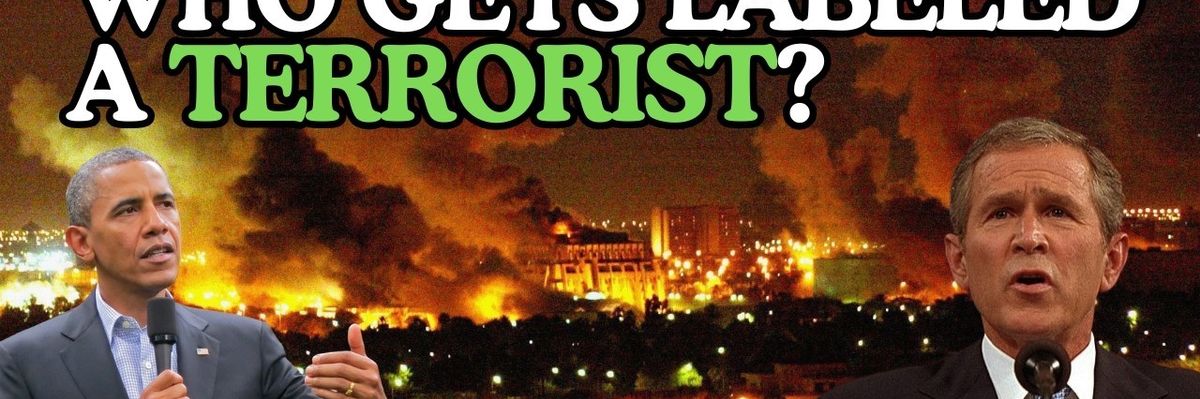
New episode of 'Always at War' with Elizabeth Beavers explores how U.S. laws have been used to quash dissent

Analysis | Video Section
google cta
google cta

What is terrorism? And who decides who is a terrorist and who isn’t? This vague, politically malleable concept has become the justification for a global American war against terrorism that spans 78 countries — more than a third of all nations. At home, it's handed local police departments $34 billion to buy military equipment, turning terrorism into a catch-all excuse for militarizing American communities.

In this episode of Always at War, we talk with national security law expert Elizabeth Beavers to unpack how terrorism designations work as political tools rather than security measures — keeping Nelson Mandela out of America until 2008, shutting down the biggest Muslim charity in the country, and now threatening Gaza protesters with prosecution.

We trace how terrorism laws originated in anti-Palestinian activism and evolved into a legal framework so broad that it criminalizes giving "expert advice" to designated groups. Through examples like the Holy Land Foundation — whose leaders went to prison for charity work the government admitted reached legitimate recipients — we show how these laws are designed not to stop violence, but to suppress political dissent and enforce American geopolitical interests.

The episode reveals how America’s Global War on Terror did little to eliminate “terrorism” – a potentially impossible goal – but to create an endless justification for global American dominance.

By declaring war on a concept rather than specific enemies, we've built a system where peace becomes impossible and every corner of the globe becomes a potential battlefield — all while the vague definition of "terrorism" expands to include anyone who challenges American interests.

Please check out the latest episode:


- YouTube
google cta
Analysis | Video Section
Royal Navy
Top image credit: The Royal Navy guided missile destroyer HMS Duncan arrives in the port of Hamburg and moors at the Überseebrücke. The HMS Duncan arrives from Portsmouth and will leave the Hanseatic city on Tuesday, November 25, at 10:00 a.m. Marcus Golejewski/dpa via Reuters Connect

If Europe starts attacking Russian cargo ships, all bets are off

Europe

Inspired by the U.S. seizure on the high seas of ships carrying Venezuelan oil, Britain and other NATO countries are now considering using their navies to do the same to ships carrying Russian cargoes.

This would be a radical escalation of existing moves against Russia’s so-called “shadow fleet,” which have been restricted to the ports and territorial waters of NATO states. As such, they can be considered to fall under the sovereign jurisdiction of the states concerned. An extension of this strategy, as presently contemplated by some European countries, would be a limited but reasonable and comparatively risk-free way of increasing economic pressure on Russia.

keep readingShow less
Friedrich Merz
Top image credit: EUS-Nachrichten via shutterstock.com

Germany's grandstanding on Iran: The best Europe can muster?

Europe

In a striking display of recklessness, German Chancellor Friedrich Merz declared the Islamic Republic of Iran to be in its “last days and weeks,” a regime he asserted had “no legitimacy.”

While other Western leaders condemned the bloody clampdown on the protests in Iran — with, according to conservative estimates, around 2,500 a in few days — none of them went so far as to boldly prognosticate an imminent demise of the regime in Tehran.

keep readingShow less
Trump and Lindsey Graham
Top photo credit: U.S. President Donald Trump, with Secretary of Commerce Howard Lutnick and Senator Lindsey Graham (R-SC), speaks to reporters aboard Air Force One en route from Florida to Joint Base Andrews, Maryland, U.S., January 4, 2026. REUTERS/Jonathan Ernst

Does MAGA want Trump to ‘make regime change great again’?

Washington Politics

“We must abandon the failed policy of nation building and regime change that Hillary Clinton pushed in Iraq, Libya, Egypt and Syria,” then-candidate Donald Trump said in his acceptance speech at the Republican National Convention in 2016.

This wasn’t the first time he eschewed the foreign policies of his predecessors: “We’re not looking for regime change,” he said of Iran and North Korea during a press conference in 2019. “We’ve learned that lesson a long time ago.”

keep readingShow less
google cta
Want more of our stories on Google?
Click here to make us a Preferred Source.

LATEST

QIOSK

Newsletter

Subscribe now to our weekly round-up and don't miss a beat with your favorite RS contributors and reporters, as well as staff analysis, opinion, and news promoting a positive, non-partisan vision of U.S. foreign policy.