

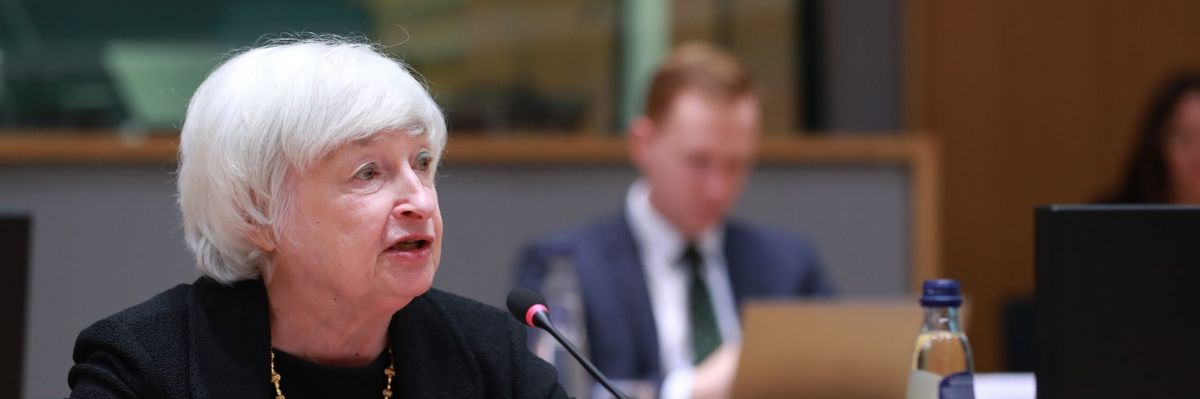
U.S. Treasury Secretary Janet Yellen said recently that U.S. sanctions on Iran simply are not working, or at least working “much less than we would ideally like.” This was quite a significant admission, as Yellen heads the government agency responsible for developing and imposing U.S. trade and economic sanctions regimes.
Is the U.S. government finally recognizing that sanctions are falling short of their stated foreign policy objectives? Secretary Yellen appeared to admit as much, saying that while U.S. sanctions on Iran have not led to behavior change, they have led to a “real economic crisis in the country, and Iran is greatly suffering economically because of the sanctions.”
Same strategy, same results
Iran is just the latest example of how sanctions rarely, if ever, meet their stated goals yet consistently succeed in causing mass civilian suffering and casualty. In North Korea, for example, U.S. sanctions have created intense barriers to humanitarian aid distribution, as many banks do not want to face the risks associated with navigating transactions to the country. They have gendered impacts, creating a “dire economic and food situation” that forces women into spaces of heightened risk of “sexual and gender-based violence, transactional sex and prostitution, and high levels of trafficking.”
In addition, while causing significant harm to civilians, economic sanctions have failed to prevent North Korea’s proliferation of its ballistic missile and nuclear weapons programs.
In Venezuela, Alena Douhan, a United Nations Special Rapporteur, found U.S. sanctions have “devastating” impacts that “[violate] the rights to freedom of movement, food, health, education, and access to justice.” While creating and exacerbating economic and humanitarian crises across the country, including the downfall of the economy, U.S. sanctions have not had their stated impact of compelling the Venezuelan government to change its behavior or decrease its power.
Meanwhile, the U.S. issued broad-based sanctions following Russia’s invasion of Ukraine, however, the Russian economy has proved more resilient than anticipated. Most countries still maintain economic and diplomatic ties to Russia rather than isolating the country and Russian military aggression is only increasing with the Kremlin’s announcement to use Belarus as a staging ground for tactical nuclear weapons. These instances demonstrate, as highlighted by Council on Foreign Relations (CFR) President Richard Haass, just how much sanctions “have not come close to persuading Putin to reverse his policy.”
In Afghanistan, after the U.S. military withdrawal in August 2021, the Taliban took control and installed themselves as the country’s de facto government. They have since maintained power, despite being a sanctioned entity on the U.S.’s Specially Designated Global Terrorist (SDGT) list since July 2002, and the U.S. freezing Afghan assets. Meanwhile, Afghans suffer as economic and humanitarian devastation sweep the country; World Food Programme (WFP) statistics show there are “more than 6 million people on the brink of famine-like conditions” — exacerbated by U.S. policies.
In Somalia, the March 2008 designation of al-Shabaab played a leading role in drastically reducing and blocking aid during the 2011 famine, resulting in U.S. sanctions policy greatly contributing to the deaths of “about 258,000 people between October 2010 and April 2012, according to the Famine Early Warning Systems Network (FEWS NET). This famine was predicted and largely preventable. In its wake, al-Shabaab remains an active threat in Somalia today.
In Cuba, a State Department Memorandum shows that the U.S. embargo, launched in the early 1960s, aimed to weaken support for Fidel Castro “through disenchantment and disaffection based on economic dissatisfaction and hardship.” A 1982 CIA memo lays out these failures, revealing that U.S. sanctions policy towards Cuba: 1) “have not met any of their objectives” 2) “have almost no chance of compelling the present Cuban leadership” 3) “provided Castro with a scapegoat for all kinds of domestic problems” and 4) “Cuban adjustment to the impact of the sanctions left the United States with limited economic means to influence Havana's behavior.” These failures have not altered harsh sanctions, with the Biden administration continuing the Trump-era “maximum pressure” campaign against the country.
Often serving as another way for the U.S. to promote hegemony in the name of democracy and human rights, regime change is both a dubious objective in and of itself and is one sanctions cannot achieve. Indeed, scholars who have studied whether sanctions lead to regime change agree that “they rarely, if ever, work,” while ample evidence demonstrates that sanctions cause harm to civilian populations and civil society.
Progress thus far
There is reason to hope that a change in course is possible. The Treasury Department underwent a sanctions modernization process beginning with the October 2021 Sanctions Review, and culminating in two December 2022 policy shifts. First, the U.S. and Ireland co-led the adoption of United Nations Security Council Resolution (UNSCR) 2664, creating a standing humanitarian carveout across existing UN sanctions regimes. Second, the Treasury Department implemented the UNSCR domestically by authorizing "Historic Humanitarian Sanctions Exceptions," issuing new and amended general licenses to ease the flow of humanitarian, peacebuilding, and other life-saving activities in sanctioned areas. These initiatives are welcome first steps — but more can and must be done.
Time for a sanctions rethink
The 1982 CIA Memo on Cuba indicates that the U.S. government has had at least 41 years of internal evidence of sanctions not meeting their stated objectives. What can be done to ensure that U.S. foreign policy does not continue this déjà vu?
Humanitarian carveouts alone cannot meaningfully mitigate harms to civilians in sanctioned areas, nor can they create the enabling environment civil society needs to carry out their work in support of these civilians. Without reforms to the U.S. material support statute, which prohibits engagement with designated foreign terrorist organizations (FTOs), critical peacebuilding and humanitarian action by civil society organizations (CSOs) will remain functionally banned. This means that not only is the kind of conflict resolution that could deprive FTOs of the chaos they need to survive effectively prohibited, but many populations forced to live under FTO-controlled territories are unable to receive needed aid.
This is because, under the material support prohibition, CSOs could face civil or criminal liability for engaging these communities. While U.S. foreign policy states intentions to punish terrorist entities, it actually ends up punishing innocent civilians, and undermining its own professed goals of countering terrorism and preventing violent extremism.
Likewise, future sanctions should have built-in sunset provisions. This would provide for data-driven and evidence-based approaches to sanctions regimes, whereby their continuation is not guaranteed, but determined by findings of efficacy. According to the U.S. Government Accountability Office (GAO), as of now, “Federal agencies do not conduct comprehensive assessments that measure how effective sanctions are in meeting U.S. foreign policy goals.” Current sanctions regimes should be reviewed through routine impact assessments for relevance, efficacy, and to what extent they are meeting their objectives. Precedent should be set to ensure that sanctions that fall short of their intended targets are revamped or discontinued.
The scope of sanctions should be, by matter of practice: targeted, well-defined, time-bound, have clear and measurable objectives, and have specific off-ramps. Further, the U.S. should move beyond implementing broad-based sanctions that ask too much of citizens of other countries that have little control of how their governments operate.
These are all policy and legal choices. Amendments, reforms, and even more meaningful humanitarian carveouts are all possible — they just require the Biden administration to live up to its promise of implementing a human rights-based foreign policy agenda.
This administration could make history by becoming the first to acknowledge that national security and counterterrorism aims are not at odds with, but rather complementary to, peacebuilding and humanitarian action aims. It can create norms around these aims being mutually beneficial, rather than mutually exclusive.
To paraphrase Tolkien in the Lord of the Rings, “All that [Biden administration officials] have to decide is what to do with the time that is given [them].” We do not yet know if President Biden will seek or be granted a second term. This administration would be wise to make the most of the time that is given and implement these life-saving changes to sanctions policy as quickly as possible.