

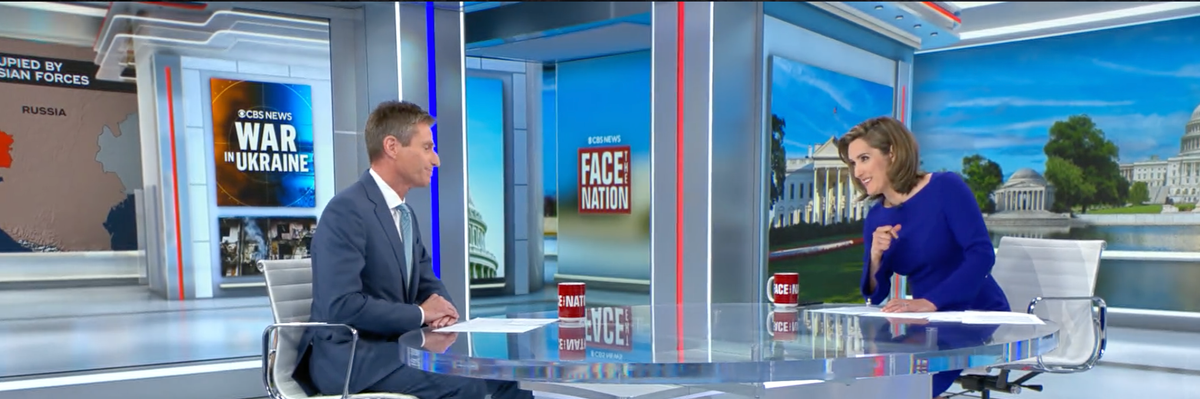
You could see something new playing out on the Sunday shows this weekend: Some TV news networks are starting to raise questions about whether the U.S. involvement in the Ukraine might have some downsides.
But not on CBS's "Face the Nation."
After hearing from House Speaker Nancy Pelosi — who called for "more weapons, more sanctions" — and Ukrainian Ambassador to the U.S. Oksana Markarova — who asked for "more military support, more sanctions" — "Face the Nation" host Margaret Brennan warmly welcomed Jim Taiclet, the chairman and CEO of Lockheed Martin, tossing him questions that weren't even softballs, they were bouquets.
One can imagine how that might have come about. Earlier in the week, President Biden visited a Lockheed Martin factory in Alabama that makes Javelin anti-tank missiles, pitching his requests for $33 billion in aid to Ukraine and subsidies for American microchip production. So Ukraine and supply-chain issues were in the news, and Taiclet could address both.
But still, what it came down to was a major television network inviting onto its marquee news show the head of the largest weapons manufacturer in the world — the company that profits more from war than any other company worldwide — and not asking a single pointed question.
Watch the entire six-minute segment and ask yourself if state television in a totalitarian country would have done it any differently.
After praising the Javelin and marveling at Lockheed's ability to ramp up production so quickly, Brennan actually fed Taiclet a line to make it seem like what he was doing is particularly noble.
MARGARET BRENNAN: You said -- well, you implied you’re basically doing on spec, right?
JIM TAICLET: That's right.
MARGARET BRENNAN: But you're a businessperson. You have to plan ahead. We don't know how long this war is going to last. The CIA says, you know, Vladimir Putin thinks he's got to double down here. So, how long are you planning for with this ramp up?
The idea that Lockheed is taking a risk and doing this "on spec" is risible. Orders are pouring in, not the least of which being a new request from the Army for $239 million in Javelins over the next three years.
And Taiclet himself then proceeded to make the case that for Lockheed, things are looking very good indeed for sales on Javelins, Stingers, and “advanced cruise missiles.”
“The Ukrainian conflict has highlighted a couple of really important things for us,” he said. “One is that we need to have superior systems in large enough numbers. …So, we know there's going to be increased demand for those kinds of systems from the U.S. and for our allies as well and beyond into Asia Pacific most likely too.”
Taiclet said the “second really valuable lesson” from the war in Ukraine is that “control of the air space is really critical” and then began the upsell:
So products and systems like F-16, F-35, patriot missiles, THAAD missiles, we know that there's going to be increased demand for those kinds of equipment, too, because the threat between Russia and China is just going to increase even after the Ukrainian war, we hope is over soon. Though two nations, and regionally Iran and North Korea, are not going to get less active. Probably they're going to get more active. So we want to make sure we can supply our allies and our country what they need to defend against that.
This guy is a weapons merchant. He sees crises as opportunities. And once the war in Ukraine is over, he's clearly looking forward to increased tensions with Russia, China, Iran and North Korea.
Brennan questioned nothing.
How much are U.S. taxpayers spending on those Javelins? She didn't ask. The Pentagon's 2023 budget request calls for buying 586, at a total cost of $189 million, or about $322,000 per unit.
How much is too much? Global military spending was already at astronomical levels even before Ukraine — topping $2 trillion for the first time in 2021, according to the Stockholm International Peace Research Institute. The United States accounts for 38 percent of that, more than the next 11 highest-spending countries combined.
Just how much money is Lockheed Martin making from all of this? It's by far the largest arms company in the world, with $67 billion in sales last year. In fact, it made so much money in 2021 that it spent $4.1 billion simply buying back its stock — a move that typically increases share prices and makes stock options wildly more lucrative.
So how much did Taiclet earn last year? $18 million. How much bigger a bonus will he get this year? Who knows?
Brennan also encouraged Taiclet to complain about supply chain issues.
MARGARET BRENNAN: So what do you need to do that, because you did say supply chain is an issue? I read that there's over, what, 250 microchips or semiconductors in each Javelin.
JIM TAICLET: That's right.
MARGARET BRENNAN: We know there's an effort in Congress to get legislation to try to create more semiconductors here instead of relying on Asian suppliers. Can you do this scale-up without that kind of legislation?
Answering that question directly and honestly might have led to embarrassing Brennan, since Taiclet told investors last month that supply-chain issues are already being resolved, and that “we expect these timing impacts to be recovered over the course of 2022.”
So he sidestepped:
JIM TAICLET: It will be extremely helpful to have the bipartisan Innovation Act passed, for example, because we do need to invest more in the infrastructure in the U.S. so we have domestic supply, especially in microprocessors. And so our production line can run today, but in the future we're going to need more domestic capability in microprocessor, not only design, but manufacturing, testing, et cetera, so that were have assured supply of those microprocessors in the future.
Brennan kept on trying to feed him lines:
MARGARET BRENNAN: But we've heard on this program time and again from businesspeople how important that is to get done. Congress still hasn't voted on it or voted it through.
JIM TAICLET: Right.
MARGARET BRENNAN: Do you have any commitments from anyone here in Washington to get this to the president's desk soon?
JIM TAICLET: Well, we know that there's a lot of support for it both in Congress, in the administration, the Commerce Department, et cetera.
MARGARET BRENNAN: Because it takes time to scale that up?
So it wasn't just that CBS invited the world's biggest weapons manufacturer to address its huge audience about an ongoing war — it fluffed him up and tried to get him to whine more, even as he spoke enthusiastically about future opportunities to make a killing.
"Face the Nation" was an outlier on Sunday, however. Hosts on several other networks asked at least a few skeptical questions of their guests.
Ironically, it may have taken an admonitory column by New York Times opinion columnist Thomas Friedman to change their tone.
Friedman, whose optimistic warmongering during the Iraq war became synonymous with clueless, armchair-warrior punditry, wrote on Friday that we "are edging toward a direct war [with Russia] — and no one has prepared the American people or Congress for that." He continued:
We need to stick as tightly as possible to our original limited and clearly defined aim of helping Ukraine expel Russian forces as much as possible or negotiate for their withdrawal whenever Ukraine’s leaders feel the time is right.
But we are dealing with some incredibly unstable elements, particularly a politically wounded Putin. Boasting about killing his generals and sinking his ships, or falling in love with Ukraine in ways that will get us enmeshed there forever, is the height of folly.
Bret Baier on "Fox News Sunday" and Abby Phillips on CNN's "Inside Politics" both actually quoted from Friedman's column.
On Fox News, mentioning Friedman’s piece led Sen. Lindsay Graham to even further heights of hawkery, declaring that "Putin must go. I like Tom Friedman, but… let's take out Putin by helping Ukraine." Even Baier asked if there was another way. "There is no offramp. No offramp," Graham insisted.
By contrast, on CNN, quoting Friedman led to a strong discussion with former CNN Moscow correspondent Jill Dougherty and New Yorker writer Robin Wright about what could "trigger a wider war."
Phillips asked Wright about her recent article declaring that "the conflict has rapidly evolved into a full proxy war with Russia, with global ramifications."
"We were initially reactive," Wright said. "We crossed a threshold in saying we want to weaken Russia, that Ukraine, independent and sovereign, will long outlast Vladimir Putin." Wright added that U.S. intelligence officials "went a step too far about the language about the intelligence we were giving."
And Dougherty raised the possibility of diminishing popular support, saying some Americans are "looking at the economy, and inflation going through the roof, and people who have investments are looking at the market, and there might be some people who say well where's all this money coming from? And why is it going to Ukraine? Don't we have problems?"
NBC's "Meet the Press" stuck entirely to the abortion debate. On ABC's "This Week," host Martha Raddatz promised viewers a discussion of how "intelligence leaks prompt new fears that the U.S. could be closer to direct conflict with Russia" – but that topic didn't actually come up in the two reports about Ukraine later in the show.
In the most hopeful sign that Washington journalists are becoming more skeptical in their reporting of the war in Ukraine, CNN "State of the Union" host Jake Tapper peppered U.N. Ambassador to the United Nations Linda Thomas-Greenfield with solid questions, starting with a crucial one:
TAPPER: So, the U.S. is supplying deadly weapons, financial aid, intelligence that allows Ukraine to kill Russians. At what point is this just a proxy war that the U.S. is fighting against Russia, but the U.S. is not the one pulling the trigger? Where's the line there?
Thomas-Greenfield's answer was non-responsive, simply asserting that support will continue and "Russia has felt the consequences of our support for the Ukrainians."
TAPPER: I mean, we're not giving them the location of a Russian general so that they can order Uber Eats for them. It's with the express purpose of, here is where this Russian general is. Go do what you're going to do. And then the Ukrainians kill them.
The ambassador parried again:
THOMAS-GREENFIELD: We're providing them with the intelligence, so that they can defend themselves against Russian aggression and also put them in a position where they're stronger at the negotiating table against the Russians. How they use that intelligence is up to them.
Good questions. The next step, of course, is demanding real answers.