

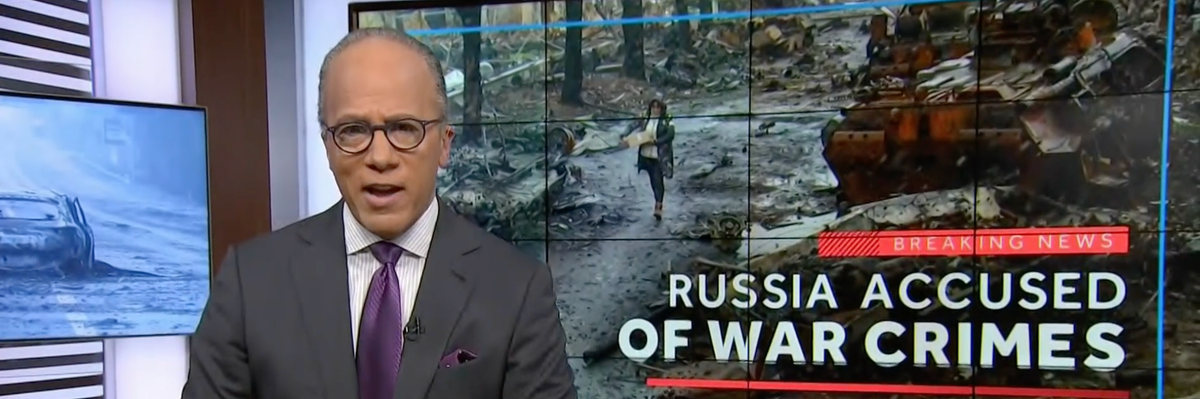
The evening news programs of the three dominant U.S. television networks devoted more coverage to the war in Ukraine last month than in any other month during all wars, including those in which the U.S. military was directly engaged, since the 1991 Gulf War against Iraq, according to the authoritative Tyndall Report. The only exception was the last war in which U.S. forces participated in Europe, the 1999 Kosovo campaign.
Combined, the three networks — ABC, CBS, and NBC — devoted 562 minutes to the first full month of the war in Ukraine. That was more time than in the first month of the U.S. invasion of Panama in December 1989 (240 mins), its intervention in Somalia in 1992 (423 mins), and even the first month of its invasion of Afghanistan in November 2001 (306 minutes), according to a commentary published Thursday by Andrew Tyndall, who has monitored and coded the three networks' nightly news each weekday since 1988.
“Astonishingly, the two peak months of coverage of the [2003] Iraq war each saw less saturated coverage than last month in Ukraine (414 minutes in March of 2003 and 455 minutes in April),” he wrote. “…The only three months of war coverage in the last 35 years that have been more intensive than last month were Saddam Hussein’s invasion of Kuwait in August 1990 (1,208 minutes) and his subsequent removal in January and February 1991 (1,177 and 1,033 minutes respectively).”
That was at a time, however, when the network evening news devoted about a third more time to foreign news than it has in recent years when international news coverage has fallen to all-time lows.
Last month’s coverage of Ukraine even eclipsed by a wide margin the three networks’ coverage of the chaotic end of Washington’s 20-year war in Afghanistan last summer. Last August, the month with the most intense coverage, the three networks devoted a total of 345 minutes (or only about 60 percent of last month’s total Ukraine coverage) to the war’s abrupt denouement. Once U.S. forces had fully withdrawn by August 31, network coverage of Afghanistan fell precipitously to a total of just 103 minutes between September 1 and the end of year, despite the desperation of the country’s humanitarian situation that followed (and persists).
While the major cable news networks often receive more public attention, the evening news shows of ABC, CBS, and NBC collectively remain the single most important source of international news in the United States.
On weekday evenings, an average of some 20 million U.S. viewers tune in to national news programs on one or more of the three networks. That’s roughly four times the number of people who rely on the major cable stations — Fox News, MSNBC, and CNN — for their news during prime time. About two million more people watch the network news via the internet, according to Tyndall. The actual news content on each network runs about 22 minutes; in March, the total number of minutes of content for all three weekday evening news shows would have reached around 1500 minutes.
Historically, the amount of news coverage devoted to foreign wars has been positively correlated with the direct involvement of the U.S. military. “Normal expectations are that wars are always more newsworthy in America when American lives are at risk,” according to Tyndall, who noted that the only war in the last several decades to which the networks devoted as much time in one month as last month’s total coverage of Ukraine was in Kosovo in April 1999 (565 minutes) when U.S. aircraft led NATO’s bombing campaign against Serbia.
But the Russian invasion of Ukraine, which began in late February, “has overturned all normal patterns of journalistic response,” according to Tyndall. He gave most of the credit to the leadership and media savvy of President Volodymyr Zelensky who has largely controlled the narrative conveyed to Americans via the networks.
“It is a demonstration of Zelensky’s perceived newsworthiness that both ABC World News tonight and NBC Nightly News decided to assign their anchors to an extended interview with him, despite the fact that he would not be speaking English, meaning that the audio would consist of the stilted tones of a simultaneous translator,” Tyndall observed.
It also helped that “the overall structure of the coverage has been Kyiv-based,” in part due to Russia’s enactment of strict censorship coverage that, among other things, made it much more difficult to cover Moscow’s views. “Yet, more unusual for the American news media, there has been precious little coverage from Washington,” Tyndall observed. “Normally in a war in which the United States is not involved, it would be the default position of the American news media to search for a fair-and-balanced way to present both sides of the conflict. It is to Zelensky’s credit that, this time, the networks had no problem seeing the conflict from his point of view.”
This has extended even to the networks’ treatment of the refugee crisis provoked by the Russian invasion. “Normally, refugees are a seen-from-both-sides problem: desperate Syrians, or Haitians, or Central Americans clamoring at a border for humanitarian relief — and immigration officials at checkpoints guarding against an untrammeled influx that might overwhelm the host country,” according to Tyndall. “In this case, …there was no doubt that these refugees, mostly women and children and the elderly, were on a righteous ‘unarmed road of flight,’ as the bard puts it.”
The fact that all three networks sent their anchors to Lviv or Poland to cover the displaced and the refugees underlined both the importance of the story and the side that they were effectively taking, according to Tyndall.
In stressing the importance of Zelinsky’s own role, Tyndall noted that last month’s intensity of coverage is not explained by the uniqueness or importance to U.S. national security of Ukraine itself. In all of 2014, when both the pro-Moscow government in Kyiv was ousted and Moscow invaded and annexed Crimea and aided secessionist forces in the Donbas, the three networks devoted a total of 392 minutes, or an average of just over 32 minutes a month. Of course, that invasion resulted in U.S. and Western sanctions against Russia that set relations on a downward trajectory from which they have never recovered.
The networks’ fixation with Ukraine essentially filled to overflowing the “news hole” for international news. Only short snippets, including North Korean missile tests, the China East airliner crash, U.S.-China talks (which also centered around Ukraine), and Venezuela’s release of two U.S. oil executives were mentioned by one or more of the networks during the month. The economic situation in Russia itself, as well as the sanctions levied against Moscow and the country’s oligarchs — both of which were directly related to Ukraine in any event — were also the subject of discrete stories.
The Ukraine coverage in March also crowded out the latest developments in the devastating humanitarian crises caused by Afghanistan’s collapsed economy and the ongoing wars in Yemen and Ethiopia.