

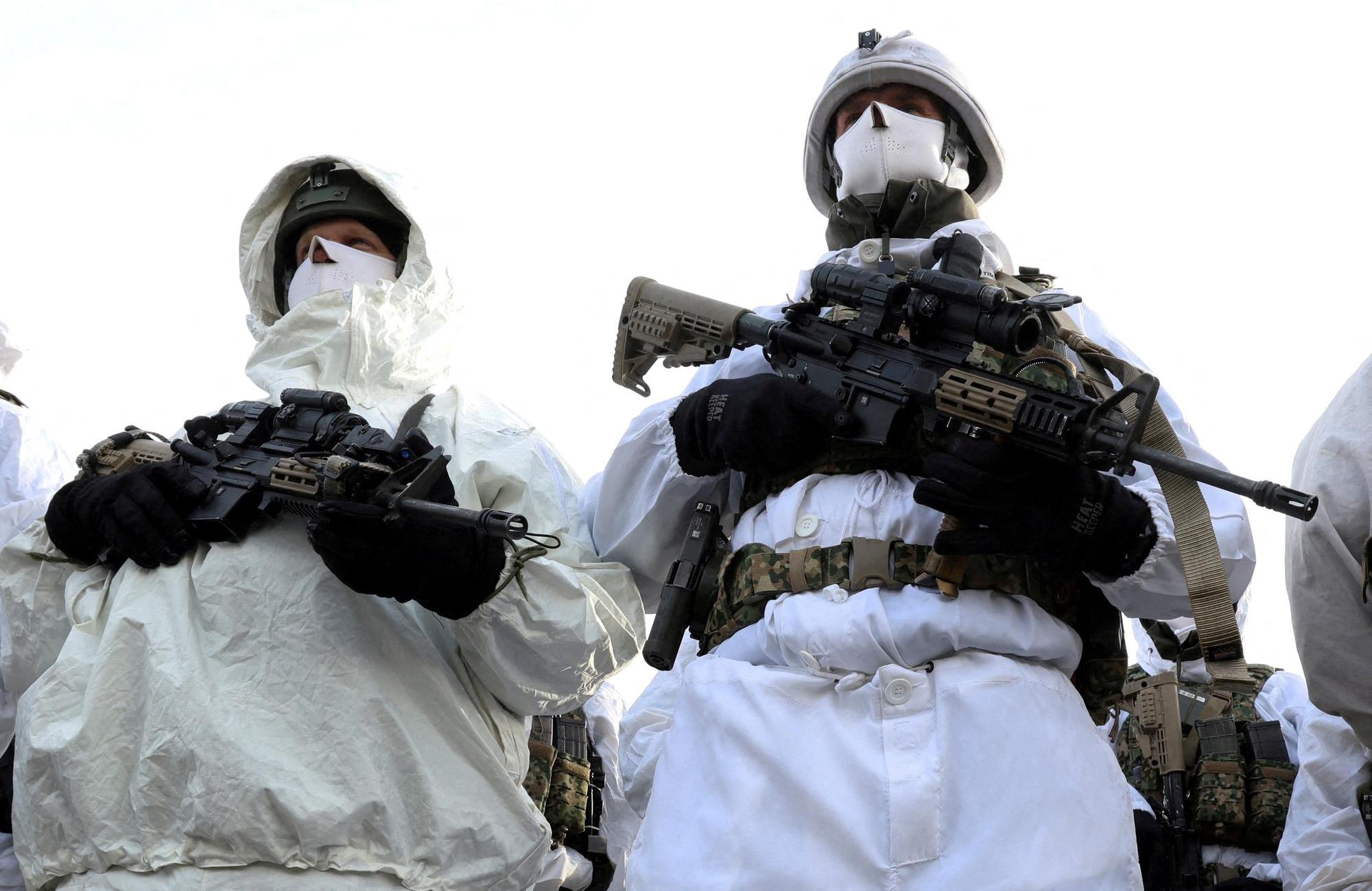
Last week, NATO launched “Arctic Sentry,” a new “multi-domain activity” that, for the first time, places Allied operations in the Arctic under a single command structure. The move marks a significant scaling-up of NATO's footprint in the Arctic. But unfortunately, as NATO’s regional military presence increases, the mechanisms for preventing that footprint from generating a crisis are not keeping pace.
“In the face of Russia’s increased military activity and China’s growing interest in the High North, it was crucial that we do more,” said NATO Secretary General Mark Rutte on February 11.
Russia and China are indeed increasing their activities in the Arctic. But an “Enhanced Vigilance Activity” without a parallel investment in deconfliction is incomplete deterrence: it signals resolve while leaving the door wide open to accidental escalation.
Arctic Sentry arrives in a politically charged context. President Trump has ramped up tensions in the alliance by threatening to annex Greenland. The mission follows Trump’s meeting with Rutte in Davos, where they agreed NATO should do more for Arctic defense and “prevent the Russians and the Chinese getting more access to the Arctic region.”
Even after Europe dispatched a small, symbolic force to Greenland last month, the White House made clear that European troops there would not change Trump’s mind about annexation.
Now, to ease inter-alliance tensions and stave off Trump’s calls for annexation, those same Allies are rallying behind claims about Russian and Chinese encroachment that their own officials had earlier dismissed.
The ensuing buildup
The pace of force commitments since the Arctic Sentry announcement has been striking. Days after the launch, British Prime Minister Keir Starmer told the Munich Security Conference that the UK will deploy its carrier strike group up north this year “in a powerful show of force against Russian threats in the Arctic,” led by the HMS Prince of Wales and operating alongside the U.S., Canada, and other NATO Allies. The deployment will include activity under the Arctic Sentry umbrella.
A carrier strike group signals a serious commitment to the region and is useful for deterrence, but it also raises the risks of military interactions in an already tense part of the world.
Sweden is joining with JAS 39 Gripen fighters around Iceland and Greenland. Germany is sending four Eurofighter jets. Denmark is providing four F-35 fighter jets. The UK has committed to doubling its troop deployment to Norway to 2,000 over three years.
Arctic Sentry follows Baltic Sentry, launched in January 2025 to protect critical infrastructure in Baltic waters, and Eastern Sentry, an ongoing deterrence mission along NATO’s eastern borders since September 2025. NATO is now running three simultaneous “Sentry” operations along its entire northern and eastern perimeter.
NATO says Arctic Sentry isn’t a formal operation and doesn’t imply permanent deployments. But the trend is clear: more coordination, more activity, and more military signaling, but not enough crisis-management tools to match.
Risks in the Arctic
The Stockholm International Peace Research Institute (SIPRI) warned in late 2025 that the risk of inadvertent escalation is especially high in Northern Europe, and that NATO reinforcements in the Arctic could have unintended consequences for strategic stability, including raising the specter of nuclear escalation.
Both Russia and NATO have nuclear-armed submarines moving through Arctic waters. Russia uses the region to test nuclear-powered cruise-missiles and underwater drones. Sweden, NATO’s newest member, is in talks with France and the UK on possible nuclear weapons cooperation.
Both NATO and Russian officials argue that their own buildup is just a response to what the other side is doing. Each side’s deterrence rationale feeds the other’s threat perception, and neither side has invested adequately in the off-ramps.
Moscow is predictably concerned about Arctic Sentry. The Russian Foreign Ministry called the mission “yet another provocation by Western countries, which are attempting to impose their own rules in this part of the world.” Russian Deputy Foreign Minister Alexander Grushko argued that the peaceful architecture of the Arctic region, which has been built up for decades, is being dismantled “in order to demonize Russia and militarize the region,” at precisely the moment when the Arctic needs collaboration more than ever. Russia’s embassy in Denmark says Russia’s “military-technical” reaction to Arctic Sentry will be proportionate to NATO decisions.
These statements illustrate precisely the action-reaction dynamic that should concern policymakers. Without functioning de-escalation channels, every new deployment increases opportunities for unintended escalation spirals.
The biggest risk in the Arctic isn’t a planned attack. It may start as something small: an air intercept that goes wrong in bad weather, a near-miss between a ship and a submarine, a misread military drill, or a political overreaction to a minor incident.
Guardrails alongside deterrence
Arctic Sentry should be paired with Arctic risk-reduction measures modelled on OSCE confidence- and security-building measures. There’s already a foundation to build on.
The U.S. and Russia recently agreed to restart high-level military-to-military dialogue for the first time since 2021. NATO allies should support and widen this effort.
NATO and Russia should invite each other’s observers to military exercises to build trust and prevent these drills from being viewed as aggressive. Russia has already signaled an openness to hosting NATO observers. Last year, military officers from the U.S. and two other NATO members, Hungary and Turkey, observed the Russian-Belarusian Zapad drills.
NATO has not formally invited Russian observers to NATO exercises since 2022. The last invitation was for the Norwegian-led NATO exercise, Cold Response 2022, which Russia declined after the Ukraine war started. Norway did not invite Russia to observe Nordic Response 2024 or Joint Viking 2025. Russian-Chinese drills in recent years, such as Ocean 2024, have not had confirmed NATO observers.
NATO and Russia should restart talks on routine military data exchanges. Russia has refused to exchange military data since 2022, calling the decision a response to the non-compliance of other OSCE member states.
Restarting these deconfliction measures would reduce the risk of miscalculation as both NATO and Russia increase their activities. Guardrails and deterrence should go hand in hand.