
Follow us on social

google cta
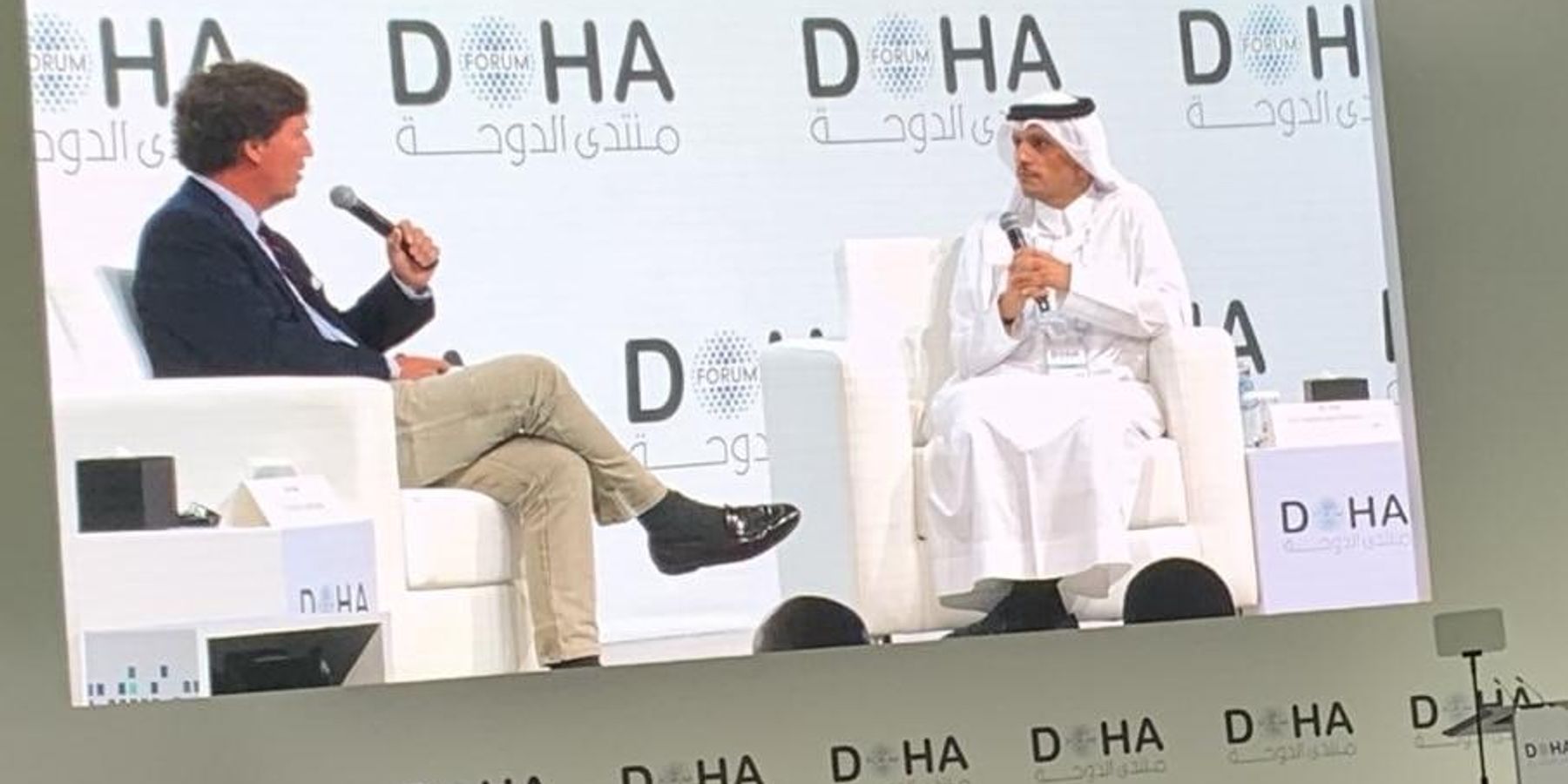
Tucker Carlson Doha Forum

Tucker Carlson to Qatar premier: why did Israel bomb you?

Despite criticism, the conservative host interviewed Mohammed bin Abdulrahman on the September attack on his country, Trump's peace plan, more

Reporting | QiOSK
google cta
google cta

Carlson made for an unlikely host of a conversation with the prime minister and minister of foreign affairs of Qatar, Mohammed bin Abdulrahman, and also a brave one: the Conservative talk show maven has long been accused by the likes of Laura Loomer for being a paid agent of the Qatari monarchy.

Carlson made light of that on the stage at the Doha Forum on Sunday, repeating that he has never taken money from Qatar, and if anything he has paid money out of his own pocket to visit and is buying a house there. "I'm American and a free man and I'll be wherever I want to be," he said to applause. "I have given my money to Qatar, and want to ask if that means that I bought you, and that you will spread my propaganda?"

That got a laugh from the foreign minister but for about 20 minutes the discussion in the packed main ballroom was serious. Carlson wasted no time in asking what many had queried after the Sept. 9 Israeli bombing of Qatar. Israel said they attacked because Qatar was hosting Hamas operatives in the country. Didn't Israel and the United States both ask Qatar — the only mediator in the conflict — to bring them there to help the war?

After acknowledging that Hamas representatives were in Doha at the behest of both states, the foreign minister said, "the concept of mediation is that it is a safe place for the two parties ... to have a mediator be bombed by one of the parties in the conflict is unprecedented and I have said that many times. I think it is not acceptable, no one can swallow it."

While there has been plenty of speculation about when Washington knew about Israel's plans and when, Tucker reiterated the official line that Trump was taken unawares by Netanyahu's orders to kill Hamas operatives in a residential area of Doha that day. He added that the bombing had "short circuited" the administration's attempts to get a ceasefire agreement through at the time. Sheik Mohammed bin Abdulrahman agreed.

"President Trump was very clear from the beginning, since the attack ...he expressed his frustration, his disappointment for such a thing," the foreign minister said. "He knows how helpful we were to this process. This kind of move was shocking for him...it was happening while we were trying to convince Hamas to sign the offer by President Trump at that time."

"He made it clear to everyone that this was a red line," he added. "I think this was one of many efforts to sabotage the relations between Qatar and the United States."

Carlson noted the apology that Washington forced Netanyahu to make to the Qataris. The U.S. also extended a new major security agreement to Doha shortly thereafter.

The foreign minister also mentioned the "disinformation" that has painted Qatar as a puppet master of Islamic radicalism and financier of Hamas. He said for years Qatar had sent money to the Hamas-run Gaza strip for humanitarian aid under the auspices and encouragement of the Israeli government and with the knowledge the U.S. "When they claim this financing of Hamas it has no basis," he said. As for why Qatar invests and lobbies in Washington, he said. "To make sure we are not being attacked." He pointed out "Qatar has never gone to the U.S. to encourage them to bomb this country or support that country. We have always been about how we can get to peace in the region."

On the issue of implementing the peace plan in Gaza, which cannot go anywhere until there is stabilization there, bin Abdulrahman said there will no progress until Israel withdrawals. "Now we are at the critical moment … A ceasefire cannot be completed unless there is a full withdrawal of the Israeli forces (and) there is stability back in Gaza,” he said.

Carlson noted that oil-rich Qatar has been accused of causing the war by supporting Hamas but will likely be on the hook to pay for rebuilding the Strip too. The foreign minister was quick to say, no, it will not be primarily responsible for what should be a multi-country effort as proscribed in the Trump plan. "We are not the ones who are going to write the check," he said, adding that Qatar will always help the Palestinians directly.


Dear RS readers: It has been an extraordinary year and our editing team has been working overtime to make sure that we are covering the current conflicts with quality, fresh analysis that doesn’t cleave to the mainstream orthodoxy or take official Washington and the commentariat at face value. Our staff reporters, experts, and outside writers offer top-notch, independent work, daily. Please consider making a tax-exempt, year-end contribution to Responsible Statecraftso that we can continue this quality coverage — which you will find nowhere else — into 2026. Happy Holidays!

Top photo credit: Tucker Carson and Qatar FM Mohammed bin Abdulrahman at Doha Forum (vlahos/RS)
google cta
Reporting | QiOSK
Does Israel really still need a 'qualitative military edge' ?
An Israeli Air Force F-35I Lightning II “Adir” approaches a U.S. Air Force 908th Expeditionary Refueling Squadron KC-10 Extender to refuel during “Enduring Lightning II” exercise over southern Israel Aug. 2, 2020. While forging a resolute partnership, the allies train to maintain a ready posture to deter against regional aggressors. (U.S. Air Force photo by Master Sgt. Patrick OReilly)

Does Israel really still need a 'qualitative military edge' ?

Middle East

On November 17, 2025, President Donald Trump announced that he would approve the sale to Saudi Arabia of the most advanced US manned strike fighter aircraft, the F-35. The news came one day before the visit to the White House of Saudi Crown Prince Mohammed bin Salman, who has sought to purchase 48 such aircraft in a multibillion-dollar deal that has the potential to shift the military status quo in the Middle East. Currently, Israel is the only other state in the region to possess the F-35.

During the White House meeting, Trump suggested that Saudi Arabia’s F-35s should be equipped with the same technology as those procured by Israel. Israeli Prime Minister Benjamin Netanyahu quickly sought assurances from US Secretary of State Marco Rubio, who sought to walk back Trump’s comment and reiterated a “commitment that the United States will continue to preserve Israel’s qualitative military edge in everything related to supplying weapons and military systems to countries in the Middle East.”

keep readingShow less
Think a $35B gas deal will thaw Egypt toward Israel? Not so fast.
Top image credit: Miss.Cabul via shutterstock.com

Think a $35B gas deal will thaw Egypt toward Israel? Not so fast.

Middle East

The Trump administration’s hopes of convening a summit between Israeli Prime Minister Benjamin Netanyahu and Egyptian President Abdel Fattah el-Sisi either in Cairo or Washington as early as the end of this month or early next are unlikely to materialize.

The centerpiece of the proposed summit is the lucrative expansion of natural gas exports worth an estimated $35 billion. This mega-deal will pump an additional 4 billion cubic meters annually into Egypt through 2040.

keep readingShow less
Trump
Top image credit: President Donald Trump addresses the nation, Wednesday, December 17, 2025, from the Diplomatic Reception Room of the White House. (Official White House Photo by Daniel Torok)

Trump national security logic: rare earths and fossil fuels

Washington Politics

The new National Security Strategy of the United States seeks “strategic stability” with Russia. It declares that China is merely a competitor, that the Middle East is not central to American security, that Latin America is “our hemisphere,” and that Europe faces “civilizational erasure.”

India, the world's largest country by population, barely rates a mention — one might say, as Neville Chamberlain did of Czechoslovakia in 1938, it’s “a faraway country... of which we know nothing.” Well, so much the better for India, which can take care of itself.

keep readingShow less
google cta
Want more of our stories on Google?
Click here to make us a Preferred Source.

LATEST

QIOSK

Newsletter

Subscribe now to our weekly round-up and don't miss a beat with your favorite RS contributors and reporters, as well as staff analysis, opinion, and news promoting a positive, non-partisan vision of U.S. foreign policy.