

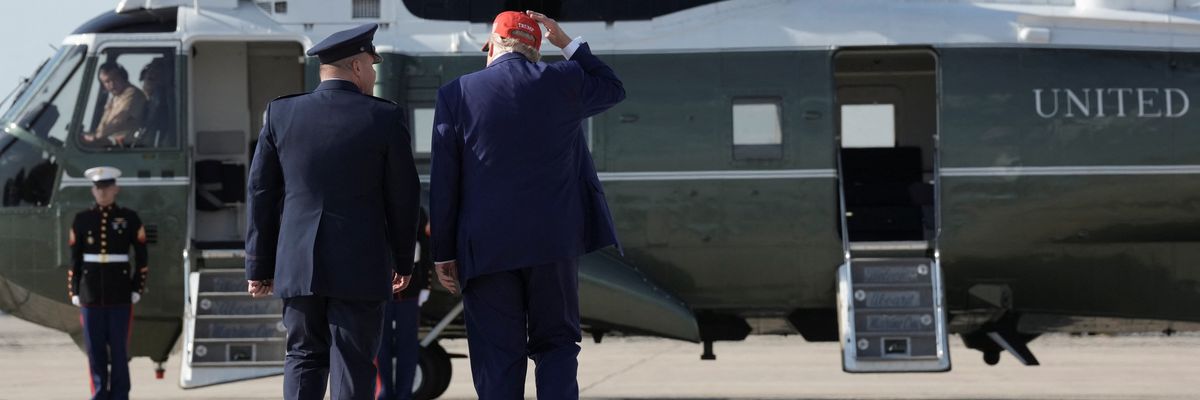
President Donald Trump told the American people tonight in a brief address to the nation that Iran's nuclear program has been ""completely totally obliterated" after U.S. airstrikes on Iran overnight into Sunday morning, Tehran time.
He congratulated Israeli Prime Minister Benjamin Netanyahu, who launched Israel's strikes against Iran on June 13 and has been asking for U.S. assistance ever since. "We have worked as a team like no team has worked together before."
According to Trump and confirmed by reports earlier, the mountain facility at Fordo was struck, as well as the enrichment plant at Natanz, as well as a another site at Isfahan. The strikes were carried out in part by B-2s, which can carry payloads of 30,000-pound "bunker buster" bombs. Later reports indicated that dozens of bunker busters were used on Fordo and Natanz, and that Navy submarines fired 30 TLAM cruise missiles at the Natanz and Isfahan sites.
Trump praised the "brilliant military minds" who helped plan the successful attacks — "the likes of which the world has not seen in many, many decades."
The said now there "will be either peace or there will be tragedy for Iran, far greater for Iran than we have witnessed in the last many days," he added, noting there "are many other targets." He then proceeded to say "God Bless the Middle East, God Bless Israel" and then blessed the U.S. military.
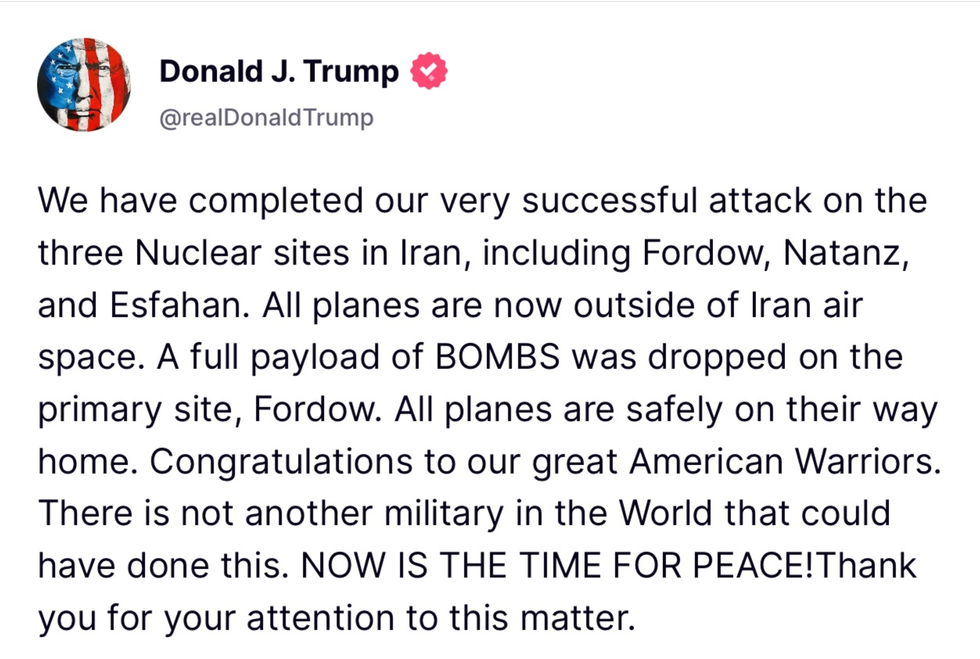
His remarks came after he first announced the strikes around 8 PM EST on his Truth Social account:
Adam Weinstein, a Quincy Institute Middle East fellow who served as a combat Marine in Afghanistan, said the U.S. has now officially put the 40,000 troops in the Middle East in harm's way, a warning that many had tried to convey to the president and administration all week in the run up to tonight's action.
"You’ve put every U.S. troop and embassy in the region at risk and squandered America’s diplomatic leverage—though you’ll likely think you’ve strengthened it."
Some of the biggest MAGA supporters who had been against U.S. war with Iran have so far not moved.
“Every time America is on the verge of greatness, we get involved in another foreign war,” posted Republican Rep. Marjorie Taylor Greene, who has been among the most vocal in the run up to the strikes.
“There would not be bombs falling on the people of Israel if Netanyahu had not dropped bombs on the people of Iran first. Israel is a nuclear armed nation. This is not our fight. Peace is the answer”
Lawmakers pounced on the fact the president did not have Congressional authorization to attack, knowing that there was no imminent threat to the country.
“This is not Constitutional,” posted Rep. Thomas Massie (R-Ky), who had been vocalizing opposition to the strikes and had proposed legislation to stop them.
When Speaker Mike Johnson posted that the Congress did not have time to authorize because leaders "knew" the country was in "imminent danger" (he points to the nuclear weapons that don't yet exist and accuses Iran of being the "world's largest state sponsor of terrorism"), Massie shot back: "Why didn’t you call us back from vacation to vote on military action if there was a serious threat to our country?"
Rep. Warren Davidson, (R-Ohio), also a veteran, urged caution. "While President Trump’s decision may prove just, it’s hard to conceive a rationale that’s Constitutional. I look forward to his remarks tonight."
"According to the Constitution we are both sworn to defend, my attention to this matter comes BEFORE bombs fall. Full stop," posted Rep. Jim Himes, (D-Conn).
"It is so grossly unconstitutional," said Sen. Bernie Sanders (I-Vt.) at a rally after hearing the news. "The only entity that can take this country to war is the U.S. Congress, the president does not have the right."
Senator Tim Kaine, (D-Va.) has proposed a Senate version of the War Powers bill which was supposed to get a vote this week. "The American public is overwhelmingly opposed to the U.S. waging war on Iran. And the Israeli Foreign Minister admitted yesterday that Israeli bombing had set the Iranian nuclear program back 'at least 2 or 3 years,'" he posted on X on Saturday. "So what made Trump recklessly decide to rush and bomb today? Horrible judgment. I will push for all Senators to vote on whether they are for this third idiotic Middle East war."
Of course congratulations have already been streaming in from the hawkish members of Congress on both sides of the political aisle, especially pertinent committee chairmen and ranking members.
"Our commander-in-chief has made a deliberate — and correct— decision to eliminate the existential threat posed by the Iranian regime," said Sen. Roger Wicker (R-MS), chairman of the Senate Armed Services Committee. "We now have very serious choices ahead to provide security for our citizens and our allies and stability for the middle-east. Well-done to our military personnel. You're the best!"
Sen. Jim Risch (R-Idaho) said this won't be a forever war and won't involve American boots on the ground, but Trump was right to take "decisive action" because disarming Iran is "for the good of the world."
“We stand with Israel tonight and pray for the safety of its people and the success of this unilateral, defensive action.”
Interest groups including the Republican Jewish Coalition and AIPAC (American Israel Public Affairs Committee) that have been pushing for this war were quick to thank Trump tonight.
"Today’s successful, targeted military action proves once again that nobody has been tougher on Tehran, or a better friend to Israel, than President Trump," exclaimed the RJC, one of Trump's biggest campaign supporters.
"Tonight will go down in the history books as one of the most consequential orders ever given by a U.S. President. God speed to our heroic war fighters."
Article is being updated as story develops
- Israel is luring the US into a trap ›
- Poll: Trump voters don't want US involved in Israel’s war on Iran ›
- Short, sharp shock? Trump's idea of quick victory is illusory | Responsible Statecraft ›
- ‘Locked and loaded’: Trump appears to threaten war with Iran ›