

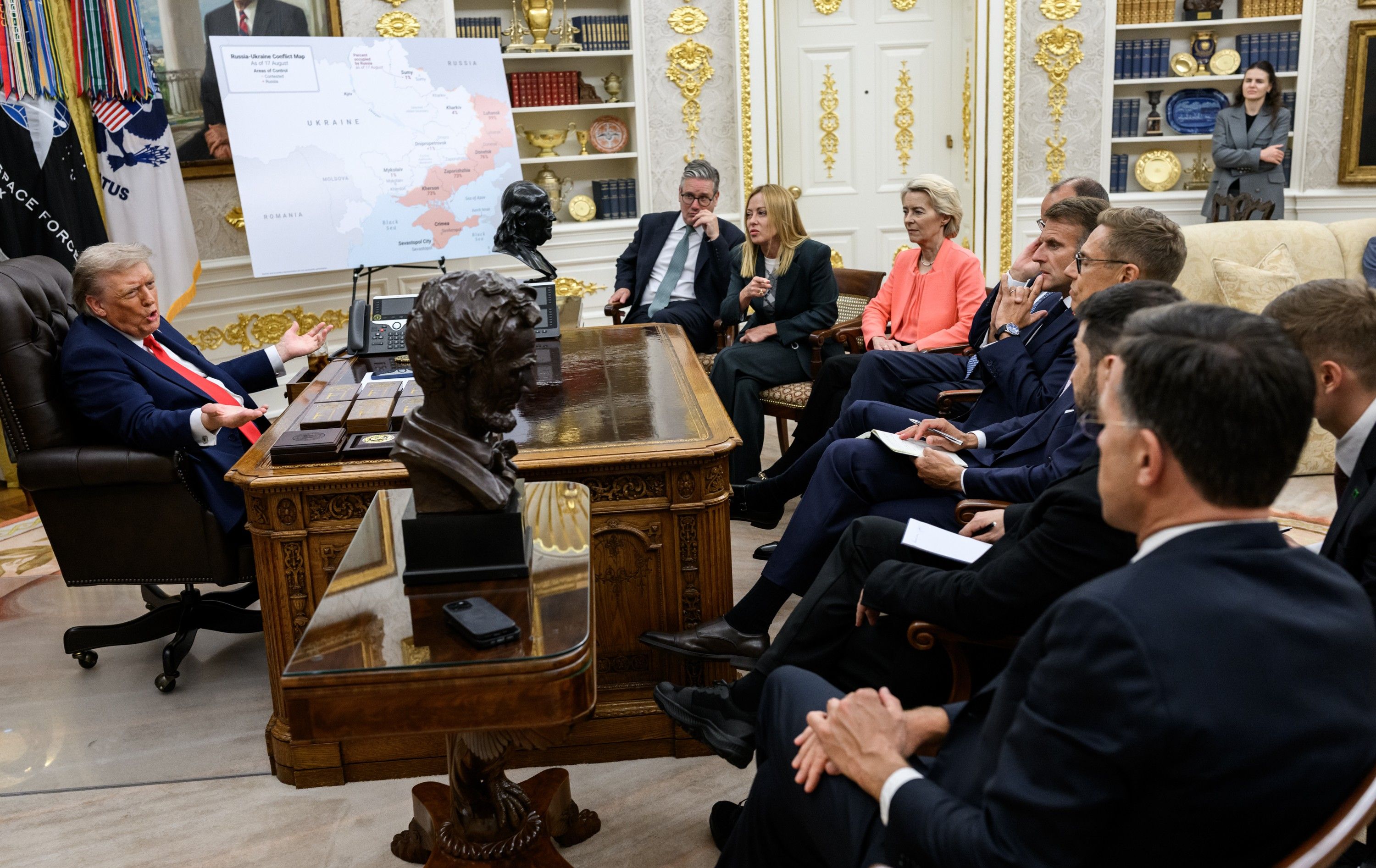
The failure of this week’s meeting in Washington to move the needle forward toward peace hinges, in my opinion, on the failure of the participants to properly understand the security dilemma they are facing.
Rather than seeking security for all, Europe is still seeking partial security, only for Ukraine. This short-sightedness stems from the desire to punish Russia, which argues that it is only defending its national interests.
It is telling that, toward the end of their joint press conference, Putin said he agreed with Trump’s claim that this war could have been prevented if Trump had been president. Many saw this as a throw-away line designed to ingratiate himself to Trump, but I believe that Putin was remarking on how different Trump’s approach to the conflict is from that of his predecessor. While Biden saw NATO as an unvarnished force for good; Trump appears to appreciate that it can also be seen as a threat, especially by those who have been excluded from it.
The arguments in favor of NATO expansion are all about the way the world “ought” to be. To understand why NATO can be seen as a threat, however, we must distinguish between what “ought” to be, and what “is.”
In the idealistic world of “how things ought to be,” NATO expansion is always benign because its members are democracies. Objecting to NATO expansion is therefore synonymous with objecting to the expansion of democracy. NATO thus becomes the Instrument of Democracy, seen as the summum bonum.
That is why NATO’s relentless expansion has always been a core security issue for Russia. Whatever else it may be, NATO remains, first and foremost, a military alliance, one that should now be preparing itself, according to the head of NATO's Military Committee for a “wartime scenario.”
NATO’s military function, accompanied by the longstanding exclusion of Russia from possible membership, even though it asked to be considered at least four times, makes its expansion a threat. And the same would hold true for any country whose security environment is so drastically altered.
Thus, when Putin says that a true peace settlement must address “the root causes” of the conflict, he is not just talking about specific grievances. He is also referring to the West’s deep-seated sense of moral supremacy that underlies them.
Understanding this is vital, because it means that there can be no true and lasting peace in Europe until multiple moralities learn to coexist. An important step in this direction would be having both Russia and Ukraine become part of a larger, pan-European security framework.
For Russia, this means that the West would have to give up the notion that security can be achieved by building up defenses against all its putative enemies, and instead embrace the idea that peace can only be achieved in partnership with its putative enemies, through dialogue. At times, the West has seemed to agree with this principle (in both the Istanbul Summit of 1999 and Astana Summit of 2010), but in practice it often reverts to coercion and brute force to achieve results that better suit its interests.
Such a dialogue was Mikhail Gorbachev’s ambition, even before the collapse of the Soviet Union. The decision, made by Bill Clinton in the early 1990s, to expand NATO while simultaneously excluding Russia from it, is the main reason the Cold War never truly ended, and has now erupted into war. At the time, Boris Yeltsin told Clinton that NATO expansion was not a problem, but “Russia has to be the first country to join NATO.”
The solution to this security dilemma is as obvious today as it was then — a pan-European security framework that embraces Russia and its neighbors, rather than excludes some of them. The reluctance of European leaders to discuss this openly suggests that they are still thinking of containing Russia, along the lines that John Foster Dulles envisioned in the 1950s.
They have forgotten that it was not rollback and liberation that led to the end of communism, but détente, rapprochement, and the Helsinki Process of the 1970s. Western leaders, however, only came to realize the need for coexistence after the Cuban Missile Crisis. Do we really need another such crisis today to remind us?
It may seem naïve to think about a European security framework that includes both Russia and Ukraine today. But if one wants to both end the war and secure a lasting peace for Europe, it is the only realistic option.