

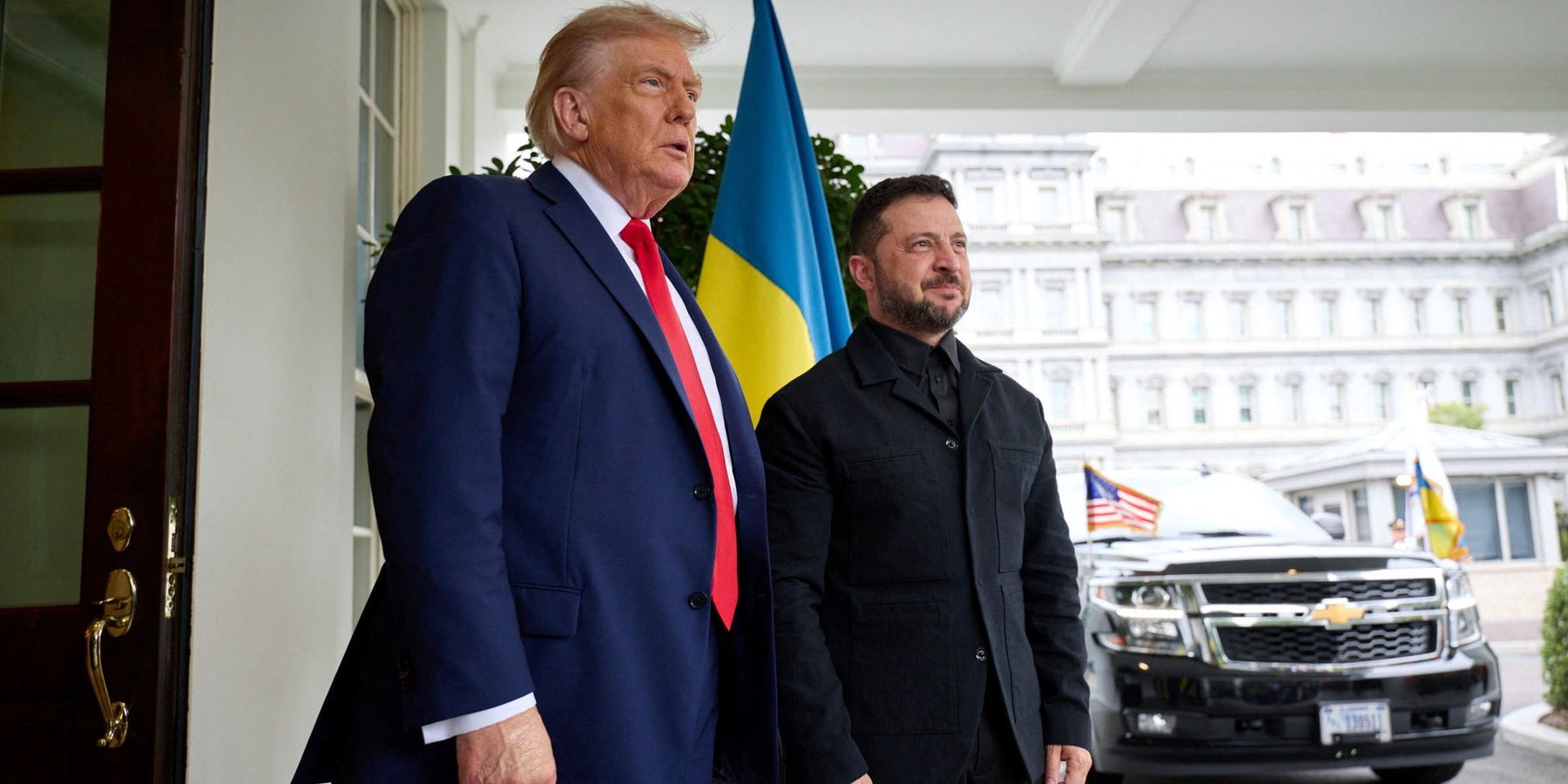
President Trump's meetings on Monday with his European and Ukrainian counterparts generated what appeared to be a consensus on a host of key war termination issues, the biggest among them being a format for viable security guarantees to Ukraine.
Trump suggested that Russian President Vladimir Putin has acquiesced to “Article 5-like” guarantees for Kyiv, a development that drew praise from Ukrainian President Volodymyr Zelenskyy and the European leaders in attendance.
This proposal is not new. Indeed, it harkens back to the 2022 Istanbul peace talks, which stipulated that Ukraine was to receive guarantees similar to NATO’s collective defense provision from a coalition of guarantor states. That coalition was to include Russia itself and, at a later stage in those negotiations, Moscow introduced a clause requiring unanimous consent from all signatory states before the collective defense provision could be triggered.
Ukrainian negotiators rejected that revision on the grounds that it amounted to Moscow’s veto over the West’s ability to defend Ukraine in the event of a future Russian re-invasion. Yet there are other potential issues with Article 5-like guarantees that, though quite not as glaring, can nonetheless derail the White House’s ongoing peace initiative if not addressed directly.
Though Moscow has clearly accepted the principle that Kyiv should come out of this war with a viable defensive deterrent against future aggression, the devil is in the details on precisely what form this deterrent can take.
Over the past three years, Moscow has consistently rejected any scheme for security guarantees that would greenlight the permanent deployment of NATO or Western troops on Ukrainian soil. The Kremlin has demonstrated a degree of flexibility in other areas, including on freezing the lines in the southeast and not attempting to block Ukraine’s path to EU membership. There is, however, no indication that it has budged on what has been its bright red lines surrounding Western contingents in Ukraine. The Kremlin reiterated its stance during the Monday meeting, which also included a phone call between President Trump and Putin.
“We reaffirm our repeatedly stated position on our categorical rejection of any scenarios that envisage the appearance in Ukraine of a military contingent with the participation of NATO countries,” read a statement by Russia’s Foreign Ministry.
Yet even on this point, there are nuances that will have to be sifted through by U.S. and Russian negotiators. Russia stridently rejects the preemptive deployment of Western troops in Ukraine after a peace deal is reached, but that is a different proposition from a situation where a European contingent is inserted in response to a future Russian reinvasion.
In either case, it will have to be determined what function these European troops (as President Trump has categorically ruled out U.S. boots on the ground) will play. Will they join the Ukrainian military in engaging Russian forces along the line of contact, or would their role be confined to logistics, support, and manning rear lines? These points should be elucidated by European leaders not just to provide Kyiv with clarity on what the West is and is not willing to do, but for the sake of European publics that deserve to know if their governments are committing themselves to go to war against Russia over Ukraine if hostilities resume.
On the issue of preemptive deployments, it remains to be seen if the Kremlin is willing to demonstrate any flexibility in agreeing to small European contingents whose role is strictly limited to training and maintenance work. In that rather unlikely scenario, the Kremlin would push for strict verification mechanisms and ironclad assurances that such a force neither gradually grows in size nor takes on more direct military functions.
In practice, “Article 5-like” guarantees to Ukraine can look a lot like what the West is already doing for Ukraine, but with additional functions that may or may not include the imposition of no-fly-zones and aerial support. If Moscow gets enough of what it wants in terms of the other components of a settlement — particularly on sanctions relief, not just a prohibition against Ukraine’s NATO membership but documented guarantees against the alliance’s eastward expansion, and a satisfactory resolution of territorial issues — then it may find that it has reasons to settle for some version of a Taiwan-style strategic ambiguity model that leaves the door open on European deployments in response to a future invasion but does not commit any Western country to fight for Ukraine.
It is clear that Russia has red lines on these questions, and it is of paramount importance at this advanced stage in negotiations to identify exactly where they lie. Unlike in Istanbul 2022, Ukraine now has a group of guarantors willing to provide meaningful security assurances. Yet the window for a peace deal is not infinite, and there may not be another opportunity to settle this war in the short to medium term if these talks fall flat.
The security concerns at play are far too important both for Moscow and Ukraine not to be spelled out and explicitly agreed, lest they become a diplomatic poison pill that threatens to undo the substantial progress made in Alaska and in the White House over the past week.
- 'Security guarantees' dominate talks but remain undefined ›
- A different kind of security guarantee for Ukraine ›
- For peace in Ukraine, Russia needs 'security guarantees' too | Responsible Statecraft ›
- Why Putin is winning | Responsible Statecraft ›
- Is a breakthrough looming in Ukraine talks? ›