

The small country of Costa Rica, home to just over five million people and roughly the size of West Virginia, has long prided itself on being a bastion of democratic norms in Latin American politics.
To its north lie Nicaragua, El Salvador, and Honduras, nations that, over the past several decades, have experienced periods of near-social collapse and outright dictatorship. Nearby Colombia and Venezuela have wrestled with their own, well-documented crises. By contrast, Costa Rica has consistently ranked high among global democracy watchdogs, which have pointed to its strong institutional protections for voting rights, its high literacy rate, and its reputation for civic stability as hallmarks of a healthy and vibrant political system.
That is changing. Since 2022, the country has been governed by the right-wing populist President Rodrigo Chaves. The Chaves administration has drawn close to El Salvador’s president, Nayib Bukele, and has sought his government’s assistance in constructing a prison modeled on El Salvador’s CECOT megajail. At the same time, homicides in the country have surged, unsettling a population long accustomed to seeing Costa Rica as an island of calm in a turbulent region.
As drug trafficking routes have shifted through Central America, Costa Rica has become an increasingly important transit hub, bringing with it competition among criminal groups and a sharp rise in homicides. While much of the crime is drug-related, there have also been rises in robberies, and the incarceration rate rose from 282 per 100,000 inhabitants in 2022 to 359 per 100,000 in 2025. For many Costa Ricans, the change has felt abrupt: neighborhoods that once saw little lethal violence have experienced drive-by shootings, contract killings, and public assassinations tied to narco-trafficking disputes.
Costa Rica has also recently faced widening inequality, underemployment, and strains on public services, developments critics attribute in part to decades of market-oriented reforms encouraged by international financial institutions. Increased migration from neighboring countries and Venezuela has added additional pressure to housing, labor markets, and social systems.
Even as homicide rates reached record highs during his administration, Chaves is popular; his approval ratings hover near 60 percent. The persistence of his support suggests that voters may see the crisis less as a failure of leadership than as evidence of larger structural issues.
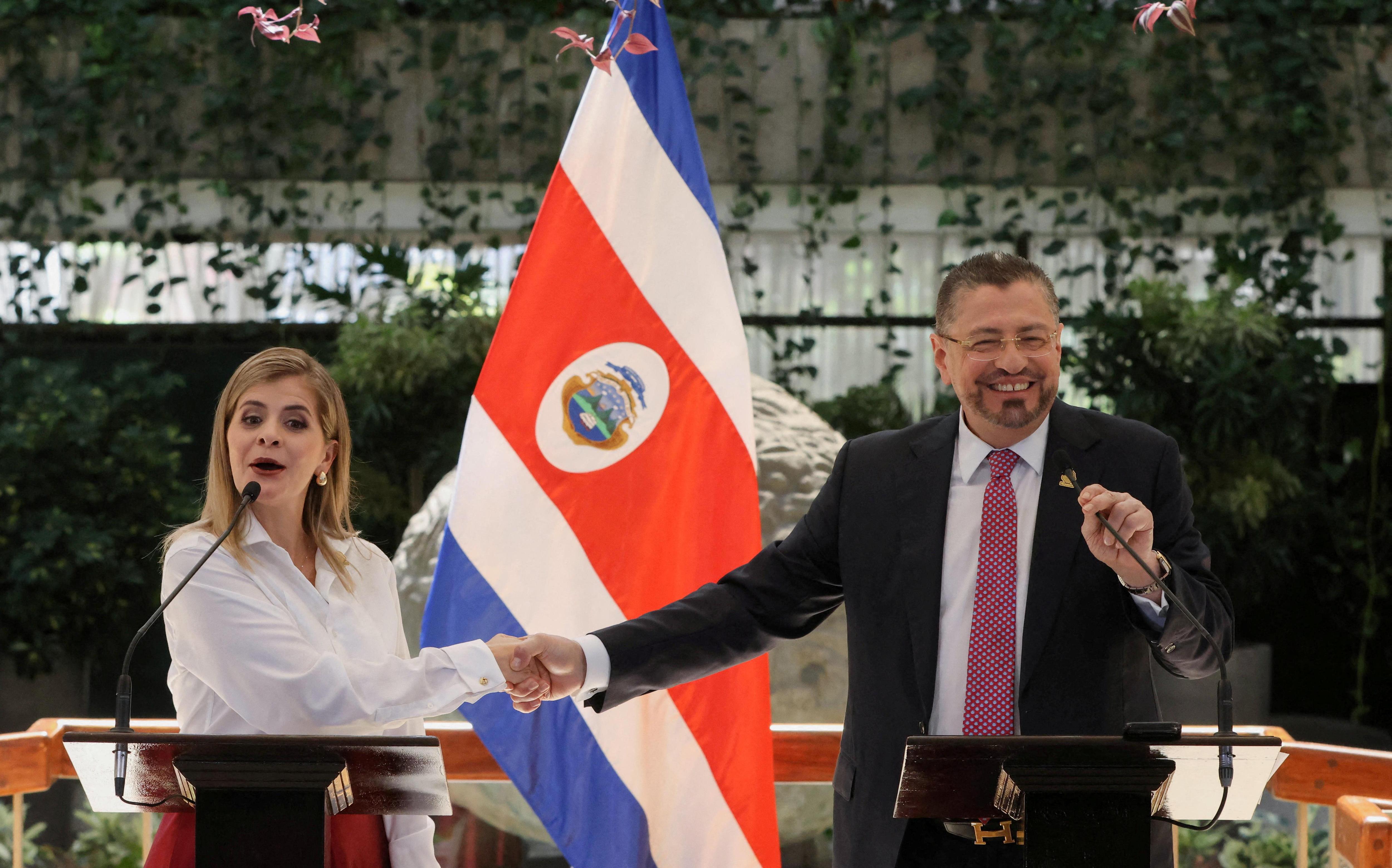
On February 1, Laura Fernández, the candidate of Pueblo Soberano, a Chaves-backed political party, won the presidential election with 48% of the vote. She fought off 19 other candidates and surpassed far beyond the 40% she needed to win in the first round of election. Campaigning on an explicitly anti-institutional platform, she was handpicked by Chaves as his successor (the Constitution bars presidents from seeking reëlection for eight years) and positioned her administration as continuing his goals of limiting the legislative and judiciary branches' power. The race was widely seen as a referendum on the ruling party, and her landslide victory confirmed Costa Ricans appetite for a more confrontational, strongman-style politics.
"Today, Costa Rica closes a cycle in its political history," Fernández declared to a crowd of cheering supporters during her victory speech. "What was called the Second Republic, formed in 1948 in battlefields drenched in the blood of our fathers and brothers, has remained in the past by the express will of Costa Rica. It is up to us to edify the Third Republic."
Fernández was evoking a crucial turning point in Costa Rican history, a civil war that took 2,000 lives, resulted in the abolition of the military, and ushered in a new constitution that reshaped the nation’s political order, a period known as the Second Republic (the First Republic was formed after independence in the nineteenth century and defined by its oligarchic structure that politically excluded vast swaths of the country). Established in 1949 by José Figueres Ferrer, who also expanded suffrage, public education, and the welfare system, the current government organizes civilian rule by ensuring the strength of autonomous institutions, separating power between the executive, legislative, and judiciary branches, and giving full authority to an independent election tribunal that safeguards voting.
For decades since, Costa Rica has been internationally known for its independent courts, its robust electoral system, and a press that operated largely without fear of reprisal helped turn elections into predictable, almost prosaic affairs. But Chaves's hostility towards the other branches of government and the press throughout his presidency set off alarm bells about the health of the country's democracy.
Alongside labelling journalists as “political sicarios” and repeatedly denounced Costa Rican establishment news outlets like La Nacion, Chaves has used state power to pressure companies connected to media outlets and given presidential orders to cancel advertising for media outlets deemed in opposition to the executive branch's goals.
A feature of the Chaves presidency has been his Wednesday press conferences, in which administration-vetted journalists, often influencers, are allowed to ask questions and the president and ministers answer them, usually involving discrediting of the mainstream press, judges, lawmakers, and opposition parties. In 2025, the World Press Freedom Index by Reporters Without Borders moved Costa Rica from 26th to 36th place globally, marking the fourth consecutive year of decline from its peak of 5th place in 2021.
Also in 2025, both the Supreme Court and the Supreme Electoral Court asked the legislature to lift Chaves's presidential immunity based on corruption charges and “political belligerence,” respectively. He has also led demonstrations against Attorney General Carlo Diaz, who was investigating him for illicit campaign financing and abuse of power.
Though the other Costa Rican branches of power have so far been able to counter these power-grabbing attempts, experts say the democratic backsliding is moving at a fast pace, and coupled with rising economic insecurity and the highest murder rates Costa Rica has seen in its modern history, have made for a particularly high stakes election.
Fernández won by casting herself as a continuation of Chaves, and has even promised that she would name him as chief of staff. Fernandez’s victory confirms that a voting majority of the country approves of Chaves’s rhetoric and approach to power. Moreover, this election saw the highest voting turnout since 1998 at 70%, skyrocketing from 60% at its lowest in 2022.
“Participation rose across the whole country, not just in the Central Valley or the coasts,” said Ronald Alfaro, a political scientist at the University of Costa Rica’s Center for Investigation and Political Study. “And looking at the data, the Pacific and Atlantic coasts went heavily for Fernández and Pueblo Soberano. So when thinking about what the decisive factor in these elections were, it’s the urban-rural divide.”
On March 7, both Chaves and Fernández, alongside other Latin American leaders, will attend a high-stakes security summit hosted in Florida by President Trump. Costa Rica and the United States have historically had friendly relations, and that has continued with Chaves’s government; in early 2025, a deal between the countries resulted with 200 migrants being deported to Costa Rica. Fernández has said that she will seek the U.S.’s help particularly on the fight against organized crime and narco-trafficking.
Fernandez will begin her term on May 8. Though she lacks the 38-member majority to be able to alter the Constitution and bring about her promised Third Republic, her party controls 53% of the legislative assembly and will be able to accomplish things like passing economic and security reforms.
“Right now, their goals have been very vague,” said Alfaro. “Their campaign slogan was “la continuindad del cambio” (the continuity of change), and that’s all been undefined; what exactly does that change look like? Soon, they’re going to have to establish their priorities.”