

Trump’s decision in June 2025 to bomb Iran’s nuclear facilities in the final days of Israel’s war on Iran removed any lingering doubts about his administration’s willingness to cross the longstanding U.S. red line of directly attacking Iran’s nuclear program.
As a result, every subsequent American military threat, against Iran as well as the rest of the world, was imbued with a credibility that only the precedent of naked aggression can impose. The U.S. military’s abduction of Venezuelan President Nicolás Maduro in January only reinforced that credibility.
But the U.S. strike on Iran, or Operation Midnight Hammer, has also set in motion two consequences that run directly counter to his vision of coercing Iran into submission.
First, the brief U.S.-Iran dustup following Operation Midnight Hammer communicated to Iran that while Washington was now more likely to pull the trigger, it was by no means eager to enter a costly and open-ended firefight. Indeed, it did not escape the attention of the Iranians that while the Trump administration warned Tehran that any Iranian response to Operation Midnight Hammer would trigger a devastating U.S. response, Iran’s ballistic missile retaliation against U.S. bases in Qatar elicited not Trump’s wrath but his framing of the episode as an opportunity to move toward “peace and harmony.” This was then promptly followed by his brokering of a ceasefire between Iran and Israel.
Second, the joint U.S.-Israeli war on Iran in June liberated Iran from its own fear of total war. In the months and years leading up to the 12-Day War, Tehran’s intoxicating belief that war could and should be avoided — at every turn and at any cost — had infused the Iranian decision-making apparatus with a paralyzing caution that, on the one hand, deterred Iran from retaliating decisively against Israeli attacks while at the same time emboldened Israel to repeatedly push the limits of escalation with impunity.
But that edifice of fear would collapse under the weight of Israel’s war on Iran in June 2025, and the United States’ direct participation in that war. In its place emerged a sober recognition that Iran was no longer standing on the brink of a war it could prevent but was already fully immersed in a recurring cycle of limited Israeli and American wars inside Iranian territory.
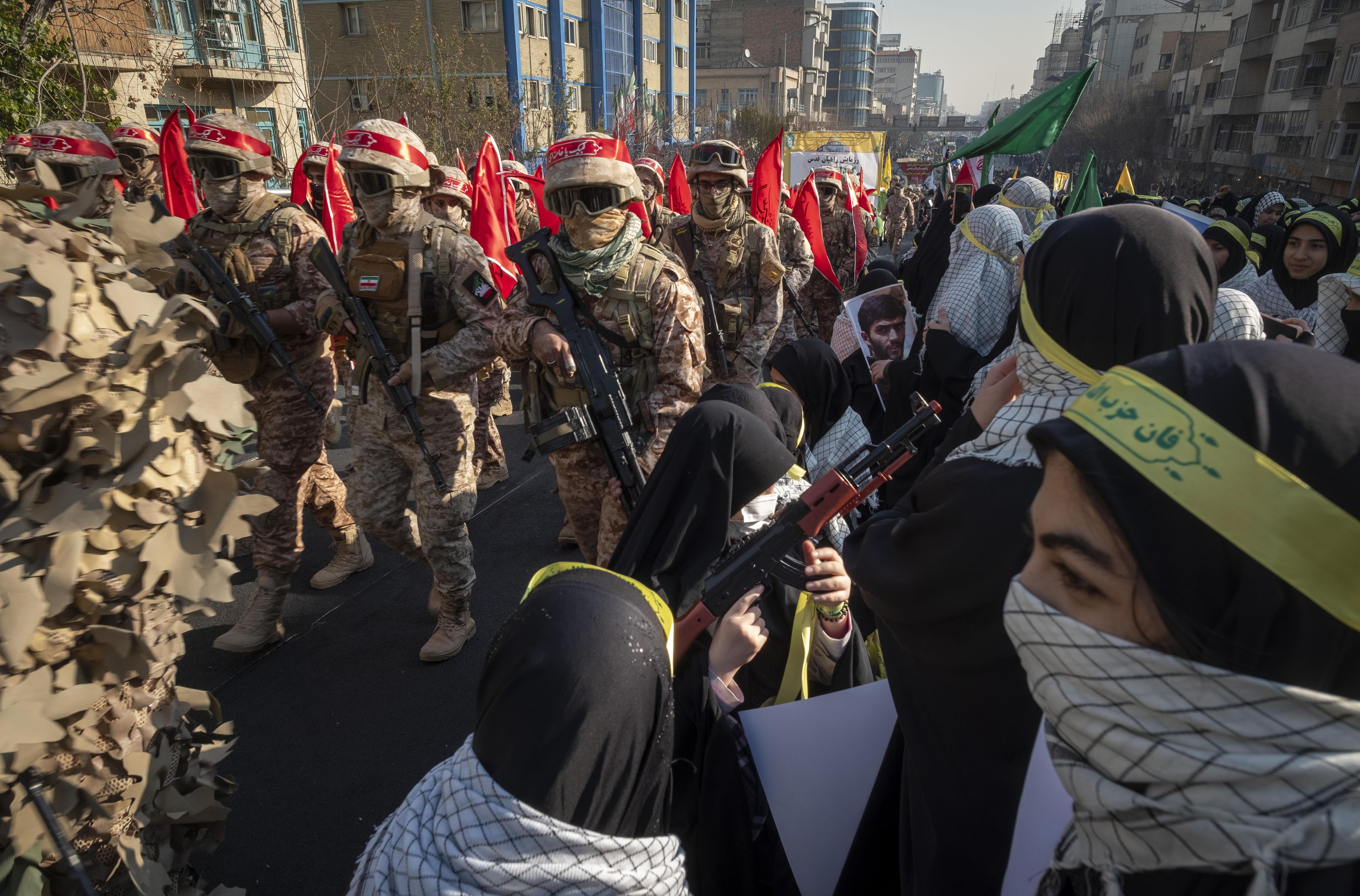
Iran’s generals understood that the only reliable way to conclusively break that cycle was to drive the confrontation beyond Washington’s comfortable terrain of swift, manageable military interventions and into a realm where the costs of continued escalation would become unbearable for the United States and Israel alike. In the recent warning of Iran’s Supreme Leader Ali Khamenei, “If they start a war this time,” he cautioned, “it will be a regional war.”
For Washington, this shift in Iranian consciousness could not have occurred at a worse moment in time. Iran has been thrust into a state of full-mobilization for a regional war at the very moment when it has become unmistakably clear that Washington’s appetite for military adventures does not extend beyond spectacular, swift, and high-impact demonstrations of military dominance.
The suggestion here is by no means that the Iranian armed forces are somehow on par with, let alone superior to, those of the U.S. military. Rather, an acute asymmetry has emerged in the two sides’ resolve and pain tolerance, an asymmetry in which, paradoxically, the militarily weaker party is structurally less constrained in its willingness to both endure and impose costs, resulting in a strategic posture far less favorable to the U.S. than the raw balance of military power would suggest.
More paradoxical, still, is that this sharp imbalance in resolve has crystallized at precisely the moment when Iran’s overall regional position is far more precarious than at any point in recent decades, a precarity made possible by the collapse of Assad’s rule in Syria and the significant weakening of Hezbollah’s operational depth in Southern Lebanon.
This asymmetry in resolve has found political expression in the recent resumption of talks between Iran and the United States over the nuclear program, assuming, of course, that the current negotiations reflect a sincere U.S. effort to reach an agreement and not, as was the case during last year’s negotiations, an attempt merely to lull the Iranians into complacency ahead of war.
The talks are not, as is often claimed, evidence of U.S. success in coercing Iran to come to the negotiating table. Instead, the talks reflect a growing realization within the Trump administration that Washington’s options are limited: either climb to the next and final rung of the escalation ladder, which is a full-scale war with Iran, whose duration and intensity would likely escape U.S. control, or return to a negotiated settlement of the nuclear dispute.
Should current talks result in a resolution of the nuclear file, they will stand as yet another outward expression of the realization in Washington that a total war with Iran is a monstrous black box the United States has no desire to open. For if Trump truly believed the U.S. could win militarily against Iran in the time-frame, shape, and intensity of his choosing, he would already have started this war, just as he did in the operation to abduct Venezuelan President Nicolás Maduro.
What has prevented him from doing so, more than anything else, is Iran’s very real and sizable capacity to drag the United States and the entire region into a grinding, drawn-out war of attrition that would further accelerate the decline of U.S. global hegemony in ways previously thought unimaginable.
To be sure, the current impasse offers precious little by way of novelty. On the contrary, almost all of its defining features were either knowable or predictable before Trump’s withdrawal from the JCPOA. Indeed, President Obama’s pursuit of nuclear diplomacy was driven chiefly by the same military realities that have until today prompted Trump to pursue diplomacy with Iran.
Nine years after Trump first set out to overwrite the legacy of Obama’s deal, the paths available to Washington are clearer than at any point since the 1979 Islamic Revolution: a total regional war whose limits would not be set by Washington, or a nuclear settlement that, while not perfect from Trump’s standpoint, would pull the United States back from the brink of an open-ended and intractable regional war with an Iran.
If Washington’s participation in Israel’s June 2025 war with Iran elevated U.S. military force to a perfectly viable instrument of the United States’ Iran policy, the success of current talks would signal the formal undoing of that logic. But should the failure of talks pave the way for another full-scale war, the United States and Israel will be fighting an Iran vastly different from June. For the Iran of today appears to have made its peace with the grim conclusion that while a decisive slog with Israel and the United States is sure to be agonizing, it is preferable to the recurring attrition of repeated wars and a chronic strategic vulnerability that only emboldens adversaries to target Iran and its regional allies.
This cold calculus is captured with unsettling clarity in an oft-quoted Iranian proverb: marg yek bar, shivan yek bar—“death once, wail once.”
- Is Israel's plan to draw the US into a war with Iran? ›
- Why Arab states are terrified of US war with Iran ›
- Veterans urge Trump to reject war with Iran ›
- 'Going it alone' approach will leave one person holding the Iran bag | Responsible Statecraft ›
- The cost of Trump's Iran war is already adding up quickly | Responsible Statecraft ›
- Senate unable to halt Trump’s war on Iran ›
- How targeting water changes the entire face of the war | Responsible Statecraft ›
- The Iran war's early lessons | Responsible Statecraft ›
- Trump's war is a gift to Iran’s hardliners | Responsible Statecraft ›
- US strikes on Iran risk resuming a war Trump wants to freeze ›