

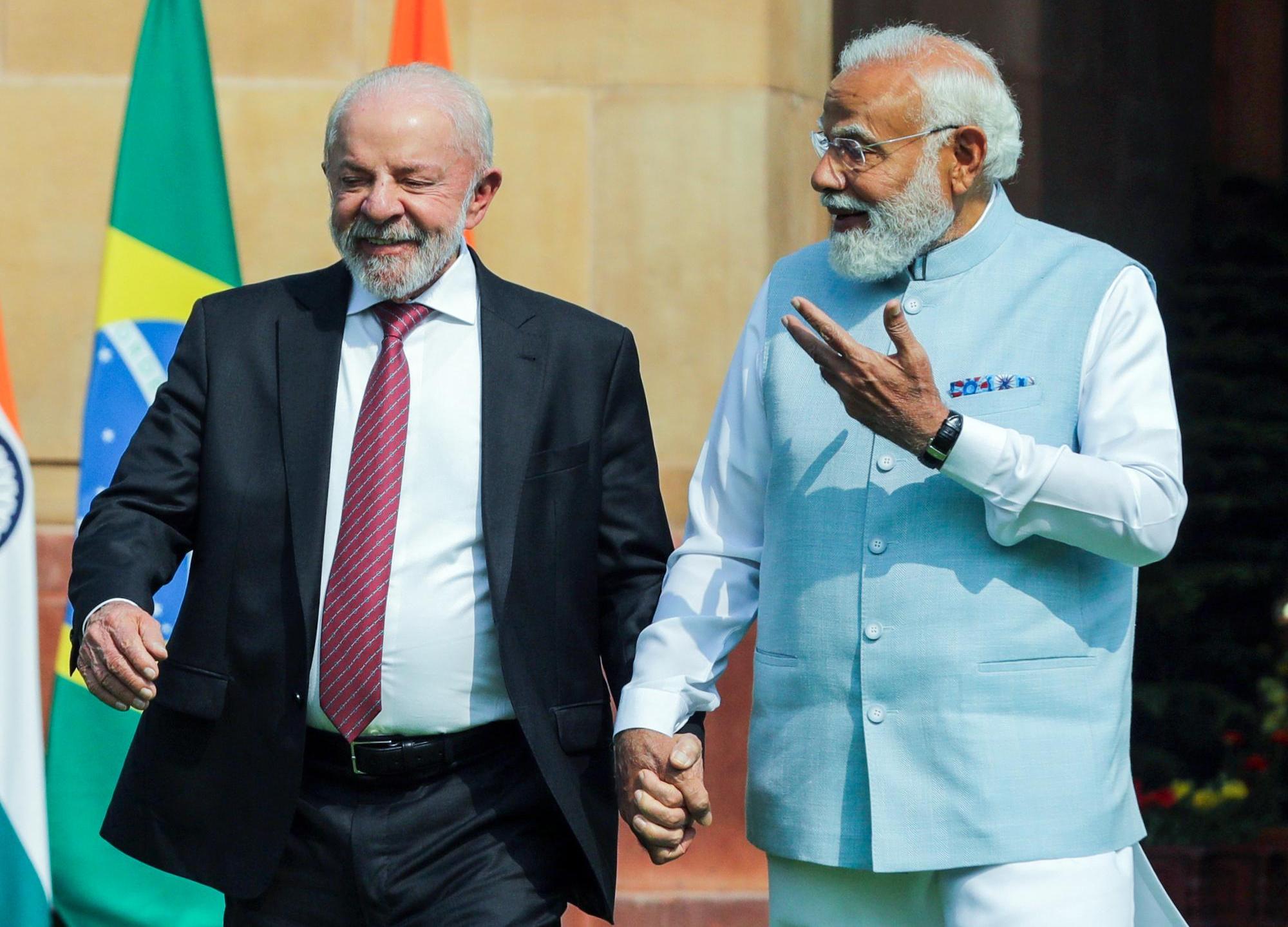
When Brazilians vote for president in October, multilateralism will likely be on the ballot. President Luiz Inácio Lula da Silva has long stressed diversifying and deepening the diplomatic and trade relations of Latin America’s largest nation with the rest of the world.
His most likely opponent, Senator Flávio Bolsonaro, the son of former President Jair Bolsonaro, will argue that Brazil belongs squarely in Washington’s camp.
The Bolsonaro clan has long criticized Lula’s dogged embrace of the BRICS bloc, for example, as well as his attempts to insert Brazil into major geopolitical debates as unnecessarily provocative to the Trump administration with which the family has enjoyed close ties. Whether to align with the United States — as Brazil’s neighbor Argentina has done under President Javier Milei — or double down on a decidedly independent foreign policy is a question that will be put to voters this October.
In a sign of where his priorities lie, Lula opted against attending the inaugural meeting of President Donald Trump’s Board of Peace in Washington — Lula declined Trump’s invitation to join — and instead headed to India to attend the AI Impact Summit. He traveled with a large delegation of officials, lawmakers, and business leaders intent on signing various new partnerships and trade deals with the world’s most populous nation.
Brazil has done relatively little business with India compared to its robust trade portfolio with the United States and China. Deepening commercial ties with India is yet another hedge for a Brazilian government eager to diversify its export markets in an era of increasing geopolitical competition.
Lula and his advisers have long argued the necessity of this approach, but the trade war Trump launched against Brazil last summer has undoubtedly given it new life. In standing up to Trump’s demands that the Brazilian government drop all charges against Jair Bolsonaro, who is currently serving a lengthy prison sentence for his role in an attempt to overturn the 2022 election, Lula enjoyed a polling bump at home. This has placed his domestic opponents in the awkward position of having to either defend Brazilian sovereignty — thus implicitly aligning with Lula — or criticize the U.S. government, potentially alienating Trump.
Lula will almost certainly remind voters of this dynamic as the October election approaches. Trump eventually backed down and opened a direct line of communication with Lula. The two have since met in person and, as at least one analyst predicted early on, seemed to hit it off. Lula is tentatively scheduled to visit the White House next month.
But Brazil remains on alert. In fact, in a recent interview, Lula’s main foreign policy adviser went so far as to assert that in an increasingly uncertain world Brazil must increase its military spending, which currently stands at about one percent of GDP. A stronger, more assertive, and independent Brazil is what Lula will propose to voters.
This is the context in which his India trip — and his snub of Trump’s Board of Peace — should be understood. Brazil’s Foreign Ministry reportedly sees ties with India, a fellow-charter member of the BRICS group, as more important than ever and wants to bolster its relationship with India in pursuit of multilateralism. In New Delhi, Lula reiterated his call for a reconfiguration of the U.N. Security Council — including permanent seats for Brazil and India.
Speaking at the AI Impact Summit alongside Indian Prime Minister Narendra Modi and French President Emmanuel Macron, Lula sharply criticized the business model of major technology platforms, arguing that their profitability “depends on the exploitation of personal data, the invasion of the right to privacy, and the monetization of eye-catching content that amplifies political radicalization.” He also called for global governance standards for artificial intelligence, rules and institutions capable of safeguarding democratic integrity and human rights.
Last Thursday, Lula met with Macron on the sidelines of the summit to discuss global peace and security as well as expanding cooperation. Macron used the occasion to invite Lula to attend the next G7 summit, scheduled for June in France, signaling Paris’s ongoing desire to cultivate Brazil as a reliable partner in major international deliberations. Although it hasn’t been reported, Lula very likely also pressed Macron on the stalled trade deal between the European Union and MERCOSUR, which would, when consummated, create the world’s largest common market.
France, whose politically powerful farm lobby is worried about competition from South American exporters, has been the prime opponent of the deal, which has been a strategic priority for Brazil for well over a decade.
After India, Lula traveled to South Korea, where he met with President Lee Jae Myung and signed 10 memorandums of understanding spanning trade, critical minerals, digital technology, agriculture, health, and security cooperation. The two sides also adopted a four-year action plan covering sectors from defense and space to food security and agreed to resume talks on a South Korea–Mercosur trade deal.
Lula used the visit to court South Korean investment in Brazil’s rare-earth and nickel reserves and to expand market access for Brazilian agricultural and higher-value exports. He capped the tour with a surprise stop in Abu Dhabi to push forward the Mercosur–UAE trade deal and deepen cooperation in a host of other areas as well. Cumulatively, the trip reinforced Lula’s longstanding claim that an active, autonomous foreign policy can deliver greater tangible economic and strategic gains than automatic alignment with any one nation.
That is the proposition he will put before voters later this year. Not a rupture with the United States, nor a romanticized alignment with any alternative bloc, but a pragmatic multilateralism designed to maximize autonomy. It bears mentioning, of course, that Modi and India represent opposing ideological camps. Lula is a left-wing elder statesman whereas his Indian counterpart is a noted right-wing nationalist. Yet both took pains to demonstrate their exceedingly warm working relationship. Lula’s opponents will argue that his ecumenical global stance — as comfortable in Moscow and Beijing as he is in Washington, if not more so — risks unnecessary friction with the United States.
Lula, in turn, is likely to counter that sovereignty in the 21st century depends on working with all comers to seize the initiative.
The most high-profile deal to come out of Lula’s India trip was a new agreement related to rare earth minerals, key inputs for electric vehicles, solar panels, jet engines, and advanced electronics. As geopolitical competition intensifies and supply chains tighten, these minerals have acquired strategic weight far beyond their commercial value.
According to Roberto Goulart Menezes, an international relations scholar at the University of Brasília, the urgency of leveraging Brazil’s rare earths and critical minerals escalated during last summer’s stand-off with the Trump administration. By elevating rare earths in its negotiations with India, Brazil is shoring up its agency in an increasingly heated geopolitical climate.
The current trip to Asia, then, is not incidental to Brazil’s core interests. It is a test case. If Lula can translate diplomacy into durable trade flows and technological cooperation, he will have tangible evidence that an independent foreign policy delivers concrete returns. Tellingly, the Brazilian president saw this as a better use of his time than listening to Guns N Roses alongside Trump’s Board of Peace in Washington.
- Trump's sphere of influence gambit is sloppy, self-sabotage ›
- Brazil's Lula goes to China this weekend for more than trade interests ›