

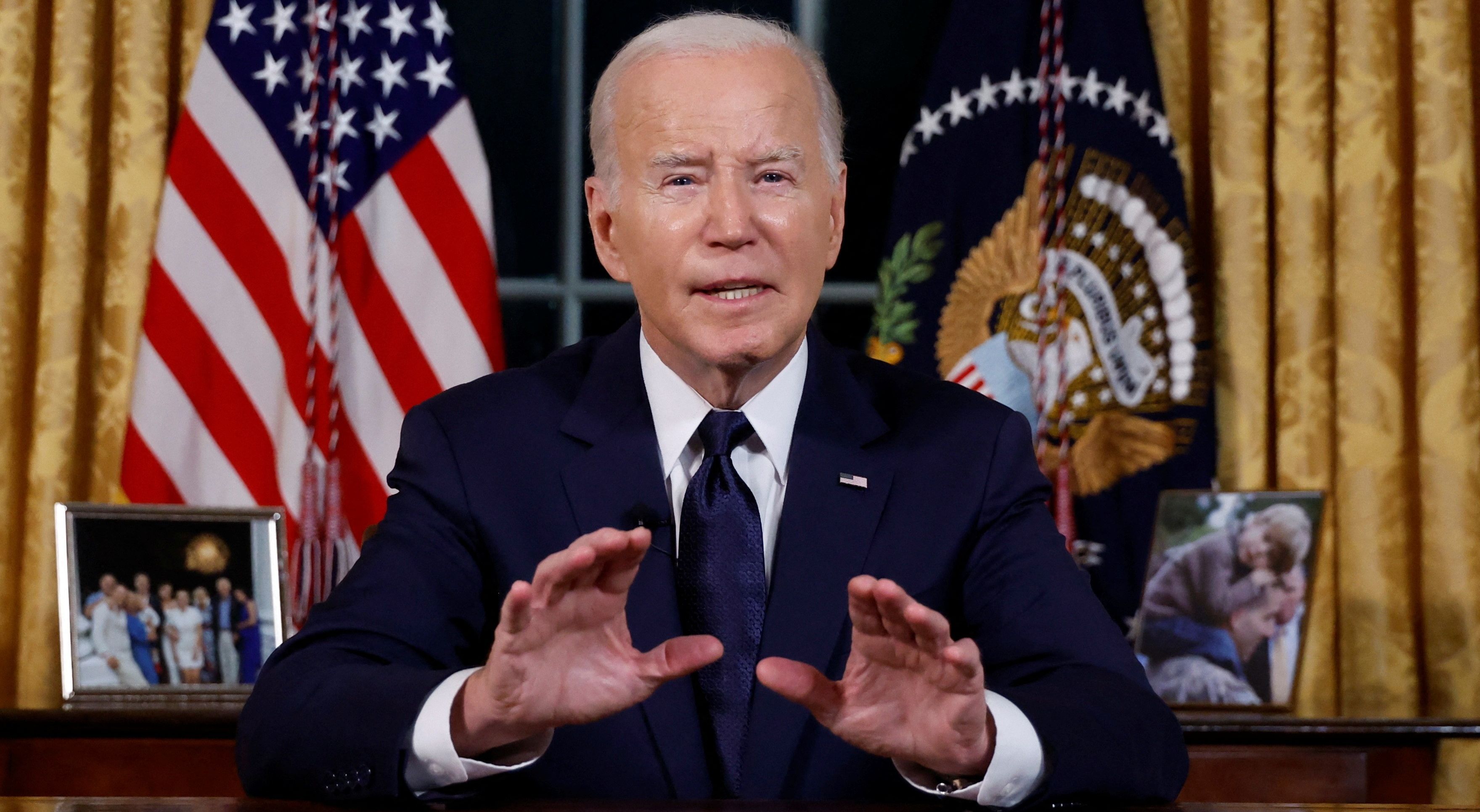
In his recent address concerning the wars in Gaza and Ukraine and U.S. involvement in both, President Biden quoted the famous line by former Secretary of State Madeleine Albright, that America is “the indispensable nation.” This is indeed the belief by which the U.S. foreign and security establishment lives and works.
As Biden’s speech reflected, it is one way in which the establishment justifies to American citizens the sacrifices that they are called on to make for the sake of U.S. primacy. It is also how members of the Blob pardon themselves for participation in U.S. crimes and errors. For however ghastly their activities and mistakes may be, they can be excused if they take place as part of America’s “indispensable” mission to lead the world towards “freedom” and “democracy.”
It is therefore necessary to ask: Indispensable for what? Empty claims about the “Rules-Based Order” cannot answer this question. In the Greater Middle East, the answer should be obvious. I suppose that a different hegemon might have made an even bigger mess of the region at even greater cost to itself than the United States has succeeded in doing over the past 30 years, but it would have had to put some really serious effort into the task. Nor is it clear that the absence of a superpower hegemon could have made things any worse.
In this time, not one beneficial U.S. effort at peace in the region has succeeded; few were even seriously attempted. And more than this, the U.S. has not even fulfilled the core positive role of any hegemon, that of providing stability.
Instead, it has all too often acted a force of disorder: by invading Iraq and thereby enabling an explosion of Sunni Islamist extremism that went on to play a dreadful role in Syria as well; by pursuing through 20 years a megalomaniac strategy of externally-driven state-building in Afghanistan, in defiance of every lesson of Afghan history; by destroying the Libyan state, and thereby plunging the country into unending civil war, destabilizing much of northern Africa, and enabling a flood of migrants to Europe; by repeatedly wrecking or abandoning possibilities of a reasonable deal with Iran; and most gravely of all, by refusing to take an even remotely equitable approach to the Israel-Palestine conflict, and failing through the greater part of the past thirty years to make any serious effort to promote a settlement.
Over the past generation, successive U.S. administrations turned a blind eye, not merely while the Likud governments slowly killed the “two-state solution” and stoked Palestinian and Arab rage through its settlement policy, but while Prime Minister Netanyahu deliberately helped build up Hamas as a force against the Palestine Liberation Organization, so as not to have to negotiate seriously with the latter.
This strategy has now proved catastrophic for Israel itself. It was also carried out with no regard whatsoever to the interests of the United States or its European allies in the face of Islamist terrorism.
And what have the American people themselves gained from this? Nothing at all, is the answer; while the losses can be precisely calculated: More than 15,000 soldiers and contractors killed in Afghanistan and Iraq; more than 50,000 wounded, and often disabled for life; more than 30,000 veteran suicides; 2,996 civilian dead on 9/11, an attack claimed by al-Qaida as a reprisal for U.S. Middle East policy; some $8 trillion subsequently expended in the “Global War on Terror.”
Elsewhere in the world, the U.S. record has not been so disastrous, but nor has it remotely justified claims to the necessity of U.S. primacy. The only area where this has been broadly true is in Europe. In World War II and the Cold War, the United States liberated western Europe and defended democracy there; while in the rest of the world, all too often it stepped into the shoes of European colonialism.
After the Cold War, populations in eastern Europe genuinely welcomed U.S. protection — though Biden’s claim that if not stopped in Ukraine, Putin will invade Poland is baseless. Russia has neither the will nor the capacity to do so; and in any case, if NATO membership is not a sufficient deterrent, what was the point of offering NATO membership to Ukraine?
Outside Europe, the only region where the United States can truly be said to have played a largely positive role to date is East Asia (the Vietnam War obviously excepted), and for the same reason: that Japan and South Korea welcome alliance with the United States. And while other states, like the Philippines, wish to balance between America and China, they do not wish America to leave. This role however requires U.S. presence, not U.S. primacy. Since China cannot invade Japan and South Korea — let alone Australia — the United States can perfectly well stand on the defensive behind its existing alliance systems, while sharing influence elsewhere with Beijing.
As to Africa, countries there do not have conflicts with each other that America has to control or mediate. Africa’s problems are internal, and the U.S. has done very little since 9/11 and the Global War on Terror to help. The recent increase of U.S. interest in Africa is mainly a reaction to Russia’s and China’s growing commercial stake there.
Strangest and most striking of all is the U.S. role in its own backyard, in Mexico, Central America and the Caribbean, whose problems really do affect the population of the United States. As in Africa, the United States does not need to suppress local conflicts between states, for these have long since ceased. Once again, the threats are internal, but are also driven to a very great extent by the demand for illegal drugs in the United States. One result of the internal decay of these countries is the huge flow of migrants to the United States, which is causing blowback and political discord in America itself.
Faced with this threat, and concerned with the interests of U.S. citizens, it might be assumed that the regional hegemon would prioritize this region and devote serious resources to its development. This would also be in tune with the “foreign policy for the middle class” that Biden promised in his election campaign.
In fact, the comparative figures for U.S. aid are positively grotesque. Total U.S. development aid to Mexico and all of Central America since 2001 comes to $12.21 billion. This compares to $64.8 billion to Israel and $32.8 billion to Egypt. Even Georgia has received almost twice as much aid as Mexico ($3.9 billion to $2.1 billion) — and Georgia is 6,000 miles from the shores of the United States with a population less than one thirtieth that of Mexico.
Faced with problems from Mexico spilling over into the United States, some leading Republican politicians are now calling not for more assistance, but for the U.S. military to be deployed in Mexico to fight drug traffickers — an insane idea that reveals the moral and practical bankruptcy of U.S. primacy on its own continent.
The neglect of America’s neighbors to the south reveals something else about U.S. primacy: that whatever a region’s problems, the U.S. only becomes engaged if it sees a real or alleged danger that a rival power is taking an interest. This could be called the approach of the dog in a manger elevated to a basic strategic principle. It is well summed up in an article by Suzanne Maloney of the Brookings Institution about the previous — and disastrous — attempt of the Biden administration partially to pull back from the Middle East without solving the basic problems there:
“The White House devised a creative exit strategy, attempting to broker a new balance of power in the Middle East that would allow Washington to downsize its presence and attention while also ensuring that Beijing did not fill the void.”
If the U.S. really wants to pull back from the Middle East, it should welcome other states trying to play a positive role — as China has done by promoting détente between Iran and Saudi Arabia.
The pursuit of global primacy is also intellectually and morally corrupting for Americans themselves. To justify its costs and sacrifices to ordinary Americans requires on the one hand vastly overblown claims to the promotion of democracy, on the other a colossal exaggeration of both the threat and the evil of other states. The result is a public discourse that all too often resembles baby food spiked with cyanide — the pap being the language of America spreading freedom, and the poison being that of mistrust for other countries and their peoples.
Even if a successful — if not "indispensable" — U.S. global primacy were possible, it could not be based on a foundation as corruptive as this.
- Republicans balk at Biden plan to put Israel, Ukraine - and Taiwan? - aid to one vote ›
- Why do we let Israel and Ukraine wag the US dog? - Responsible Statecraft ›