

On August 1, the Trump administration imposed a 50% tariff on Brazilian imports, sending high-volume sectors like coffee, beef, and textile companies scrambling to adjust to their new reality. The tariffs came on the back of a lobbying campaign from an unlikely source — Brazil itself. Whereas other foreign entities are lobbying the U.S. government to reduce their tariffs, allies of ex-president Jair Bolsonaro asked for more.
Eduardo Bolsonaro, financed by ex-president father Jair Bolsonaro, is the main catalyst behind the lobbying efforts. And by not registering his activities, Eduardo Bolsonaro may be running afoul of the U.S. foreign lobbying laws.
For several months, the younger Bolsonaro has been lobbying the White House and the U.S. Congress to carry out a maximum pressure campaign of tariffs and sanctions against his own country over the Brazilian authorities’ prosecution of Jair Bolsonaro. The primary target of Eduardo Bolsonaro’s campaign is Alexandre de Moraes, the Brazilian Supreme Court Justice leading the investigations into the ex-president.
The elder Bolsonaro is accused of attempting a coup in 2022 to remain in office, which allegedly included a plot to poison President Luiz Inácio “Lula” da Silva and assassinate Moraes. Citing a flight risk, Moraes ordered Bolsonaro to wear an ankle monitor, a move the ex-president called a “supreme humiliation." On Monday, the Brazilian Justice went a step further, placing Jair Bolsonaro under house arrest after he violated a court order prohibiting the use of social media.
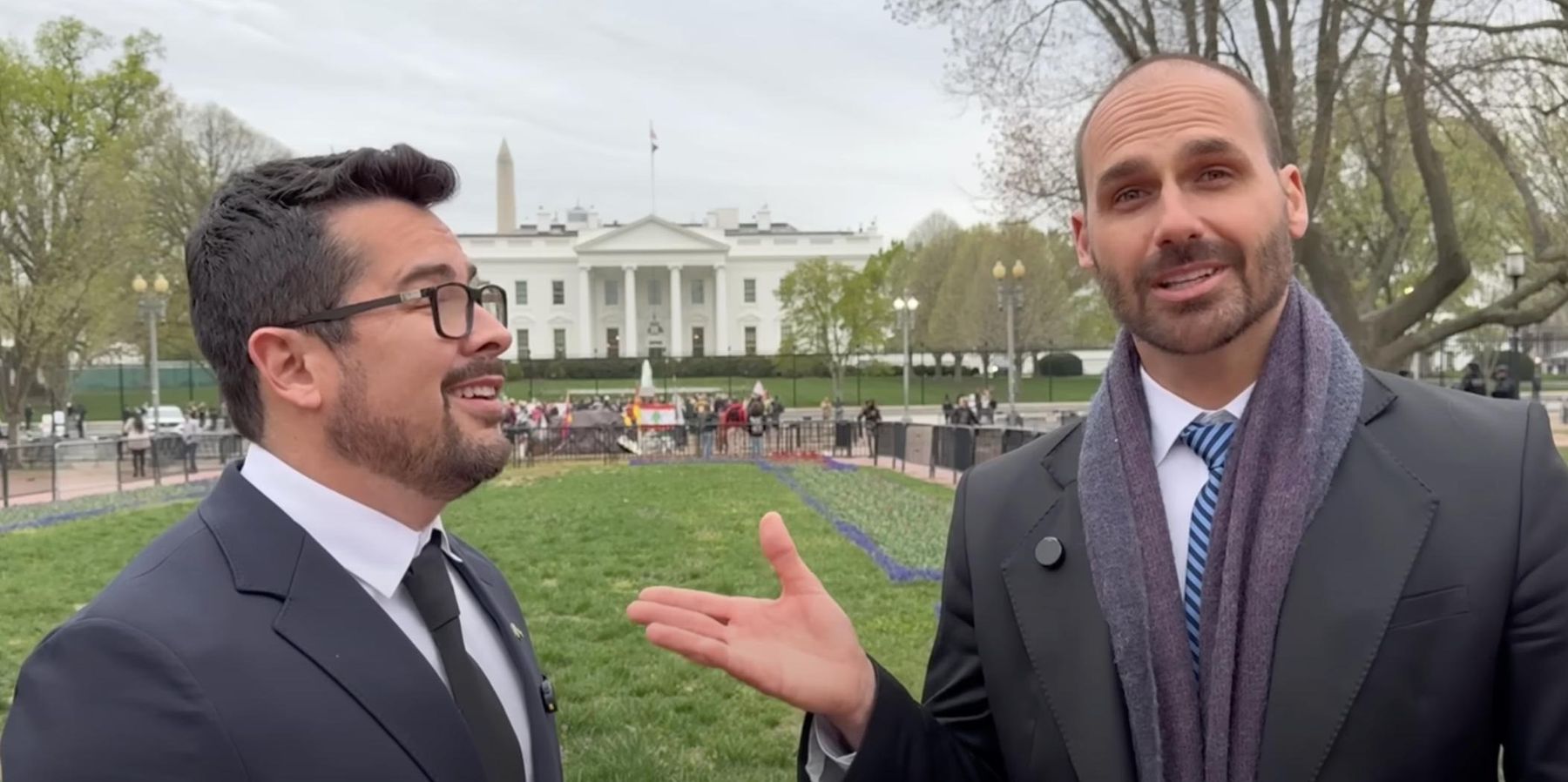
Nicknamed “Number Three” by his father as if assigning ranks in a battalion, Eduardo Bolsonaro moved to the U.S. in March and quickly became the family’s chief emissary and lobbyist abroad. Alongside Paulo Figueiredo, the grandson of Brazil’s last military dictator, Eduardo Bolsonaro has met with U.S. lawmakers, including chair of the House Foreign Affairs Committee Brian Mast (R-Fla.), co-president of the Tom Lantos Human Rights Commission Chris Smith (R-N.J.), and Republican Assistant Whip Rep. Maria Elvira Salazar (R-Fla.). Eduardo Bolsonaro has also bragged about his close relationship with the White House itself.
A week after a meeting on May 14 between Eduardo Bolsonaro’s entourage and Rep. Cory Mills (R-F who asked Secretary of State Marco Rubio during a hearing if he would consider sanctions against Moraes. “That is under review, and there’s a strong possibility that it could happen,” replied Rubio.
Trump seemingly took the call to action seriously, escalating the stakes far beyond targeted sanctions. On July 9, he sent a letter to President Lula announcing the tariffs. “Due in part to Brazil’s insidious attacks on Free Elections, and the fundamental Free Speech Rights of Americans, starting on August 1, 2025, we will charge Brazil a Tariff of 50% on any and all Brazilian products sent into the United States,” Trump declared.
Eduardo Bolsonaro immediately celebrated the 50% tariffs — referring to them as the “Moraes Tariff” — and responded with a video on his YouTube channel taking credit. “Over the past few months, we have maintained intense dialogue with officials from President Trump's administration, always aiming to accurately and document the reality Brazil is experiencing today,” he said. “The letter from the president of the United States only confirms our success in conveying what we have been presenting to Brazil with seriousness and responsibility.”
Days before the tariffs set in, Trump also imposed Magnitsky sanctions on Moraes, freezing any assets the Brazilian Justice has under U.S. jurisdiction and preventing him from using credit cards backed by U.S. financial companies. Once again, Eduardo Bolsonaro celebrated the decision and took credit. “When I exiled myself to the U.S., I made my intention very clear: to sanction Alexandre de Moraes,” he said. “Today, I have the feeling of a mission accomplished.”
Moraes alleges that Eduardo Bolsonaro’s campaign in the U.S. is being bankrolled by his father with the objective of “shaking the country's economy.” Jair Bolsonaro has reportedly sent around $350,000 to his son. “I put money in [Eduardo’s] hands, quite a lot,” Bolsonaro acknowledged in May, around the same time Eduardo Bolsonaro’s lobbying campaign ramped up.
To date, Eduardo Bolsonaro has not registered as a foreign agent under the Foreign Agents Registration Act (FARA), the U.S. foreign lobbying law. As an elected official to Brazil’s National Congress, Eduardo Bolsonaro could qualify for an exemption from registering as a foreign agent. However, Josh Rosenstein, a FARA expert and partner at Sandler Reiff, explained to RS that to do so, the State Department needs to recognize his role as an elected official and interpret his actions as within the scope of his duties.
A State Department spokesperson told RS in an email that the agency had not received a notification from Eduardo Bolsonaro or the Brazilian government that his lobbying actions fall under official government activity.
“Absent the form or some similar official notification to the State Department, FARA's regulations are clear that the exemption is unavailable,” explained Rosenstein. The Department of Justice, which, under the Trump administration, has reserved FARA charges only for instances of “traditional espionage,” is unlikely to ask Eduardo Bolsonaro to register as a foreign agent.
Eduardo Bolsonaro's lobbying campaign for sanctions and tariffs succeeded — perhaps too much. His political gambit could backfire, as some would-be allies are already blaming the Bolsonaros for the new tariffs, leaving the family increasingly politically isolated. A new AtlasIntel and Bloomberg poll shows Lula’s approval rating is now at over 50% for the first time since October 2024, having steadily climbed since Trump’s initial tariff threats.
Meanwhile, the Trump administration has given the cold shoulder to the actual Brazilian government.
In a recent interview with the New York Times, Lula said that it has been impossible to contact Trump about the tariffs. “I designated my vice president, my agriculture minister, my economy minister, so that each can talk to their counterpart to understand what the possibility for conversation was. So far, it hasn’t been possible…So I hope that civility returns to the Brazil-U.S. relationship.”
- Trump's Latin American sticks could end up stuck in his spokes ›
- Trump's tariffs against Brazil over Bolsonaro will backfire, on us ›
- Why SCOTUS won’t deter Trump’s desire to weaponize trade ›
- Trump's Brazil tariffs could boomerang on Bolsonaro | Responsible Statecraft ›