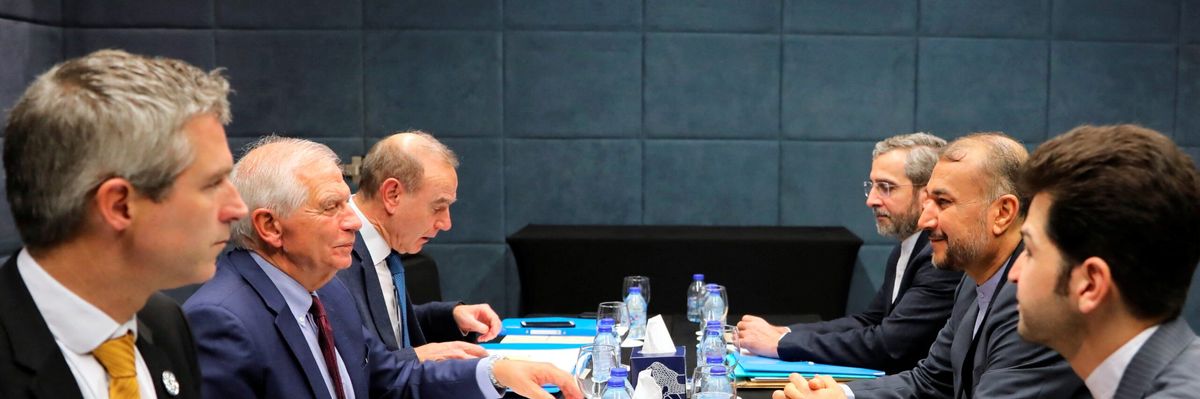
With all diplomatic engagement effectively halted since September 2022, the crisis over Iran’s ongoing nuclear program has folded into the background of international politics. Both sides are wary of escalating the situation, but Iran’s economic and political isolation is taking a toll while its nuclear program is accumulating a growing stockpile of highly-enriched fissile material.
Currently, Iran is amassing enough “nuclear material for several nuclear weapons,” according to Rafael Mariano Grossi, Director General of the International Atomic Energy Agency.
After 17 months of diplomatic fits and starts, the moribund Joint Comprehensive Plan of Action remains the cleanest framework to end the crisis and yet, its revival is elusive. The Biden administration’s proposals to resume compliance have run out of steam, despite initial signs that Iran might accept a compliance for sanctions relief arrangement. While U.S. Iran envoy Robert Malley reiterated last week that he is still seeking a “diplomatic outcome,” another U.S. diplomat has said that Iran “continues to refuse” direct talks.
The Iranian Permanent Mission to the United Nations told said late last month that “returning parties to the JCPOA and implementing the Deal's commitments would be the only option.” Iran wants an IAEA probe into traces of uranium found at three undeclared sites closed and demanded that the IAEA never again open an investigation into its nuclear past. Both demands are beyond the scope of the JCPOA, and the other JCPOA members cannot restrict the Agency’s investigations.
Pressure is mounting as the IAEA reported a “substantial change” in the configuration of some of Iran’s centrifuges at its deeply buried Fordow facility, which elicited a joint condemnation from France, the United Kingdom, and the United States. Even if neither side deliberately escalates the crisis, without a resumption of intrusive monitoring and caps on certain nuclear activities, the situation might escape political control. It is time to start talking seriously about what a JCPOA-lite or a reasonable interim arrangement might look like.
There are No Good Alternatives to Diplomacy
Since September, nine rounds of sanctions have rightly targeted the regime’s brutal crackdown on peaceful protestors, and Iran is more politically isolated than ever since it began supplying drones to Russia, killing innocent Ukrainians. On January 24, Grossi warned the European parliament that Iran has accumulated 70 kg of uranium enriched to 60 percent uranium-235 (U-235) and another 1,000 kg enriched up to 20 percent U-235. Without the re-initiation of a dialogue, Iran will continue to accumulate highly enriched uranium. Although Iran has stopped short of weapons-grade, or around 90 percent U-235, this is a political, not a technical limitation. Iran could up the ante at any provocation or shift in its security assessment.
EU JCPOA participants have the option to “snapback” previous UN sanctions on Iran, reimposing the UN arms embargo and rescinding the October 2023 lifting of the ban on importing or exporting certain types of missiles and drones. While this would signal Western seriousness about Iran’s violations, its impact would be largely symbolic as the effects of the renewed sanctions would be trifling compared to U.S. primary and secondary sanctions already in place. Any such step or threat would need to be carefully calibrated to influence Iran to engage diplomatically. Without a strategy to offer Iran an off-ramp, it could put the final nail in the JCPOA’s coffin and make it more difficult to resume negotiation. It might also add to Iran’s future list of demands. Reimposing sanctions is far easier than rebuilding a nuclear program, so Iran would likely demand that a new deal reflects that fact. Triggering the snapback mechanism should be considered a last resort, should all diplomatic efforts fail.
For now, allowing the crisis to simmer while seeking a new arrangement is the best of poor options. Iran does not have a nuclear weapon, and if Iran decided to sprint to produce one, it would still take a minimum of one-to-two years, according to a November 2022 Israeli estimate, for Iran to assemble a bomb and a warhead with a missile — and it is unlikely they could do so undetected. These estimates are corroborated by CIA Director Bill Burns’ assessment that the U.S., “doesn’t see any evidence that Iran’s Supreme Leader has made a decision to move to weaponize.”
However, the IAEA has not had eyes on certain sites that support the nuclear program since February 2021, and the intrusive monitoring established under the JCPOA has been lost in the tit-for-tat retaliation cycle since the United States withdrew from the deal in 2018. Without eyes on the nuclear program (such as those provided by the JCPOA’s verification system) and an open line of dialogue, misinterpretation of Iranian activities or U.S.-Israeli force postures could upend the strategic balance. An escalatory cycle can quickly escape the control of leaders in the fog.
What might an interim arrangement look like?
Put simply, the priority is walking back Iran from the nuclear brink. While the breakout time under the JCPOA was one year, Iran can now accumulate the fissile material for a nuclear weapon in under one week. In theory, Iran could do so in between visits by IAEA inspectors, which is the nightmare scenario that the JCPOA was constructed to avoid.
Here is what an interim arrangement might include:
Caps on uranium enrichment purity and stockpiles. Iran is unlikely to ship out a large portion of the uranium it has accumulated since it views the stockpile as leverage for a larger deal, but freezing the growth would be a measurable confidence building metric.
Caps on number and types of centrifuges. Again, it is unlikely an interim arrangement could get back to JCPOA levels, but freezing Iran’s ability to research and develop advanced centrifuges would stem the progress of its advancing enrichment program.
Re-establish IAEA inspector access to JCPOA levels. While the most ambitious request, doing so is the most necessary because it would greatly increase the confidence that Iran cannot divert any material for undeclared activities. Iran should be incentivized to prove it is doing what it says it is doing and ensure that there is no reason for a state to conduct a preventive counterproliferation operation against its multi-billion-dollar program.
In exchange for these nuclear activities, Iran would need to feel some economic relief immediately since the reciprocal nuclear actions could be affected immediately. One option is for the P5+1 to provide oil waivers, which would allow certain countries — like those affected by the loss of Russian oil — to import Iranian crude. Another option is to unfreeze Iranian assets held in banks abroad like in South Korea and Japan.
Admittedly, such an interim arrangement would look a lot like the original JCPOA. Today, the United States is functionally maintaining the maximum pressure sanctions campaign imposed by the Trump administration, but with a crucial difference: there is a clear off-ramp for Iran to relieve some of this pressure if it reins in its nuclear program.
So far, Iran has not put on its turn-signal. There is little more the United States can do to squeeze the Iranian economy beyond squashing the protest movement it seeks to support and alienating U.S. allies. To prevent circumstances from escalating beyond political control, it may be time to push for an interim arrangement, and creative options can be found within the JCPOA.