

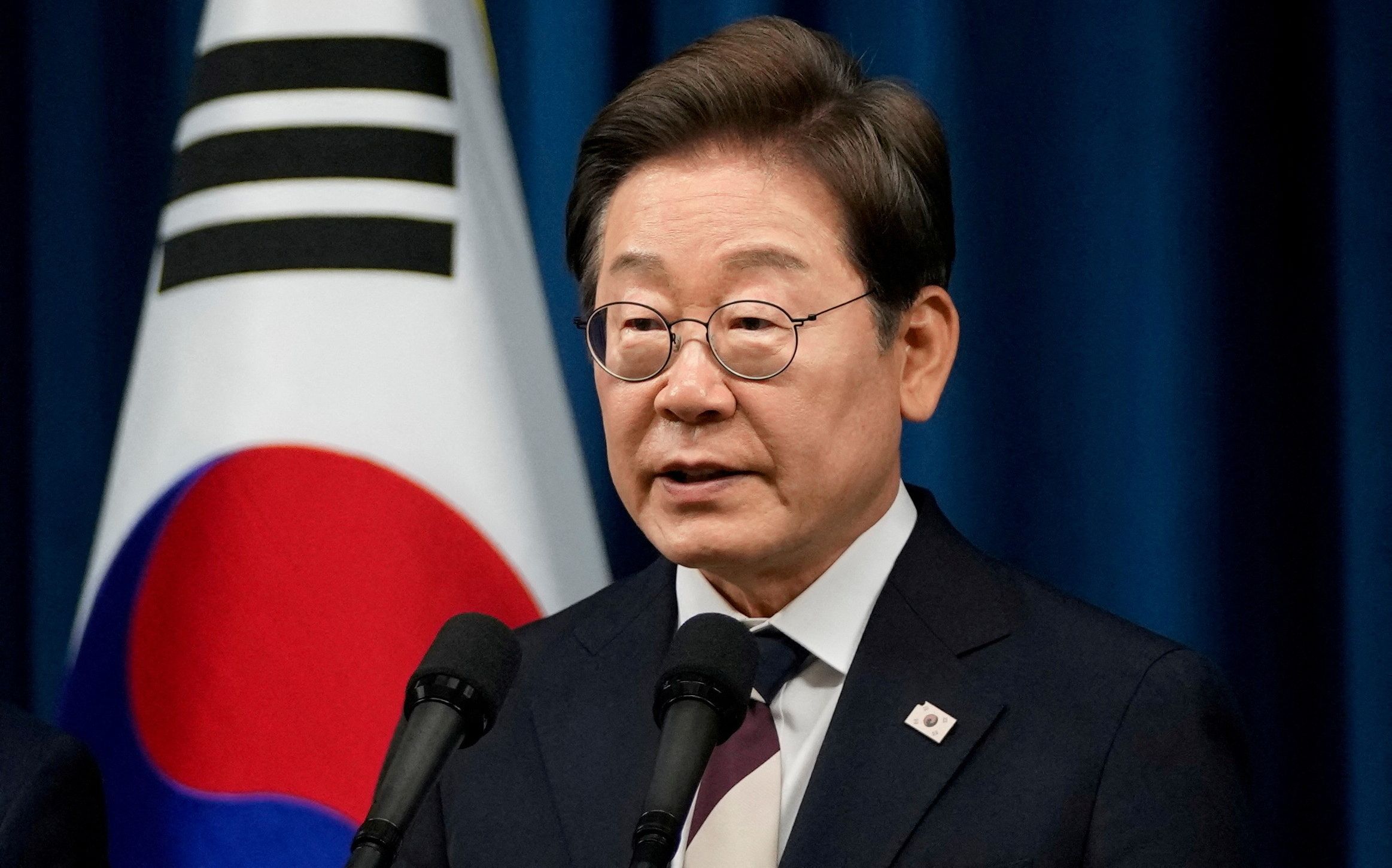
In his inauguration speech, South Korea’s new president Lee Jae Myung vowed to pursue a “pragmatic” foreign policy based on “a practical, national interest perspective.” While the complete picture of Lee’s pragmatic foreign policy remains to be seen, his decision to skip this week’s NATO summit, which South Korea was invited to as part of the Indo-Pacific Four (IP4), provided a glimpse of it.
Lee’s predecessor, Yoon Suk Yeol, aimed to pursue a so-called “value-based diplomacy,” which prioritized relationship-building and cooperation with like-minded democracies. Yoon also sought cooperation with autocracies, as evidenced by his efforts to expand ties with Vietnam and maintain engagement with China through Northeast Asian trilateral dialogue involving Beijing and Tokyo. However, Yoon placed a higher priority on strategic alignment with the United States and its key allies, notably Japan, as well as with the broader U.S.-led coalition of democracies.
In pursuing his value-based diplomacy, Yoon became an enthusiastic supporter of NATO and sought to engage closely with NATO states. Although mercantilist interests — primarily expanding South Korean arms sales to Europe in light of Russia’s war against Ukraine — loomed large in the background of Yoon’s engagement with NATO, his commitment to value-based alignment against authoritarian threats was certainly on display. At the cost of damaging South Korea’s bilateral relationship with Russia, Yoon indirectly supplied artillery shells to Ukraine, paid a surprise visit to Ukraine for a summit with Ukrainian President Zelensky, and embraced NATO’s confrontational rhetoric against Russia. In return, Yoon sought NATO’s greater involvement in pressuring and containing North Korea.
However, Lee Jae Myung appears less attached to the idea of value-based alignment. A vocal critic of Yoon’s foreign policy, Lee has stressed that pursuing values, though important, cannot come at the cost of unconditionally subordinating South Korea’s national interests. This perspective reflects a sober recognition that South Korea shares many, but not all, interests and priorities with its U.S. ally and other like-minded democracies.
Lee and his advisers may have determined that there were few tangible benefits to attending the NATO summit — and that would not be entirely wrong. The summit would not have served meaningful strategic, diplomatic, or political purposes for Seoul.
Arms sales and defense industry cooperation, which has been a strong connective tissue between South Korea and European states in recent years, might have lost much of its significance as a talking point simply because many deals and agreements are already in place now and can be discussed bilaterally at the working level. In the security dimension, despite wishful thinking that NATO can contribute to deterrence in Asia, the reality is that Europe can hardly afford to manage the Russian threat on its own and lacks the resources to contribute to deterrence in the Pacific in a viable manner. Overall, the list of substantive strategic cooperation between South Korea and NATO may be too short to justify annual South Korean participation in the NATO summit at the presidential level.
Moreover, Seoul does not share a common stance with Washington and its NATO allies on several sensitive diplomatic issues. By skipping the summit, Lee avoided an uncomfortable situation of having to endorse NATO’s diplomatic rhetoric that he does not support.
Regarding the Israel-Iran conflict, Seoul has criticized military escalations by all sides, differing from NATO states’ seemingly one-sided stance focused on blaming Iran in defense of Israel, the initiator of the conflict.
Under Lee, Seoul’s rhetorical position toward Russia is also set to soften and drift further away from that of NATO. The previous Yoon administration saw appeals in rhetorical convergence with NATO against Russia to confront the authoritarian alignment between North Korea and Russia. On the other hand, Lee, prioritizing tension reduction and diplomacy with North Korea, has suggested that he values Moscow as a communication channel for dialogue with Pyongyang and would therefore seek to stabilize bilateral ties with Russia.
The same can be said for China. Having a confrontational relationship with Beijing — South Korea’s biggest trade partner and the most reliable communication channel to reach Pyongyang aside from Moscow — will undermine Lee’s pragmatic foreign policy agenda and inter-Korean diplomatic initiative. In this regard, the idea of standing next to NATO leaders in condemnations of Beijing may not have been highly appealing to Lee, who is looking to host Chinese leader Xi Jinping at the upcoming November APEC summit in South Korea and improve cooperation with China on trade and managing North Korean threats.
Despite the NATO summit’s insufficient strategic and diplomatic relevance to Seoul, Lee may have still chosen to attend if it offered clear political and reputational incentives. However, there seemed to be little to be gained on that front as well.
Under the previous Biden administration, Washington branded the NATO summit as a gathering of advanced democracies across Europe and Asia. In this setting, South Korea’s former president Yoon received a big welcome and praise as a valuable partner when he attended NATO summits as an IP4 leader. Meanwhile, current U.S. President Donald Trump, with his strictly transactional approach to alliances, does not view the NATO summit as a global democratic coalition, as Biden did, but rather as an opportunity to address uneven relationships with allies and extract concessions.
As expected, in The Hague, Trump showed little regard for NATO’s traditional diplomatic symbolism and focused on advancing his “America-first” agenda: urging allies to increase their defense spending and take more financial responsibility in their military alliance with the United States. While applauding NATO’s stated goal to increase defense spending to 5% of GDP by 2035, Trump threatened to impose harsher tariffs against Spain, which had refused to commit to the 5% target.
In relation to the U.S.-South Korea alliance, Trump has not been secretive about wanting to make Seoul bear a far heavier burden. During his presidential campaign, Trump suggested that South Korea should pay $10 billion for stationing U.S. troops there, roughly nine times what the Biden administration and Seoul agreed to in 2024.
Alliance burden-sharing might have been a topic of conversation between Trump and Lee if they had met on the sidelines, which Lee may have wanted to avoid. And from a domestic political standpoint, most South Koreans aren’t concerned with their president missing out on a non-essential international summit. Today, the predominant focal point for South Koreans is Lee’s performance in addressing mounting domestic challenges, particularly economic recovery.
To be sure, the economy is inseparable from foreign policy, especially in the case of South Korea, which depends overwhelmingly on trade (making up over 90% of the GDP). In this structure, bilateral summitry diplomacy with the United States and China — South Korea’s second-largest and largest trade partners, respectively — holds high political importance. On that note, the NATO summit, centered on European military security, does not involve significant stakes for South Korea and has a minimal impact on public opinion. Therefore, Lee likely saw little to lose from skipping the summit.
In sum, Lee Jae Myung’s “NATO passing” makes sense from a cost-benefit perspective, looking at the strategic, diplomatic, and domestic political stakes involved. Ultimately, it signals that he indeed intends to shift South Korea’s foreign policy from Yoon Suk Yeol’s value-based, alliance-first diplomacy to one that places a greater emphasis on pragmatism and South Korean national interests.