

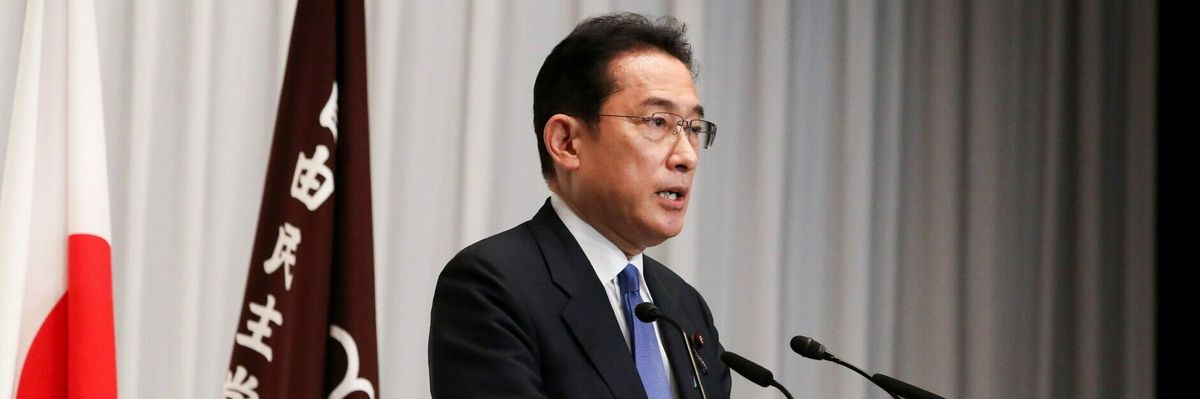
Whatever you might say about Japanese Prime Minister Fumio Kishida's approach to his country's security right now, it is more proactive than it has been in years.
Kishida, who was elected in October 2021, said he might attend the NATO summit later this month. That isn’t as surprising as it sounds. Last month British Foreign Secretary Liz Truss announced the need for “a global NATO” to address Indo-Pacific security.
But these are fools’ errands. Japan is not going to be a European power and should focus on building its defenses against the People’s Republic of China and North Korea. The Europeans are not going to deploy a serious Pacific fleet. They should concentrate on creating militaries that would act as more than speed bumps if Russia attacked.
Tokyo explained that Kishida hoped to better coordinate Russia policy with NATO. However, if Tokyo has no military aid to offer, why bother? Cooperation on sanctions could be arranged by phone.
Kishida might hope to win points with the Biden administration. But more important is fulfilling the ruling Liberal Democratic Party’s promise to increase military outlays, which requires building domestic political support for a more active role in defending East Asian-Pacific waters. China, and to a lesser degree, the Democratic People’s Republic of Korea, not Russia, should be Tokyo’s principal concern.
To a certain extent, Kishida implicitly acknowledged this in his remarks to the Shangri-La Dialogue in Singapore on Friday. Not mentioning NATO, the Japanese president said he plans to launch a new free and open Indo-Pacific "plan for peace” by next spring, which will focus on bolstering defenses in the region, including preemptive strike capabilities. Tokyo will also provide development aid, patrol boats, maritime law enforcement capabilities, "and other assistance to countries in Southeast Asia and the Pacific — where China is attempting to increase its influence — to help them better guard themselves," according to the Associated Press.
“Ukraine today may be East Asia tomorrow,” Kishida warned in his keynote address.
This is important because while Beijing has undertaken a sustained military build-up in recent years, friendly states have failed to do likewise. Taipei is most vulnerable and thus culpable, failing “to ensure that Taiwan can leverage its geography, advanced technology, workforce and patriotic population to channel Taiwan’s inherent advantages necessary for a resilient defense.”
South Korea faces significant defense challenges yet, despite its overwhelming economic advantage over the North, continues to rely on the US for military support.
Japan is the wealthiest American ally and could do the most. Throughout the Cold War, Tokyo faced the Soviet Union, which occupied Japanese territory, the PRC, a national madhouse under Mao Zedong, and North Korea, responsible for plunging the Korean peninsula into war. Yet Japan rigidly limited its military outlays to one percent of GDP, counting on the US to guarantee its security. Nothing changed even as Chinese President and Communist Party General Secretary Xi Jinping turned toward brutal repression at home and truculence abroad. Imagine the difference in the regional balance of power if Tokyo had devoted two to three percent of GDP annually to defense over the last decade or two.
Kishida and his Liberal Democratic Party are pressing the government to hike military outlays from one to two percent of GDP. Following this simple recommendation would be a notable step forward. Tokyo doing more — eventually taking over responsibility for its own defense — would be much more important than striking an ostentatious pose against Moscow.
Truss’ Pacific ambitions are equally misguided. European NATO members have been even more feckless than Tokyo. Throughout the Cold War and beyond the Europeans underinvested in defense, certain that Washington would bail them out.
Nineteen NATO members devote less than two percent of GDP to defense. Only Britain and France maintain reasonably serious militaries, more for post-colonial interventions than Europe’s defense. Germany’s efforts, resulting in minimal readiness levels for the Bundeswehr, are pitiful. Now the Europeans proclaim themselves to be shocked, shocked that Moscow attacked its neighbor.
With Russia and Ukraine engaged in Europe’s largest conflict since the conclusion of World War II, the continent is filled with military mea culpas. Europeans who spent decades cheap riding on the US declare their determination to start treating defense seriously. However, there is no guarantee that today’s embarrassed commitment to spend more will survive peace between Russia and Ukraine.
Would governments long reluctant to defend themselves from nearby Russia be prepared to launch offensive operations half a world away against China, with whom they have profitable economic ties? Many Europeans have said they are unwilling to fight for their neighbors and shown they have no interest in doing so for Ukraine.
Even if European politicians start singing updated renditions of “We are the World,” who imagines a mass naval build-up, the only effective means of Europeans to reach the PRC militarily? Most NATO members prefer cruise ships to warships.
The interest of Tokyo in looking east and NATO pointing west reflects the dual desire to become a weltmacht and satisfy an increasingly unhappy Washington. However, these proposals would have mostly symbolic effect, while undercutting more serious military efforts in their respective regions.
The best way for Tokyo and Brussels to aid America would be for them to follow Kishida's stated goals laid out in the Shangri-La Dialogue and take over responsibility for their own defense. Once they have eliminated the need to call on the U.S., they could expand their efforts around the globe.
China’s naval ambitions have grown along with Chinese power. Beijing claims as its territory the Paracel, Spratly, and Senkaku Islands (Xisha, Nansha Qundao, and Diaoyu to China) along with surrounding waters. Even more important, the PRC considers Taiwan to be part of China and is willing force reunification. Although Beijing so far has demonstrated no interest in conquering neighboring states, most importantly Japan and Philippines, the possibility increases along with China’s economic and military power.
Tokyo should concentrate on the Pacific. Japan should build up its air and naval capabilities to deter military action against its homeland and more distant possessions, such as the Senkakus. Moreover, if serious about aiding Taipei should the PRC attack — Kishida and other Japanese officials are sounding more hawkish on the issue these days — Tokyo needs to develop both defensive resilience, since its bases would become military targets, and an offensive capability to engage more distant Chinese forces.
This would leave little room to consider involvement in European contingencies. Moreover, it would be much harder to convince a population long reluctant to engage in local military operations to confront Russia over Europe. At least China poses a potentially existential threat to Japan. The Far East is of only limited concern to Moscow and would be the last site for military operations.
For the United Kingdom and NATO the situation is the reverse. Truss, thought to have ambitions to replace Boris Johnson as Tory and British leader, has channeled Winston Churchill in confronting Russia: “The war in Ukraine is our war — it is everyone’s war because Ukraine’s victory is a strategic imperative for all of us. Heavy weapons, tanks, aeroplanes — digging deep into our inventories, ramping up production. We need to do all of this.” Her objectives are to “push Russia out of the whole of Ukraine,” strengthen “the Eastern Flank,” and “support crucial states like Poland.”
Convincing the rest of NATO to go along won’t be easy. If agreed to, this agenda would take lots of money, extraordinary political commitment, and years of effort. The Europeans should concentrate on securing their continent before making plans to patrol the Pacific and face down the PRC. If they simply took care of Europe they would allow Washington to do what every president since Barack Obama has talked of doing, concentrate on the Asia-Pacific.
There is nothing wrong with the Japanese and European governments seeking to expand their reach. However, they should start improving security at home. Instead of forever turning to the US, they should relieve Washington of responsibility for maintaining a permanent defense dole for wealthy industrialized states. Once they do that, they could start thinking about traversing the globe and protecting distant peoples.