

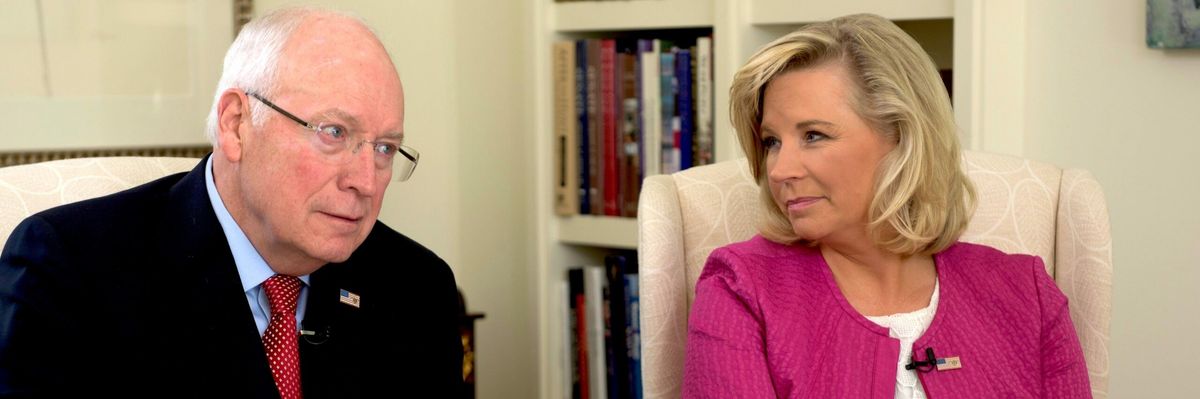
Update 9 a.m: Rep. Liz Cheney was voted out of her chairmanship of the Republican Conference this morning
***
Republican Congresswoman Liz Cheney is reportedly on the brink of being purged from GOP leadership for not only voting for the second impeachment of Donald Trump in January, but continuously being critical of the former president for telling what she calls the “big lie” that the 2020 presidential election was stolen from him.
Whatever her fate, the entire spectacle is ironic. Because since when did Cheney have a problem with telling big lies to get what she wants? Furthermore, her transformation into truthteller should be seen in its full scope, for the lies she has told in the past have promoted and sustained wars that have left hundreds of thousands of people dead, displaced millions, and created a national security state at home that has not only militarized domestic law enforcement, but has encroached upon the fundemental civil rights and liberties Cheney professes to support.
In other words, those who seek to keep Cheney in her post because of her stance on Trump should be careful what they wish for.
Let’s start with the biggest and most damaging lie in modern American history: That Saddam Hussein had weapons of mass destruction and that the Iraqi dictator was in cahoots with al-Qaeda. Not only did her father, former Vice President Dick Cheney, perpetuate these lies, but his daughter has dutifully defended and repeated them through her entire political career.
No serious person believes either of these assertions today. History and tragedy has definitively proven both wrong. The legacy of the George W. Bush administration’s big lie about Iraq is a mistake that will continue to loom larger than January 6, as terrible as that day was.
Key to the neoconservative agenda post-9/11 was been to dramatically overstate the dangers to the U.S. abroad or domestically in ways that encourage public support for military action, mass surveillance, torture, or any other illegal act hawks deem necessary to maintain a global U.S. hegemony. After 9/11, hawks became bigger and bolder in their lying, knowing the Republican president had so much public support. Truth had little to do with it.
The abuse of public trust went further than just the war itself. Cheney has long been a passionate public face for neocon propaganda.
Liz Cheney will tell you with a straight face that torture is not torture. “We don’t torture; we haven’t tortured,” Cheney said in 2017, adding, “I do support enhanced interrogation.” Cheney has always insisted that any attempt to reform FISA or to rein in mass surveillance of citizens will weaken America’s national security. Not surprisingly, Cheney’s opinion of Edward Snowden — famous for calling out James Clapper on his big lie to the U.S. Senate that American intelligence does not conduct mass surveillance — is that the whistleblower is a “traitor.”
When the New York Times ran an anonymously sourced story during the last presidential election that claimed the Kremlin had placed bounties on American troops in Afghanistan, Cheney was a primary spreader of this narrative because it undermined President Trump’s efforts to withdraw American troops from that country, something hawks fervently opposed.
The Federalist’s Tristan Justice noted, “Cheney appeared to sense a prime opportunity to capitalize on what was treated as a scandal, to not only undermine Trump, but also justify a prolonged military presence in the region while the administration took steps to pull out. Neither to [sic] Cheney, nor legacy media, appeared to hesitate due to the claims’ poor sourcing.”
U.S. intelligence later walked back this claim. If Cheney has noted this correction publicly or apologized for spreading misinformation so aggressively from an anonymous source, I’m not aware of it.
Here’s another doozy: After former President Barack Obama helped craft the Iran nuclear deal, Cheney and her former vice president father wrote in their 2015 book, “The Obama agreement will lead to a nuclear-armed Iran, a nuclear arms race in the Middle East, and more than likely, the first use of a nuclear weapon since Hiroshima and Nagasaki."
That obviously never happened. Hawks claiming nukes will ignite if we don’t go to war with some country is a well-worn tactic. A personal favorite of mine is Republican Senator Lindsey Graham saying in 2013 that my hometown of Charleston, South Carolina would be nuked if the U.S. didn’t go to war with Syria. The last time I checked, my friends and family are all still there, unharmed by nuclear weapons.
Hawks may find weapons of mass destruction all over their imaginations, yet never in Iraq where they all absolutely promised they were.
While the mainstream press largely gushes over her stand against Trump, Jack Shafer recently noted at Politico that Cheney remains more cunning than principled. “Having studied politics for decades under her mother and father, Cheney has surely gamed this out,” Shafer observed. “You can call her courageous all you want and express your astonishment at her opposition to Trump.”
“But there is more calculation on display here than there is valor,” Shafer concluded.
If nothing else, Cheney is a career-long opportunist who will tell any tall tale necessary in whatever position she holds to promote perpetual war, which has been her primary inspiration throughout her public life.
This might be the beginning to the end of Liz Cheney’s political career, thankfully, but it likely won’t be the end of Liz Cheney as a force in influencing America’s foreign policy and the overall Washington establishment. Rest assured she will continue to tell any lie necessary to succeed in her next chapter of warmongering neocon foolery.