

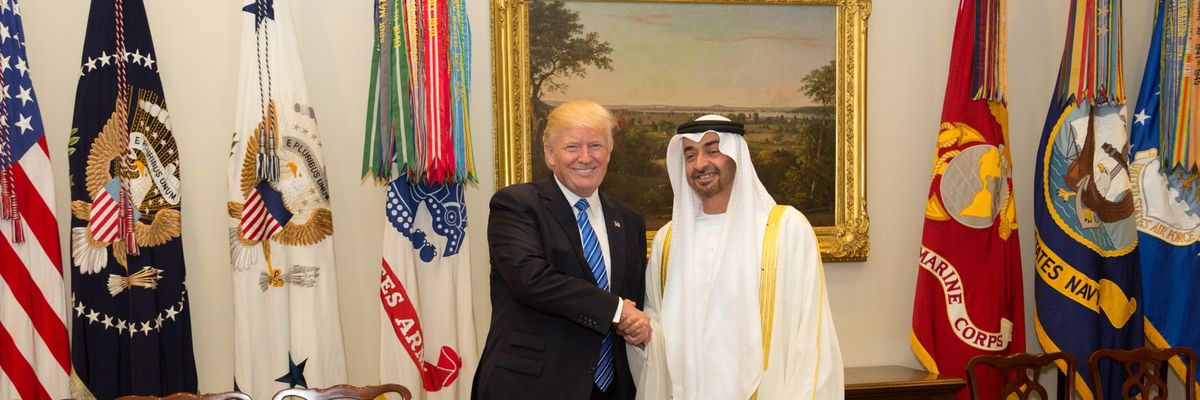
A wave of commentary followed the August 13 announcement of the normalization of relations between the UAE and Israel, as observers debated the impact of the deal on the region, the effect on the Israel-Palestine conflict, if other countries would follow suit, and whether or not the deal was as historic as the Trump administration has claimed.
Subsequent analyses have begun to gather public opinion data about the deal. James Zogby opined that the issue of Palestine is less salient among Arab publics than polls previously recorded. He stated that “attitudes across the Arab World have undergone a dramatic change in the past few years.” However, his own polling shows that the shift in opinion is not away from the salience of Palestine, but toward a pragmatic acknowledgement on the part of Arab publics that doing nothing is in fact detrimental to the Palestinian cause, as more and more land is taken by settlers, themselves driven by Israeli policies that subsidize settlement of the West Bank over life in Israel itself. Therefore, if normalizing relations with Israel helps to achieve a better outcome for the Palestinians, then those polled are in favor of that better outcome.
When considering the question of public opinion in response to the UAE-Israel deal, it is important to keep in mind that survey respondents may feel compelled to express their support for the deal. For example, a friend in Saudi Arabia told me that he had received a call requesting a reaction to the deal. My friend responded that he was too busy, knowing that criticism could elicit unwanted attention from Saudi authorities. Despite the risks, Saudi public opinion polls assert stout opposition to normalization with Israel, prompting skepticism that Saudi Arabia will normalize any time soon, despite pressure from Trump and Kushner.
In the UAE, some citizens have voiced support for the deal. An Emirati Twitter user tweeted that he will be able to visit Islam’s third holiest site, the Al-Aqsa Mosque on the Haram al-Sharif or Temple Mount, built on the location where the Prophet Mohammad is believed to have ascended to Heaven to converse with God before returning to earth. The tweet in question depicted the iconic Dome of the Rock, covered in the gold provided by the late King Hussein of Jordan in his role as the caretaker of the Muslim holy sites in Jerusalem. The apparent confusion of the Emirati — as well as English language Google — between the Al-Aqsa mosque and the Dome of the Rock generated over 1,600 comments and retweets as Twitter users debated whether he had mixed up the two holy structures, reiterating the lack of access that many Muslims have to this holy site due to travel restrictions to Israel. Twitter debates aside, Emirati citizens who privately oppose the deal may hesitate to express their dismay, aware of the possibility of recrimination in their small and highly surveilled state.
Despite commentary that attributes the UAE’s decision to normalize with Israel to its concerns about the threat posed by Iran, a crucial reason why MBZ sold out the Palestinians has been under examined. MBZ’s primary concern is not in fact Iran: he possesses the best military in the region, aside from Israel’s, and knows that Iran is highly unlikely to dare attack his territory outright. His primary concern lies in the domestic threat posed by Islamist groups, especially the Muslim Brotherhood. This antipathy towards Islamism explains the UAE’s decision to support a former foe, the Assad regime in Syria, against the Islamist groups operating there. The fear of Islamism also motivated the UAE to support General Khalifa Haftar against Libya’s Tripoli-based Government of National Accord, which is backed by Turkey — thoughthe Libyan civil war is not easily divided into sides for or against Islamism; instead the involvement of the UAE is more about irking Turkey’s Islamist president.
In the wake of the Arab uprisings nearly ten years ago, Islamist groups emerged as some of the only viable political players to withstand decades of attacks by authoritarian governments on Arab civil society. Feeling threatened by their newly apparent sway, the UAE worked with Saudi Arabia to ensure that the Muslim Brotherhood never attained real power in Egypt, despite briefly holding the presidency, and that regional branches of the Brotherhood were not able to exert significant influence despite winning parliamentary majorities in places like Morocco. From Libya to Syria to Yemen, the UAE has used military force to counteract Islamist groups, demonstrating MBZ’s determination to prevent such organizations from attaining additional outposts of control. Beyond Hamas in Palestine, no Muslim Brotherhood- affiliated or inspired group currently controls a government in the region, due in part to the efforts of the UAE.
Palestine remains a central motivating issue for the Muslim Brotherhood, its supporters, and its various local manifestations that extend from Morocco to Yemen. The salience of the issue of Palestine is partly religious. The Muslim Brotherhood asserts the primacy of Islamic identity over national identity, which includes an emphasis on transnational issues that it maintains should be important to all devout Muslims, namely access to and control of Jerusalem as the third holiest site in Islam.
However for many Arabs, the resonance of the Palestinian cause is primarily about injustice. Across the Middle East and North Africa, the seizure of Palestine by the European powers during the period of the British Mandate between the world wars, and the subsequent establishment of the state of Israel, represents one of the most blatant instances of European oppression, but by no means the only one. Populations across the region dealt with decades if not centuries of European colonialism which was later replaced by the cultural colonialism of the United States. For non-Palestinians, expressing outrage through the prism of Palestine would be met with many corresponding echoes from across the region and the world. Palestine offered a unifying symbol of collective grievance, as well as an outlet to articulate dissatisfaction with ineffective and corrupt governing structures that do not tolerate explicit critique.
Arab rulers have long used the Israel-Palestine conflict as a convenient outlet for their populations to release dissatisfaction. The ill-advised 1967 war launched by Arab governments against Israel was partly the result of leaders stoking the fires of public opinion against Israel until war was inevitable. The Muslim Brotherhood gained popularity in this era of Arab nationalism, which itself was tied to collective fury about the establishment of the state of Israel and the plight of the Palestinian people. The issue of Palestine and the power of the Muslim Brotherhood are linked. For MBZ, eliminating Palestine as a topic that unites Arab publics, often against their own rulers, is desirable for a ruler primarily concerned about the possibility of domestic unrest. Although they may not yet feel able to do so, other Arab autocrats would similarly relish the opportunity to disempower the Muslim Brotherhood, support for which is partly tied to the group’s frequent references to the issue of Palestine. Support for the Palestinian cause and support for the Muslim Brotherhood are both dangerously close to democracy, from MBZ’s perspective.
Thus far, MBZ’s efforts to kneecap the Muslim Brotherhood, in part by attempting to deflate the matter of Palestine, may leave him isolated. Sudan, Bahrain, Oman, and other countries initially fingered as possible dominoes to fall, have all maintained their unwillingness to formally normalize with Israel. Yet covert relationships with Israel are now the norm for much of the region, and these are likely to strengthen.
Arab populations are aware of creeping normalization, and some no longer feel able to voice their generalized resentments by venting anger at Israel. By not providing their publics with another safe target for their rage, the Arab autocrats are taking a chance. When their citizens can no longer safely blame Israel, they are more likely to blame their own rulers for corrupt and failing systems. If faced with another instance of mass unrest, which is likely to occur as a result of persistently low oil prices and shifting social bargains especially in the Gulf countries, MBZ and other rulers may rue their willingness to sell out the Palestinians.