
Follow us on social

google cta
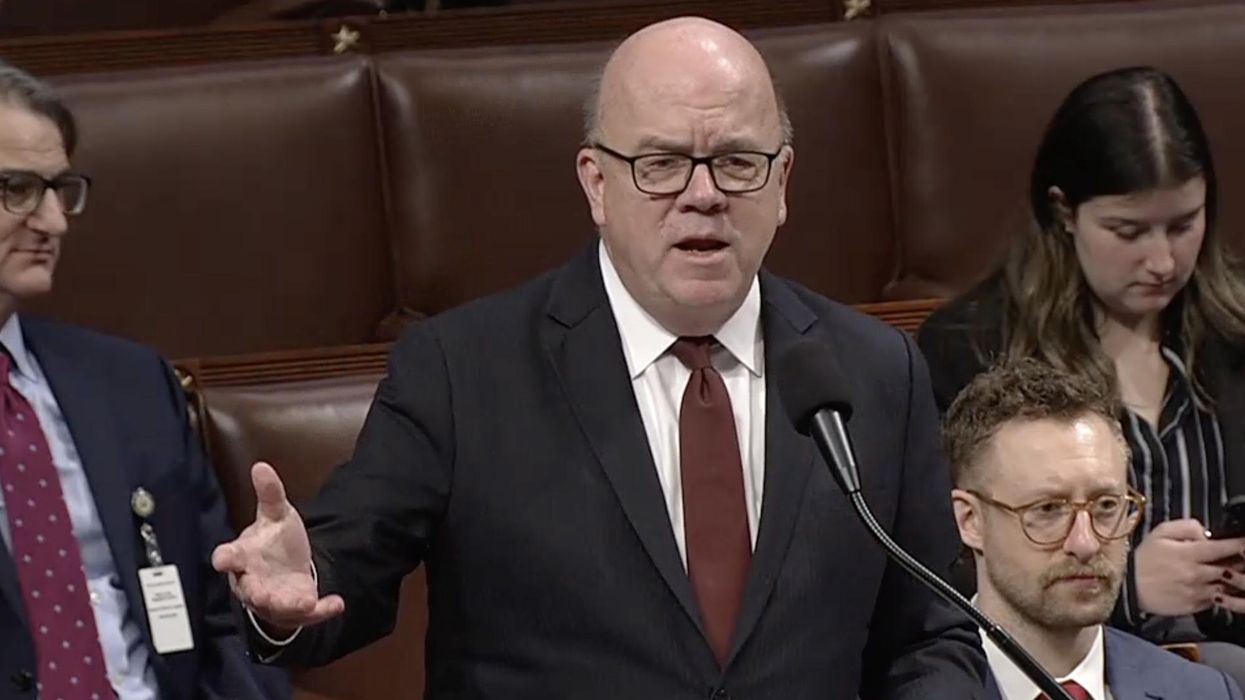
Rep. Jim McGovern (D.-Mass.)

House unable to halt Venezuela war march

Two votes narrowly failed along party lines

Reporting | QiOSK
google cta
google cta

Tonight the House of Representatives failed to pass a resolution to prevent the use of unauthorized military force against Venezuela, amid escalating hostilities against it.

Lawmakers narrowly voted to reject H. Con. Res. 64, sponsored by Rep. Jim McGovern (D.-Mass.) in a 211-213 vote. Republican representatives Thomas Massie (R.-Ky.), Marjorie Taylor Greene (Ga.) and Don Bacon (Ill.), and Democrats Joaquin Castro (Texas), Sarah Jacobs (Calif.), Ro Khanna (Calif.), and Sydney Kamlager-Dove (Ill.) co-sponsored that resolution.

Lawmakers also voted 216 to 210 to reject H. Con. Res. 61,introduced by Rep. Gregory Meeks (D-N.Y.), which would block U.S. military action against “any presidentially designated terrorist organization in the Western Hemisphere,” amid ongoing U.S. strikes against so-called “narco-terrorists” around the Caribbean. Meeks’ resolution was co-sponsored by 40 other legislators, all Democrats.

Lawmakers voted primarily along party lines for both resolutions, where Republicans largely voted against both resolutions, and Democrats largely voted for them. Exceptions on the Republican side included Reps. Massie and Bacon, who voted for Res. 61; they and Green voted for Res. 64. On the Democratic side, Rep. Henry Cuellar (Texas) voted no for both resolutions while Rep. Vincente Gonzalez (Texas) joined him to vote no on 61.

Since early September, the U.S. has repeatedly struck boats near Venezuela it alleges are bringing illegal drugs to the U.S., as part of what it calls a "non-international armed conflict" with drug cartels it has designated as foreign terrorists.

That campaign comes as the U.S. has pursued a major military build-up in the Caribbean off the coast of Venezuela in what President Trump has called a pressure campaign against Venezuelan leader Nicolas Maduro.Trump said early this month that land operations against Caracas were possible “soon.” Trump announced a blockade yesterday on sanctioned oil tankers leaving and entering Venezuela.

Lawmakers have grown increasingly weary about the boat strikes and their legality, with some wondering whether the operation’s end game is to oust Maduro.

Secretary of State Marco Rubio and Secretary of Defense Pete Hegseth gave a closed door briefing to House and Senate lawmakers on the strikes yesterday, to quell concerns about the legality of the strikes; many lawmakers left unconvinced.

On the floor before the votes, lawmakers said Congress must assert its authority to decide when to go to war.

“The constitution vests this body with authority over matters of war and peace. That power has too often been ceded to the executive branch,” Rep. Meeks said. “Congress must make clear to all of us that no president can unilaterally draw the United States into a conflict.”

Others warned against war with Venezuela altogether.

“It's easy to get into a war. It's hard as hell to get out of war,” Rep. McGovern said. “I've been around long enough to hear representatives of both parties talk about war as something simple, ‘You can get into it. We get out of it easy. No big deal.’ That's never happened!”

“Even the Pentagon says it will be very, very complicated to topple Maduro,” he said.

Previous votes in the Senate aimed at blocking possible U.S. military action against Venezuela, or the strikes against “narco-terrorists” near it, have also narrowly failed.

Reps. Ilhan Omar (D-Minn.) and Jason Crow (D-Colo.) both introduced War Powers Resolutions this fall; they were not brought to vote.


Dear RS readers: It has been an extraordinary year and our editing team has been working overtime to make sure that we are covering the current conflicts with quality, fresh analysis that doesn’t cleave to the mainstream orthodoxy or take official Washington and the commentariat at face value. Our staff reporters, experts, and outside writers offer top-notch, independent work, daily. Please consider making a tax-exempt, year-end contribution to Responsible Statecraftso that we can continue this quality coverage — which you will find nowhere else — into 2026. Happy Holidays!

Top image credit: live.house.gov [screenshot]
google cta
Reporting | QiOSK
The military's dependence on our citizen soldiers is killing them
Top image credit: U.S. Soldiers assigned to Delta Company, 1st Battalion, 133rd Infantry Regiment, 2nd Brigade Combat Team, 34th Infantry Division, Iowa National Guard and Alpha Company, 96th Civil Affairs Battalion, conduct a civil engagement within the U.S. Central Command area of responsibility Oct. 12, 2025 (U.S. Army photo by Sgt. Zachary Ta)

The military's dependence on our citizen soldiers is killing them

Middle East

Two U.S. National Guard soldiers died in an ambush in Syria this past weekend.

Combined with overuse of our military for non-essential missions, ones unnecessary to our core interests, the overreliance of part-time servicemembers continues to have disastrous effects. President Trump, Secretary Hegseth, and Congress have an opportunity to put a stop to the preventable deaths of our citizen soldiers.

In 2004, in Iraq, in a matter of weeks, I lost three close comrades I served with back in the New York National Guard. In the following months more New York soldiers, men I served with, would die.

keep readingShow less
Israel's all-seeing eye is the stealthiest cruelty of all in Gaza

Israel's all-seeing eye is the stealthiest cruelty of all in Gaza

Middle East

Discussions of the war in Gaza tend to focus on what’s visible. The instinct is understandable: Over two years of brutal conflict, the Israel Defense Forces have all but destroyed the diminutive strip on the Mediterranean coast, with the scale of the carnage illustrated by images of emaciated children, shrapnel-ridden bodies, and flattened buildings.

But underlying all of this destruction is a hidden force — a carefully constructed infrastructure of Israeli surveillance that powers the war effort and keeps tabs on the smallest facets of Palestinians’ lives.

keep readingShow less
US military draft posters
Top photo credit : Shutterstock/Cvijovic Zarko/Spatuletail/

Congress quietly moves US closer to military draft

Military Industrial Complex

A provision in this year’s NDAA will require the Selective Service System (SSS) to find a way to make registering for the draft automatic instead of letting 18-year-old males sign up themselves, which is current practice.

The SSS would have a year to try to construct a list of all potential draftees in the U.S. by pooling information from other Federal databases. “Automatic” draft registration will start a year after the 2026 NDAA is signed into law, unless the Selective Service is repealed before then.

keep readingShow less
google cta
Want more of our stories on Google?
Click here to make us a Preferred Source.

LATEST

QIOSK

Newsletter

Subscribe now to our weekly round-up and don't miss a beat with your favorite RS contributors and reporters, as well as staff analysis, opinion, and news promoting a positive, non-partisan vision of U.S. foreign policy.